In This Article
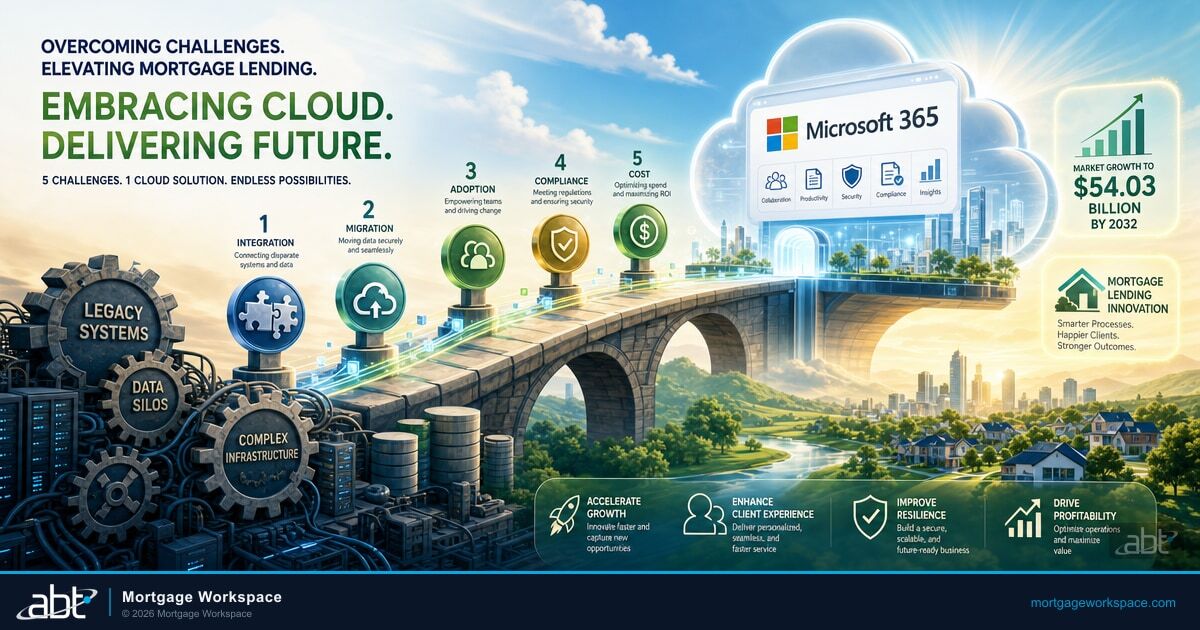
The cloud financial platform market is growing from $20.62 billion to $54.03 billion by 2032, according to Zion Market Research. Credit unions, banks, and mortgage companies are driving much of that growth - but many are still stuck in the planning stage.
The reasons aren't surprising. Legacy LOS platforms weren't built for cloud environments. Borrower data carries strict regulatory requirements that make IT leaders cautious. Teams resist unfamiliar workflows, especially when the old ones still technically work.
These challenges are real. They're also solvable. This article walks through the five most common cloud adoption challenges mortgage lenders face and the specific steps that get past each one.
The global cloud-based financial platform market - encompassing lending operations, payment processing, and banking infrastructure - is projected to grow from $20.62 billion in 2023 to $54.03 billion by 2032, driven by digital transformation across credit unions, banks, and mortgage companies.
The Cloud Adoption Gap in Mortgage Lending
Over 70% of enterprises now use industry cloud platforms, according to Gartner's 2025 analysis. But adoption rates vary dramatically by sector, and mortgage lending trails many other financial services segments.
The gap isn't about awareness. Most mortgage leaders know cloud platforms offer better scalability and lower long-term costs. The gap is about execution - specifically, the five barriers that stall migrations after the contract is signed.
Map every system, integration, and data flow
Replace legacy connections with cloud-ready APIs
Move data securely with audit trails
Train teams and celebrate early wins
Monitor costs, security, and performance
Each of these stages presents its own challenge. Here's what to expect at each one and how to get through it.

Challenge 1: Legacy System Integration
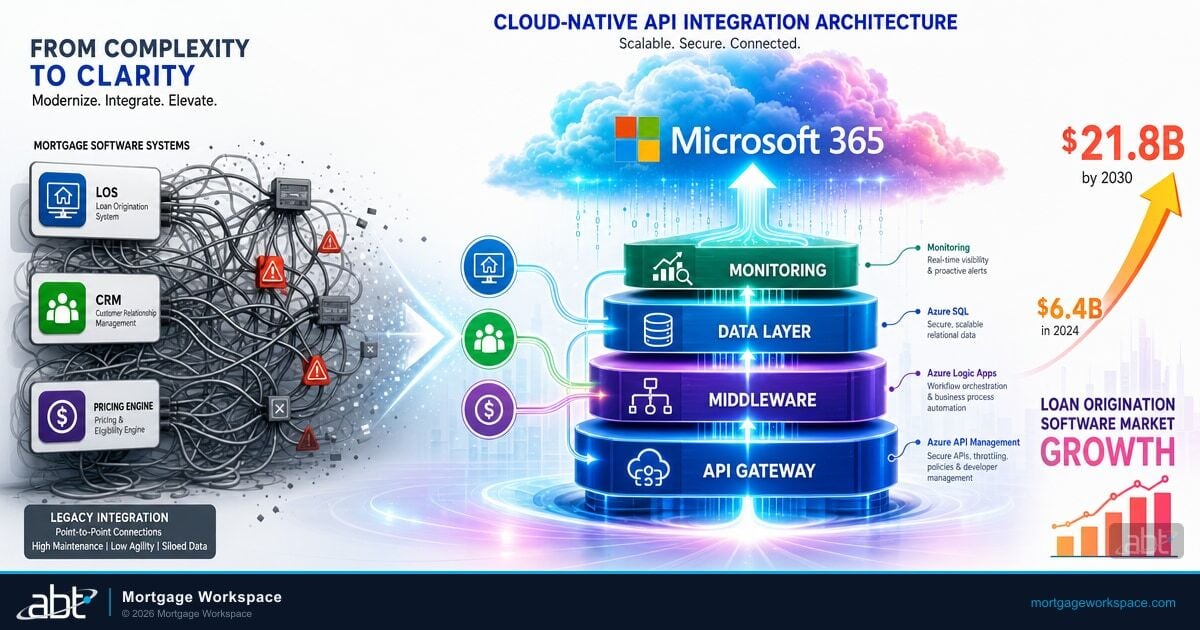
Most mortgage companies run systems built before cloud infrastructure existed. Encompass, Byte, and other LOS platforms have cloud-capable versions, but the integrations connecting them to pricing engines, document management, and CRM tools often rely on legacy protocols.
The problem: Moving the LOS to the cloud breaks integrations that depend on local network connections, file shares, or direct database access. A pricing engine that pulls rates from a local file share won't work when the LOS moves to Azure.
Legacy Integration
- File-based data exchange (flat files, CSV drops)
- Direct database connections across local network
- Manual data re-entry between systems
- No error monitoring or retry logic
- Breaks when either system updates
Cloud-Ready Integration
- REST API connections with structured payloads
- Secure HTTPS calls between cloud endpoints
- Automated data sync with validation rules
- Built-in logging, alerting, and retry
- Versioned APIs survive system updates
How to solve it:
- Map every integration before you start. Document each data flow between your LOS and connected systems. Identify which integrations use APIs (cloud-ready) and which use file-based or database-direct connections (need replacement).
- Prioritize API-first replacements. Modern integration platforms connect cloud LOS environments to downstream systems through REST APIs. These are more reliable, faster, and easier to monitor than legacy connections.
- Run parallel systems during cutover. Keep the old environment running alongside the new one during testing. Validate every integration before turning off the legacy system.
Challenge 2: Secure Data Migration
Mortgage files contain Social Security numbers, credit reports, income documentation, and bank account details. Moving this data to a cloud environment requires airtight security at every step.
Financial services saw 739 data compromises in 2025, making it the most breached industry for the third consecutive year, according to the Identity Theft Resource Center. The Marquis Software Solutions breach alone exposed sensitive data from over 700 financial institutions. Migration security isn't theoretical risk - it's the reason many lenders hesitate.
Scenario: Unencrypted Data Migration
A mid-size mortgage company migrates 50,000 loan files to a cloud environment without encrypting data in transit. An attacker intercepts the transfer and captures borrower SSNs and bank account numbers.
Consequence
The company faces GLBA penalties up to $100,000 per violation, mandatory breach notification to all affected borrowers, and potential class-action litigation. The migration project stalls for months during the investigation.
How to solve it:
- Encrypt data in transit and at rest. Use TLS 1.2 or higher for all data transfers. Verify that the target cloud environment encrypts stored data by default.
- Clean data before you migrate it. Remove duplicate records, expired loan files, and data that retention policies no longer require. Less data means less risk and faster migration.
- Test with non-production data first. Run the full migration process using anonymized data. Verify integrity, access controls, and performance before touching production loan files.
- Maintain audit trails. Log every data transfer with timestamps, source, destination, and verification hashes. Your compliance team and regulators will need this documentation.
"Most cloud migrations stall not because the technology fails, but because the integration mapping wasn't thorough enough. Spend the first two weeks documenting every data flow - it saves months of troubleshooting later."
- ABT Cloud Migration Specialist
Challenge 3: Team Adoption and Training
Technology migrations fail when teams refuse to use the new tools. Loan officers, processors, and underwriters have workflows built around the old system. Asking them to change without support creates resistance that can undermine the entire project.
First West Credit Union demonstrated what's possible with the right approach. They achieved 93% employee adoption of Microsoft 365 Copilot with 90% weekly usage, according to Microsoft's customer case study. They didn't get there by sending a training email. They built adoption into the rollout plan from day one.
Technology adoption isn't a training problem - it's a change management problem. Show every role what they gain, not just what changes.
How to solve it:
- Identify power users early. Find one or two people in each department who are comfortable with technology. Train them first. Let them become internal champions who help their colleagues.
- Show the "what's in it for me." Loan processors care about fewer manual steps. Loan officers care about faster pipeline visibility. Translate cloud benefits into role-specific outcomes.
- Provide hands-on training, not just documentation. Recorded walkthroughs, live workshops, and a dedicated support channel for the first 30 days after cutover. For remote teams, ensure they understand secure document handling in the cloud environment.
- Celebrate early wins. When the first team closes a loan faster on the new system, share that story. Concrete results build momentum faster than any executive memo.
Challenge 4: Regulatory Compliance in the Cloud
Mortgage companies operate under GLBA, the FTC Safeguards Rule, and state-level regulations including the NYDFS Cybersecurity Regulation. Cloud migration adds questions about data residency, access controls, and vendor risk management that didn't exist with on-premise systems.
The FTC updated the Safeguards Rule to require written information security programs and documented security risk assessments. GLBA non-compliance carries penalties up to $100,000 per violation. State privacy laws continue to expand in scope, pulling more financial businesses into compliance requirements.
| Regulation | Cloud Requirement | M365 Control | Status |
|---|---|---|---|
| GLBA / FTC Safeguards | Written ISP, encryption, access controls | Compliance Manager, encryption at rest/transit | Built-in |
| NYDFS 23 NYCRR 500 | MFA, encryption, incident response plan | Entra ID MFA, Defender incident response | Built-in |
| SOC 2 Type II | Continuous monitoring, audit trails | Unified Audit Log, Compliance Manager | Built-in |
| State Privacy Laws | Data residency, consent, breach notification | Geo-restricted storage, DLP policies | Configure |

How to solve it:
- Choose a cloud provider with compliance certifications. SOC 2 Type II, ISO 27001, and FedRAMP authorization demonstrate that the provider meets regulatory standards before your data arrives.
- Implement data loss prevention (DLP) policies on day one. Microsoft Purview now includes OCR-based DLP that scans images and PDFs for sensitive content automatically.
- Use Conditional Access policies. Restrict cloud access to managed devices, approved locations, and compliant endpoints. Block legacy authentication protocols entirely.
- Document everything. Regulators want evidence of controls, not promises. Audit logs, access reviews, and policy documentation should be automated, not manual.
Challenge 5: Cost Control During Migration
Cloud migration has upfront costs: consulting, licensing, training, and temporary parallel environments. Without planning, these costs surprise budget holders and stall projects mid-stream.
Organizations waste 25% to 35% of their cloud spending without proper optimization practices, according to Gartner. That's a significant portion of the projected $330 billion in global cloud infrastructure spend for 2026. The mortgage companies that control costs during migration are the ones that plan for it.
What Is FinOps?
FinOps (Financial Operations) is a cloud cost management discipline that brings financial accountability to cloud spending. It combines finance, technology, and business teams to optimize cloud costs through real-time visibility, informed trade-offs, and continuous right-sizing of resources.
How to solve it:
- Build a phased budget. Spread migration across quarters. Start with email and collaboration (low cost, high impact), then move to LOS and security (higher cost, critical path).
- Negotiate licensing during migration. Cloud providers offer migration credits and promotional pricing. A Tier-1 Microsoft CSP can structure licensing to avoid double-paying for on-premise and cloud simultaneously.
- Track cost-per-loan before and after. Establish a baseline cost using your current infrastructure, then measure the cloud environment against it monthly. The MBA tracks industry-wide origination costs that serve as useful benchmarks.
- Sunset on-premise infrastructure on schedule. Every month you keep old servers running alongside cloud services, you pay double. Set firm decommission dates and hold to them.
Key Takeaway
Cloud migration for mortgage companies isn't a technology problem - it's a planning problem. The five challenges above are predictable and solvable when you map integrations first, encrypt everything in transit, build team adoption into the rollout, automate compliance documentation, and track costs against a baseline from day one.
Cloud Readiness Checklist for Mortgage Companies
- Integration mapping complete (APIs vs legacy connections)
- Data migration security plan with encryption and audit trails
- Team adoption plan with internal champions identified
- Compliance controls mapped to GLBA, FTC Safeguards, and state requirements
- Phased budget with firm decommission dates for on-premise systems
Mortgage Workspace has guided hundreds of credit unions, banks, and mortgage companies through cloud adoption. We handle the complexity so your pipeline keeps moving.
Frequently Asked Questions
The biggest risk is data exposure during migration. Financial services was the most breached industry in 2025 with 739 reported compromises, according to the Identity Theft Resource Center. Mortgage companies mitigate this risk by encrypting all data in transit and at rest, running test migrations with anonymized data first, and maintaining complete audit trails throughout the process. Working with a cloud provider experienced in financial services reduces this risk further.
GLBA compliance during cloud migration requires a written information security program, documented risk assessments, and continuous monitoring. Choose a cloud provider with SOC 2 Type II certification. Implement data loss prevention policies, Conditional Access controls, and multi-factor authentication from day one. Maintain audit logs of every data transfer and access event throughout the migration process.
Yes. Major LOS platforms including Encompass by ICE Mortgage Technology offer cloud-hosted versions with full API integration capabilities. Cloud-based Encompass connects to pricing engines, document management systems, and CRM tools through REST APIs. The cloud version receives automatic updates and patches, eliminating the maintenance burden of on-premise deployments.
Most mortgage teams reach productive adoption within 30 to 60 days when given proper training and support. First West Credit Union achieved 93% adoption rates by identifying internal champions, providing role-specific training, and celebrating early wins. The key is translating cloud benefits into outcomes each role cares about, such as faster processing for loan processors and better pipeline visibility for loan officers.