In This Article
- What Is a Financial Services Cloud Platform?
- Four Benefits for Mortgage Operations
- Technical Requirements for Integration
- MortgageExchange: The Data Integration Layer
- M365 Guardian, Microsoft Azure, and Copilot: The Governance and AI Surface
- Common Integration Mistakes to Avoid
- Frequently Asked Questions
Mortgage operations move faster when borrower data, compliance records, and pipeline visibility live in a single system. Financial services cloud platforms promise that single system. The catch is that the platform only earns its keep when it actually talks to the systems where the loan lives: the loan origination system, the document repository, the pricing engine, and the servicing platform. Access Business Technologies operates Microsoft 365 tenants and Azure environments for more than 750 financial institutions, and the integration layer between cloud CRM and mortgage operational systems is one of the places that determines whether the platform produces lift or just adds another login.
This article covers what a financial services cloud platform does for mortgage operations, the four benefits that justify the integration work, the technical requirements that need to be in place before integration starts, how MortgageExchange connects financial services cloud CRMs to mortgage LOS and servicing systems, how M365 Guardian on Microsoft Azure adds the governance and AI surface around that integration, and the common mistakes that derail integration projects.
What Is a Financial Services Cloud Platform?
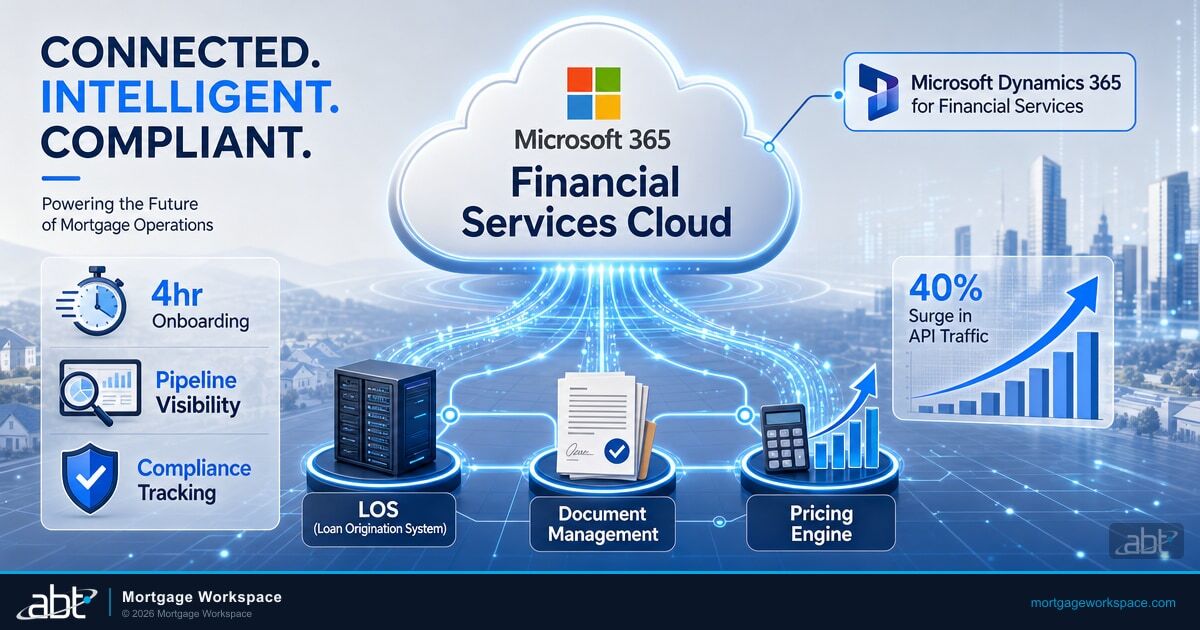
A financial services cloud platform is a cloud-hosted CRM and data management system built for regulated industries. Salesforce Financial Services Cloud is the most widely deployed in the mortgage vertical. Microsoft Dynamics 365 for Financial Services and nCino compete in the same space. The three platforms share the same shape: one record per borrower, rules-based workflow routing, and built-in audit trails.
These platforms share three core capabilities mortgage lenders care about.
- Unified borrower view. One record for each borrower combining loan data, communication history, and compliance documentation.
- Workflow automation. Rules-based task routing for follow-ups, condition tracking, and milestone notifications.
- Compliance tracking. Audit trails, regulatory reporting, and document retention built into the platform.
For mortgage lenders, the financial services cloud platform sits as an orchestration layer above the LOS. The LOS handles the loan itself. The cloud platform manages the relationship, the compliance evidence, and the operational workflow around that loan. The LOS is the system of record for the file. The cloud platform is the system of record for the customer. We cover Reducing Loan Origination Costs for Credit Unions in a companion piece.
Four Benefits for Mortgage Operations
1. Faster Borrower Onboarding
Cloud platforms with API connections to the LOS can pre-populate loan applications with existing borrower data. Returning clients skip the re-entry step. New clients benefit from open banking connections that pull income and asset data directly from their financial institutions. Lenders that connect the cloud CRM to the LOS and the document platform routinely move document verification from a one-to-two-day cycle into the same business day. See also our breakdown of The Hybrid Cloud Dilemma.
2. Pipeline Visibility Across Branches
Multi-branch mortgage operations need a single view of pipeline. Cloud platforms aggregate data from every branch, every LOS instance, and every loan officer into one dashboard. The visibility matters most for capacity planning. When one branch is overloaded and another has bandwidth, managers can rebalance workload without waiting for a spreadsheet to be rebuilt by hand.
3. Automated Compliance Documentation
GLBA, the FTC Safeguards Rule, and state-level mortgage rules require lenders to maintain complete records of every borrower interaction. Cloud platforms log those interactions automatically: emails sent, documents received, disclosures delivered, conditions cleared. During an audit, the compliance team pulls a complete borrower timeline in minutes instead of reconstructing it from four disconnected systems.
4. Post-Close Retention Marketing
The loan does not end at closing. Cloud platforms track milestones like adjustable-rate mortgage resets, private mortgage insurance drop-off dates, and rate-change opportunities. When conditions favor a refinance, the system triggers automated outreach to eligible borrowers. The system does the monitoring. The loan officer gets notified when there is an actual opportunity to call about.
Technical Requirements for Integration
API Connectivity
The cloud platform needs REST API connections to the LOS, the pricing engine, and the document management system. ICE Mortgage Technology's Developer Connect APIs, Byte Software's API layer, and Black Knight's integration toolkit all support cloud platform connections. The integration team verifies that the specific LOS version supports the API endpoints the project needs before any code is written.
Data Mapping
Field names differ between systems. The LOS calls it "Loan Amount." The cloud platform might call it "Opportunity Value." Data mapping defines how each field translates between platforms. Getting this wrong burns months in debugging. Getting it right makes every system show consistent numbers from day one.
Security and Access Controls
Mortgage data carries strict regulatory requirements. The integration must support TLS 1.2 minimum encryption for all API calls, role-based access controls so loan officers see their pipeline and managers see their branch, audit logging of every data transfer with timestamps and user context, and SOC 2 Type II compliance at both the cloud platform layer and the middleware layer.
Middleware Options
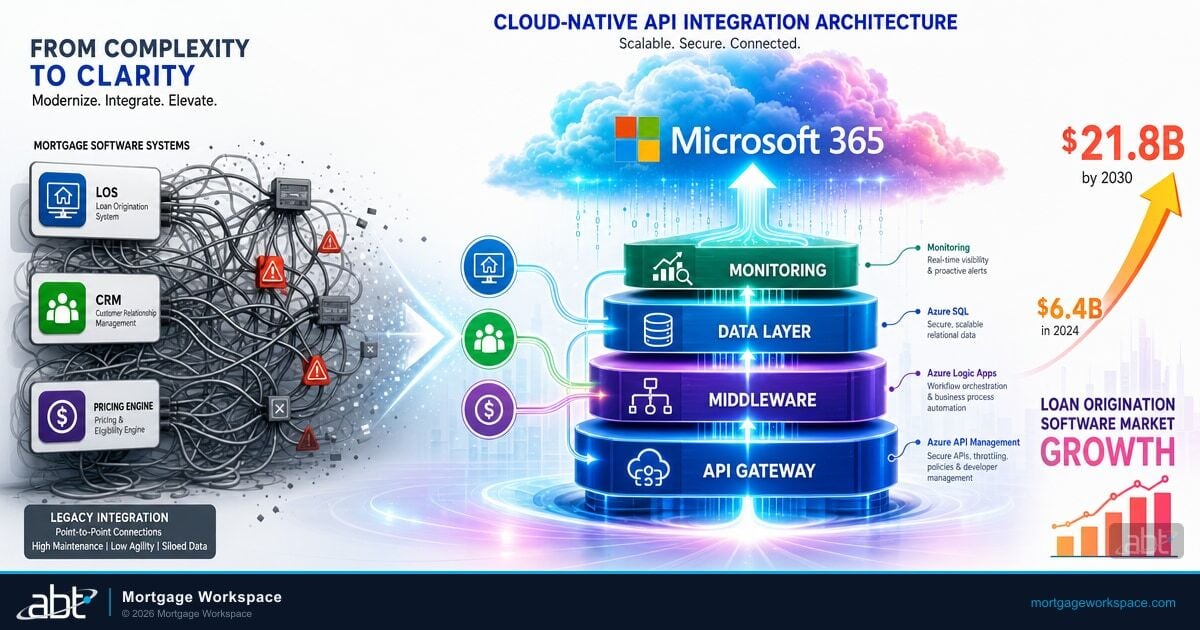
Middleware sits between the cloud platform and the LOS, handling data transformation, error recovery, and queue management. MuleSoft, Microsoft Azure Logic Apps, and mortgage-specific middleware platforms all serve this role. The middleware needs to understand MISMO data standards and ULAD formatting. Generic integration tools require extensive custom development to handle mortgage-specific data structures, which is a recurring source of cost overrun on these projects.
MortgageExchange: The Data Integration Layer
The hard part of financial services cloud integration is not standing up the cloud CRM. The hard part is the data integration between the cloud CRM and the systems where the loan actually lives. MortgageExchange is the ABT-built data integration layer that connects financial services cloud platforms to mortgage LOS, document, pricing, and servicing systems. The product is the largest interface in the ABT portfolio and the practical reason Salesforce Financial Services Cloud and Microsoft Dynamics 365 deployments at ABT-managed mortgage operations produce lift instead of friction.
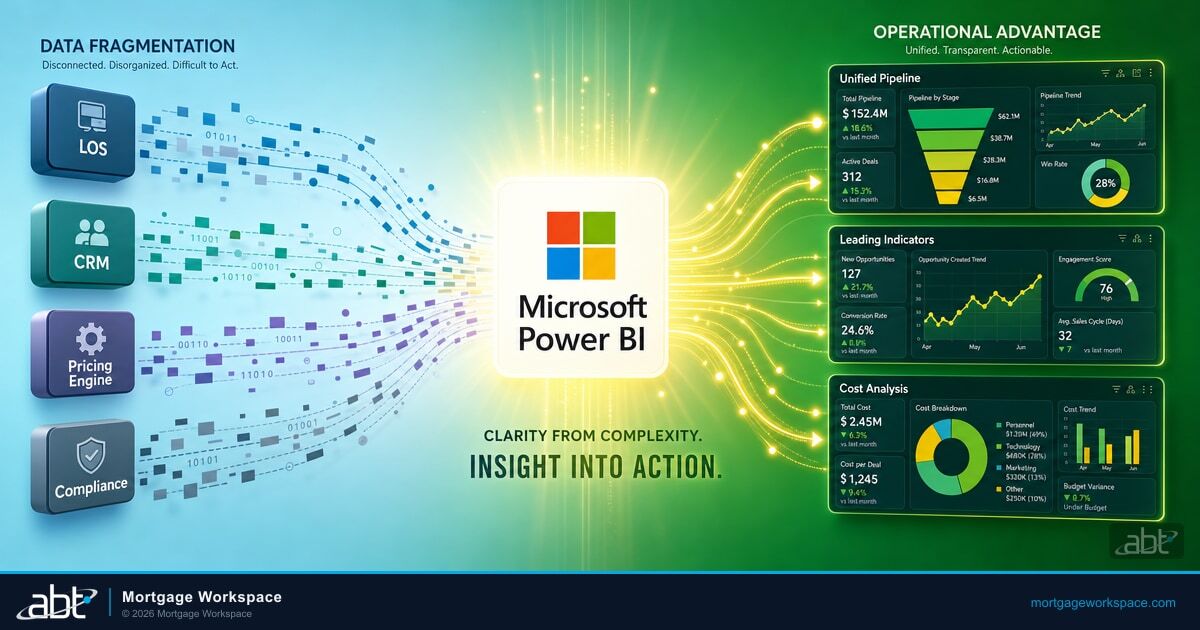
MortgageExchange handles the connections that determine whether the cloud platform reflects loan reality in real time. ICE Mortgage Technology Encompass, Calyx PointCentral, Black Knight Empower, and Byte LOS each speak a slightly different API dialect. Document platforms like DocMagic and Docutech have their own. Servicing platforms speak yet another. MortgageExchange normalizes the data flow across all of them, applies MISMO and ULAD standards on the wire, handles error recovery and queue management when an LOS endpoint goes down, and produces the audit trail of every record transferred between systems. The cloud CRM sees a single, consistent interface. The lender's IT team does not spend a year writing one-off middleware for every new connection.
The financial services cloud platform sits at the top of the stack. The LOS, the document platform, the pricing engine, and the servicing system sit underneath. MortgageExchange is the integration layer that connects them. ABT hosts MortgageExchange on Microsoft Azure, applies the same security baseline used across ABT-operated Microsoft 365 tenants, and brings the full Microsoft governance stack to bear on the data flowing between systems. The lender keeps the cloud CRM relationship with Salesforce or Microsoft. ABT runs the integration layer that makes the cloud CRM useful for an actual mortgage operation. Our guide to Overcoming the Challenges of Cloud Adoption in Mortgage Lending goes deeper on this.
M365 Guardian, Microsoft Azure, and Copilot: The Governance and AI Surface
Integration only produces lasting value when it is governed. The cloud CRM holds borrower NPI. The LOS holds the file. The document platform holds the disclosures. The integration moves that data between them every minute of the business day. Examiners want evidence that the movement is controlled, logged, and bounded by access policy. Loan officers want the AI assistant that summarizes the file, drafts the follow-up email, and pulls the right disclosure without leaving the LOS view.
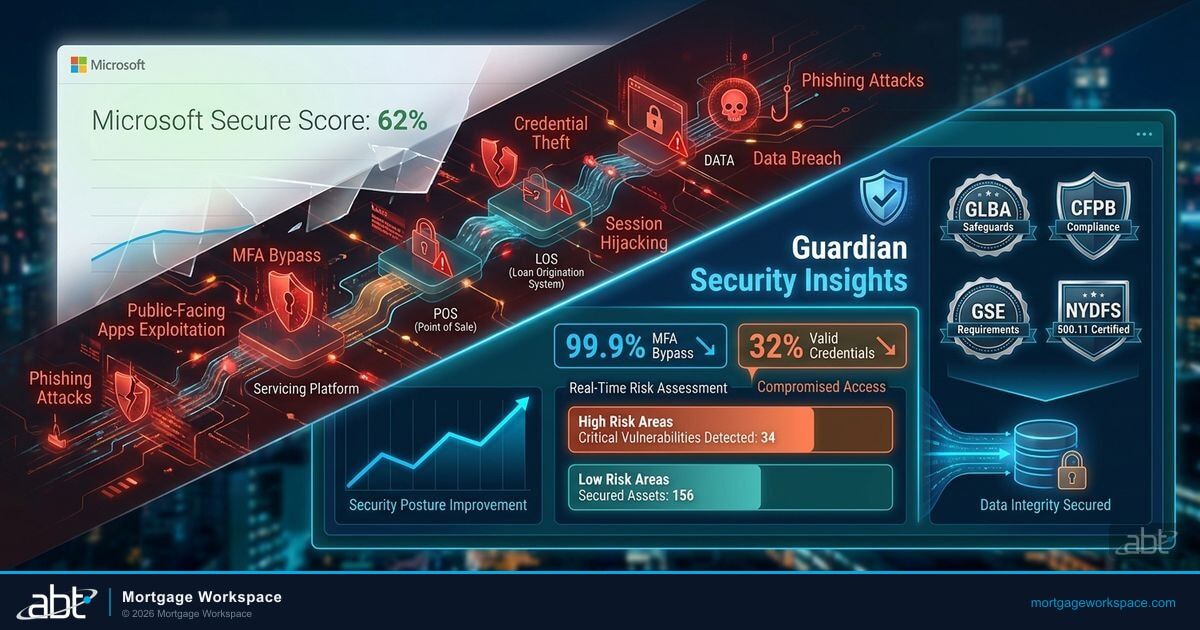
M365 Guardian is ABT's operating model on top of Microsoft Entra ID, Microsoft Purview, Microsoft Defender, Microsoft Intune, and Microsoft Sentinel for regulated mortgage operations. Microsoft Azure is where ABT hosts the integration layer and the mortgage-specific workloads that surround the cloud CRM. Microsoft 365 Copilot is the AI surface tenant-locked to the lender's Microsoft 365 environment, where Guardian's Entra ID Conditional Access and Purview Information Protection policies follow the borrower data into the Copilot session. The three layers cover the governance, the hosting, and the AI surface around the cloud CRM integration. Guardian applies the Microsoft baseline consistently across the lender's Microsoft 365 tenant, enforces least-privilege access for the integration service accounts, retains the audit trail on Purview Audit Premium, monitors the data flows in Microsoft Sentinel, and tenant-locks the Copilot deployment so the AI never leaks borrower data into a consumer model.
The cloud CRM is the relationship. The LOS is the loan. MortgageExchange is the bridge. M365 Guardian on Microsoft Azure is the governance and the AI surface around all of it.
Common Integration Mistakes to Avoid
- Starting with too many connections at once. Connect the LOS first. Add document management second. Stack additional systems after each connection is stable.
- Skipping the sandbox. Test with realistic loan data before going live. Edge cases like co-borrowers, investment properties, and jumbo loans break integrations that work fine for simple purchases.
- Ignoring change management. The team needs training on the new workflow, not just the technology. Processors who do not trust the integration will create manual workarounds that defeat the purpose.
- Forgetting ongoing maintenance. API versions change. Cloud platforms release updates. Quarterly integration health checks catch issues before they affect production loans.
Key Takeaway
A financial services cloud platform earns its keep only when it actually integrates with the systems where the loan lives. MortgageExchange is the data integration layer that connects cloud CRMs to the mortgage LOS, document, pricing, and servicing platforms. M365 Guardian on Microsoft Azure adds the governance and AI surface, tenant-locking Microsoft 365 Copilot to the lender's data and producing the audit evidence examiners ask for. The cloud CRM is the relationship layer. The integration and governance work is where the lift happens.
Talk to a Mortgage IT Specialist About Cloud Platform Integration
ABT runs MortgageExchange integrations and M365 Guardian deployments for mortgage operations of every size, from independent mortgage banks to multi-state lenders with hundreds of loan officers. A 30-minute conversation maps the current LOS, document, pricing, and servicing architecture, surfaces the integration work most likely to produce immediate lift, and outlines what an ABT-managed deployment would cover. No commitment, no quote, no obligation.
Frequently Asked Questions
Financial services cloud integration connects a cloud-hosted CRM and data management platform to the loan origination system, the document management tools, the pricing engine, and the servicing platform that a mortgage operation runs every day. The integration creates a unified view of borrower data, automates workflow routing, and maintains compliance audit trails across the entire operation. MortgageExchange is the ABT-built integration layer that handles the data flow between the cloud CRM and the mortgage operational systems.
Cloud integration improves mortgage compliance by automatically logging every borrower interaction, document exchange, and disclosure delivery in a centralized audit trail. When GLBA, FTC Safeguards Rule, or state-level audits occur, compliance teams pull complete borrower timelines in minutes instead of reconstructing records from disconnected systems. M365 Guardian extends that compliance evidence into the Microsoft 365 layer with Microsoft Purview Audit Premium, retention policies, and the cross-tenant audit reports that examiners ask for.
Mortgage cloud integration requires TLS 1.2 minimum encryption for all API connections, role-based access controls limiting data visibility by user role, SOC 2 Type II certification for both the cloud platform and the middleware layer, and comprehensive audit logging of all data transfers between connected systems to satisfy GLBA and FTC Safeguards Rule expectations. M365 Guardian adds the Microsoft Entra ID Conditional Access baseline, Microsoft Defender threat protection, and Microsoft Sentinel SIEM evidence on top of those minimum requirements.
Most financial services cloud platforms connect to legacy LOS systems through middleware that handles data transformation between older formats and modern API standards. MuleSoft, Microsoft Azure Logic Apps, and mortgage-specific middleware tools bridge the gap. ICE Mortgage Technology migrated Encompass to REST APIs in 2025, and other LOS vendors are following similar modernization paths. MortgageExchange is the ABT-built integration layer that connects the cloud CRM to legacy and modern mortgage LOS, document, and servicing systems across the platforms most ABT customers run.
Microsoft 365 Copilot is the AI surface that sits on top of the borrower data the cloud CRM and the LOS produce. Tenant-locked Copilot stays inside the lender's Microsoft 365 environment, follows the Entra ID Conditional Access and Purview Information Protection policies that M365 Guardian enforces, and does not send borrower data to a consumer model. For loan officers, that means summarizing the loan file, drafting the borrower follow-up, and pulling the right disclosure without leaving Outlook or Teams. ABT manages the Copilot deployment as part of the M365 Guardian operating model.
ABT hosts MortgageExchange and the mortgage-specific workloads that surround the cloud CRM on Microsoft Azure. Azure is the lender's customer-controlled cloud infrastructure that ABT operates as the partner of record. The integration layer runs inside the Azure environment, applies the same security baseline used across ABT-operated Microsoft 365 tenants, and produces the audit evidence on Microsoft Purview Audit Premium that the lender's compliance team needs for GLBA, FTC Safeguards Rule, and state-level audits.