In This Article
- Why Mortgage Companies Are Moving to the Cloud Now
- What Cloud Migration Actually Means for a Mortgage Company
- The Real Costs of Cloud Migration
- Five Cloud Migration Mistakes Mortgage Companies Make
- Measuring Cloud Migration Success
- The MSP Question: Migrate In-House or With a Partner?
- Frequently Asked Questions
The mortgage technology market is growing fast - analysts project it will exceed $8 billion by the mid-2020s, driven largely by cloud adoption. Mortgage companies still running on-premises servers aren't just paying more for infrastructure. They're falling behind competitors who can deploy new integrations in days instead of months.
Cloud migration for mortgage companies isn't a technology project. It's an operational shift that touches every department from origination to servicing. This guide covers what that migration actually looks like, what it costs, where it breaks, and how to avoid the mistakes that stall most lender migrations halfway through.
Cloud adoption in financial services has accelerated rapidly, with major LOS vendors like ICE (Encompass), Calyx, and Black Knight all offering cloud-native options. The question for mortgage companies isn't whether to migrate. It's how to do it without breaking compliance, disrupting loan production, or blowing the budget.
Why Mortgage Companies Are Moving to the Cloud Now
The mortgage industry resisted cloud adoption longer than most financial services sectors. Compliance concerns, LOS vendor lock-in, and the "if it's not broken" mindset kept many lenders on aging on-premises infrastructure well past its useful life.
Three forces are breaking that resistance in 2025-2026:
ICE's SDK Deprecation Forces the Issue
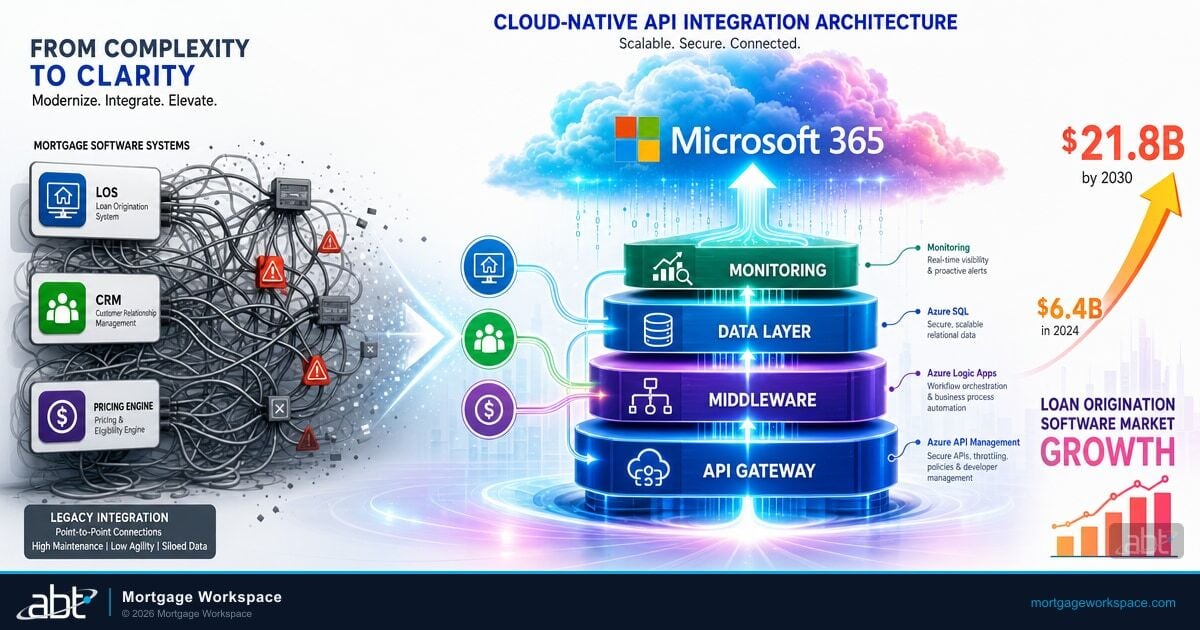
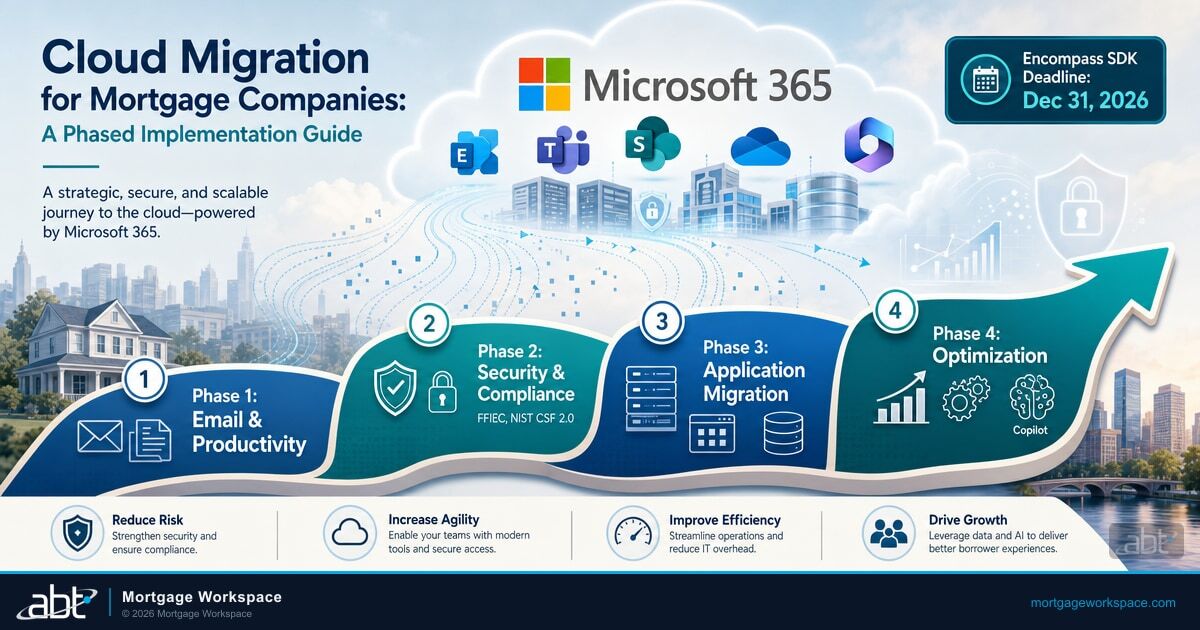
ICE Mortgage Technology announced that all Encompass SDK integrations must transition to cloud-native APIs by December 31, 2026. The SDK retirement started October 31, 2025. Every custom integration built on the legacy SDK needs to be rebuilt on Encompass Developer Connect's API-first architecture. For a detailed guide on the new setup, see Encompass cloud hosting configuration.
For lenders with 10 or 20 SDK-based integrations, this isn't optional. It's a deadline with a hard stop. And API-based integrations work better in cloud environments where network latency to ICE's cloud is consistent and predictable.
Encompass SDK Deadline: December 31, 2026
The SDK retirement is already underway. Lenders who haven't started their API transition need to coordinate cloud migration with Encompass Developer Connect integration work. Doing these separately doubles the effort and extends the risk window. For a look at what's possible with the new APIs, see API integrations for Encompass in 2025.
The FFIEC Expects Cloud-Ready Controls
The FFIEC's post-CAT guidance assumes cloud adoption. NIST CSF 2.0 and CIS Controls are technology-neutral frameworks with companion guidance for cloud environments. Examiners increasingly ask how institutions manage cloud security, not whether they use cloud services. If your entire environment is on-premises, you're still compliant. But your control framework looks outdated to modern examiners.
Remote and Hybrid Work Became Permanent
The 2020 experiment became the 2026 standard. Mortgage loan officers, processors, and closers work from home offices, branch offices, and client locations. On-premises infrastructure forces these workers through VPN tunnels that add latency, reduce reliability, and create security blind spots. Cloud-native infrastructure gives every user the same experience regardless of location.
What Cloud Migration Actually Means for a Mortgage Company
Cloud migration isn't one project. It's a sequence of interconnected moves that typically spans 6 to 18 months depending on the lender's size and complexity.
| Phase | Timeline | What Moves | Cost Impact |
|---|---|---|---|
| 1. Email & Productivity | Months 1-3 | Exchange, file servers, AD, phones | 30-40% infra cost reduction |
| 2. Security & Compliance | Months 3-6 | Conditional Access, Intune, Defender, DLP | Exam-ready controls |
| 3. Application Migration | Months 6-12 | LOS hosting, doc management, custom apps | $15K-$75K services |
| 4. Optimization | Months 12-18 | Power BI, Power Automate, Copilot | ROI acceleration |
Phase 1: Email and Productivity (Months 1-3)
Most lenders start here because it delivers immediate ROI with minimal risk. Moving from on-premises Exchange to Microsoft 365 eliminates server maintenance, provides automatic patching, and enables anywhere access.
The migration includes:
- Mailbox migration to Exchange Online
- File servers to SharePoint Online and OneDrive
- Active Directory to Entra ID (hybrid or full cloud)
- On-premises phone systems to Teams Phone
This phase alone typically reduces IT infrastructure costs by 30-40% while improving uptime from the 99.5% most on-premises environments achieve to Microsoft's 99.9% SLA.
Phase 2: Security and Compliance (Months 3-6)
Once identity lives in Entra ID, security controls follow. This phase layers on the compliance framework that examiners want to see:
- Conditional Access policies enforcing MFA, device compliance, and location-based restrictions
- Intune device management replacing on-premises Group Policy
- Microsoft Defender for Endpoint replacing standalone antivirus
- Microsoft Purview DLP policies protecting borrower data across email, Teams, and SharePoint
- Email authentication (SPF, DKIM, DMARC) configured properly
This phase is where most self-managed migrations stall. The tools exist in Microsoft 365 Business Premium and E5 licenses. Configuring them correctly for a mortgage compliance environment requires financial services expertise that general IT staff often lack.
Phase 3: Application Migration (Months 6-12)
This is the harder lift. Line-of-business applications that run on local servers need to move to cloud infrastructure or be replaced with cloud-native alternatives.
Common application migrations for mortgage companies:
- LOS hosting: Most modern LOS platforms (Encompass, Calyx Path) are already cloud-hosted by the vendor. Legacy self-hosted instances need migration plans.
- Document management: On-premises document servers move to SharePoint, Azure Blob Storage, or vendor-hosted cloud solutions.
- Custom applications: In-house tools built on local SQL Server databases migrate to Azure SQL or Azure App Services.
- Backup and disaster recovery: On-premises backup appliances replaced with Azure Backup and Azure Site Recovery.
Phase 4: Optimization (Months 12-18)
After the migration, the real value emerges. Cloud-native capabilities that weren't possible on-premises become available:
- Power BI dashboards pulling real-time data from your LOS, CRM, and compliance tools
- Power Automate workflows that eliminate manual handoffs between loan origination steps
- Azure Logic Apps connecting your LOS to third-party services without custom code
- Microsoft Copilot for summarizing loan files, drafting correspondence, and analyzing pipeline data

The Real Costs of Cloud Migration
Vendors sell cloud migration as a cost-saving exercise. The truth is more nuanced. Total cost depends on where you are today and where you're going.
What Gets Cheaper
- Hardware refresh cycles: No more $80,000-$150,000 server replacements every 4-5 years
- Maintenance labor: Patching, firmware updates, and hardware repairs disappear
- Disaster recovery: Azure replication costs a fraction of a secondary data center
- Per-user licensing: Microsoft 365 Business Premium at roughly $22/user/month includes email, security, device management, and compliance tools that would cost 3-4x as separate on-premises products
What Costs More (at First)
- Migration labor: Professional services for planning, executing, and validating the migration. Budget $15,000-$75,000 depending on complexity.
- Parallel running costs: During migration, you're paying for both on-premises and cloud infrastructure simultaneously. This overlap typically lasts 3-6 months.
- Training: Staff needs to learn new tools. Budget time and potentially external training resources.
- Integration rebuilds: Custom integrations built for on-premises may need reworking for cloud APIs.
For a 200-person mortgage company, the typical break-even point arrives between months 12 and 18. After that, the ongoing savings compound annually. Note that initial cloud costs often exceed expectations - plan conservatively and track actual spend against projections monthly.
Five Cloud Migration Mistakes Mortgage Companies Make
These patterns repeat across lender migrations. Each one either stalls the project or creates problems that surface months after go-live.
1. Migrating Without a Compliance Map
Moving to the cloud without mapping your compliance requirements first means you'll spend months retrofitting controls after migration. Map NIST CSF 2.0 or CIS Controls to your cloud architecture before you move a single mailbox. Know which controls your cloud provider handles (shared responsibility model) and which remain yours.
2. Ignoring the LOS Integration Timeline
If your LOS vendor is also migrating (like ICE's SDK-to-API transition), your cloud migration timeline needs to sync with theirs. Migrating your infrastructure to the cloud while your LOS integrations still depend on on-premises SDK calls creates a messy hybrid state. The hybrid cloud dilemma isn't just theoretical for mortgage platforms.
3. Treating It as an IT Project
Cloud migration affects loan officers, processors, closers, underwriters, and compliance staff. Every department needs communication, training, and a feedback loop. When IT migrates without operational input, users find workarounds that create security gaps.
4. Skipping the Pilot Group
Migrate a small department first. Test everything with real users doing real work for 2-4 weeks before rolling out company-wide. The pilot group catches issues that lab testing misses. Loan processing has edge cases no IT team anticipates.
5. Choosing a Generic Cloud Provider
AWS, Google Cloud, and Azure all offer cloud infrastructure. But mortgage companies running Microsoft 365 for email and productivity get dramatically better integration and compliance tooling on Azure. Splitting your environment across cloud providers adds complexity, cost, and security gaps that a single-stack approach avoids.

Measuring Cloud Migration Success
Track these metrics before, during, and after migration to prove the investment paid off:
- System uptime: Compare pre-migration and post-migration availability. Target 99.9% or higher.
- Help desk ticket volume: Cloud environments should reduce tickets related to VPN issues, file access problems, and slow performance.
- Time-to-deploy for new integrations: API-based integrations in the cloud should deploy in days, not the weeks or months that on-premises integrations required.
- Compliance evidence generation time: Measure how long it takes to pull exam-ready reports. Post-migration, this should drop from days to minutes.
- IT infrastructure cost per user: Calculate total IT spend divided by headcount. Compare quarterly, pre- and post-migration.
The MSP Question: Migrate In-House or With a Partner?
Mortgage companies with strong internal IT teams can handle Phase 1 (email and productivity) independently. Phases 2 through 4 are where financial services expertise becomes critical.
An MSP focused on financial services brings:
- Pre-built Conditional Access policies mapped to NIST CSF 2.0 and FTC Safeguards Rule requirements
- Intune compliance baselines tested across hundreds of mortgage company deployments
- Migration runbooks that account for LOS-specific quirks (Encompass WebSocket requirements, Calyx network configuration, Byte/LoanSoft connectivity)
- Post-migration monitoring that catches configuration drift before examiners do
The wrong MSP is one that treats your migration like every other small business migration. Mortgage companies have specific compliance, integration, and operational requirements that generic IT shops don't understand. ABT serves 750+ financial institutions and runs a pure Microsoft stack with no third-party MSP platforms. For more on the migration process without the headaches, see cloud migration without the headaches.
Ready to Move to the Cloud Without Disrupting Closings?
A phased migration keeps your pipeline moving while you modernize the platform underneath it. MortgageWorkspace plans each phase around loan volume so your team never loses a closing day to the move.
Frequently Asked Questions
A typical mortgage company cloud migration takes 6 to 18 months across four phases: email and productivity migration in months one through three, security and compliance configuration in months three through six, application migration in months six through twelve, and optimization in months twelve through eighteen. Smaller lenders with fewer custom integrations can compress this timeline significantly.
Migration professional services typically cost between $15,000 and $75,000 depending on complexity. Ongoing Microsoft 365 licensing runs approximately $22 per user per month for Business Premium. Most 200-person mortgage companies reach break-even between months 12 and 18 as on-premises hardware, maintenance, and licensing costs disappear. Annual savings compound after the break-even point.
For mortgage companies already using Microsoft 365 for email and productivity, Azure provides the tightest integration with identity management, security tools, and compliance features. Running Entra ID, Defender, Intune, and Purview on Azure eliminates cross-platform complexity. Splitting infrastructure across AWS or Google Cloud adds integration overhead without clear benefit for Microsoft-centric environments.
ICE Mortgage Technology requires all Encompass SDK integrations to transition to cloud-native APIs by December 31, 2026. Mortgage companies planning cloud migration should coordinate their infrastructure migration with their Encompass API transition. Rebuilding SDK integrations as API calls works better in cloud environments where network connectivity to ICE's cloud is consistent and optimized.
After migrating to the cloud, mortgage companies should align with NIST Cybersecurity Framework 2.0, CIS Controls v8.1, or CISA Cybersecurity Performance Goals. The FFIEC retired its Cybersecurity Assessment Tool in August 2025 and pointed institutions toward NIST CSF 2.0 and CISA CPGs as replacement frameworks. Each framework's guidance can be mapped to Microsoft 365 and Azure security features.

Plan Your Cloud Migration the Right Way
Two ways to start your migration assessment
Check Your Security Posture First
Run a free security grade assessment on your current M365 tenant. Know exactly where your compliance gaps are before planning your migration phases.
Get Your Security GradeTalk Through Your Migration Plan
Get a phased migration roadmap built for your LOS integrations, compliance requirements, and Encompass API transition timeline.
Talk to an ABT Cloud Migration Specialist