In This Article
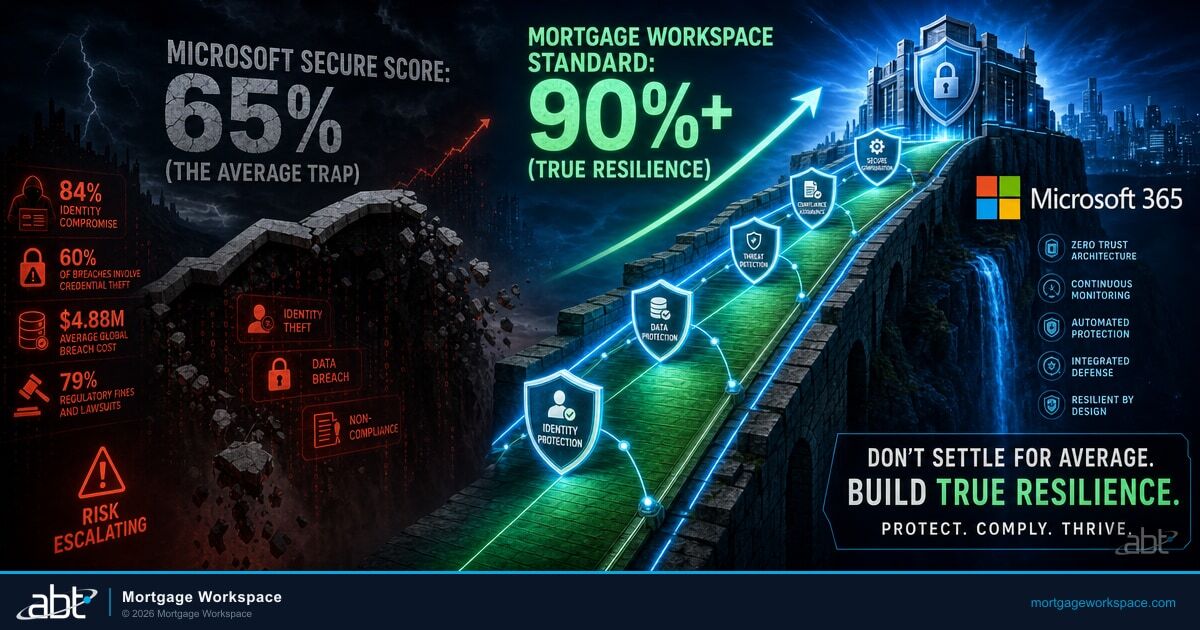
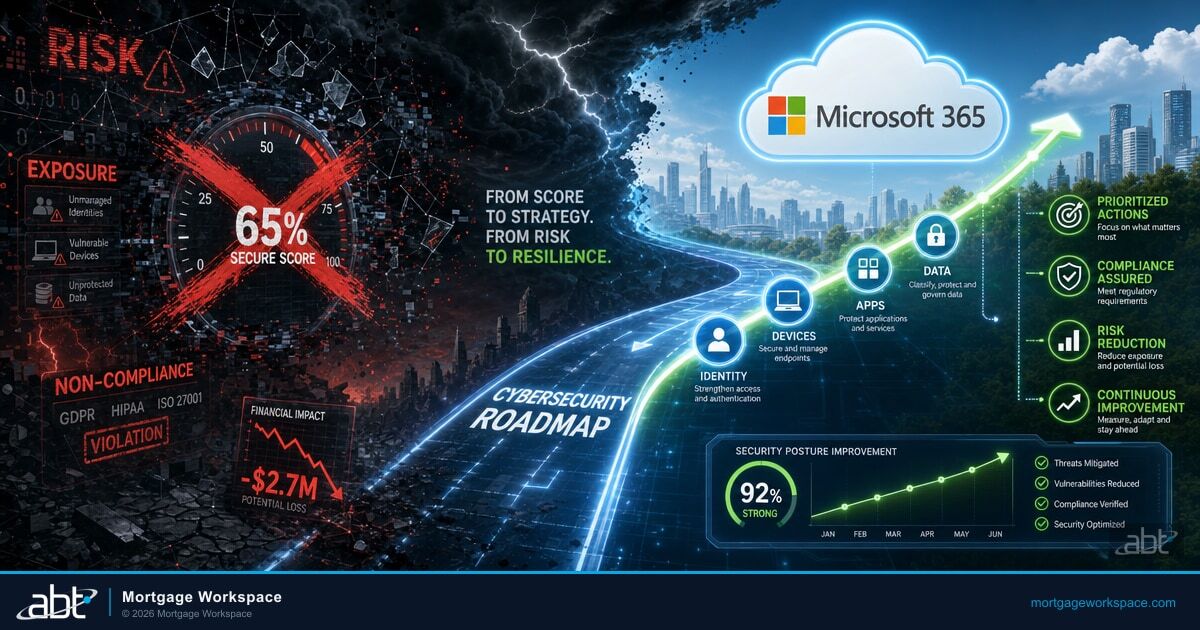
A 65% Microsoft Secure Score feels like a passing grade. It is not. The Microsoft Security Intelligence Report found that organizations above 80% experience 67% fewer security incidents than those below that threshold. For mortgage companies, community banks, and credit unions operating under FTC Safeguards Rule, NCUA Part 748, and state cybersecurity rules, that gap is real financial exposure and a real examiner finding waiting to happen.
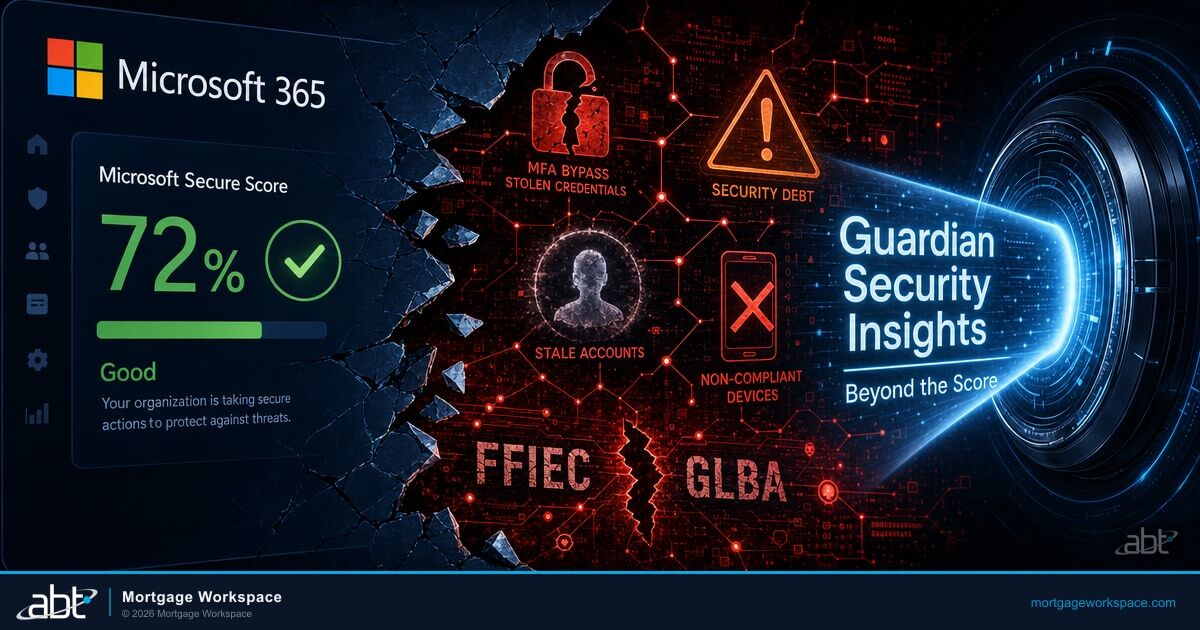
The problem is not the score itself. Microsoft Secure Score is a solid starting point. The problem is that a score without context does not tell a lender what to do next, which actions matter most for an FTC Safeguards examination, or whether the institution is improving fast enough to stay ahead of evolving threats. A spreadsheet of recommendations is not a plan. Examiners do not grade spreadsheets.
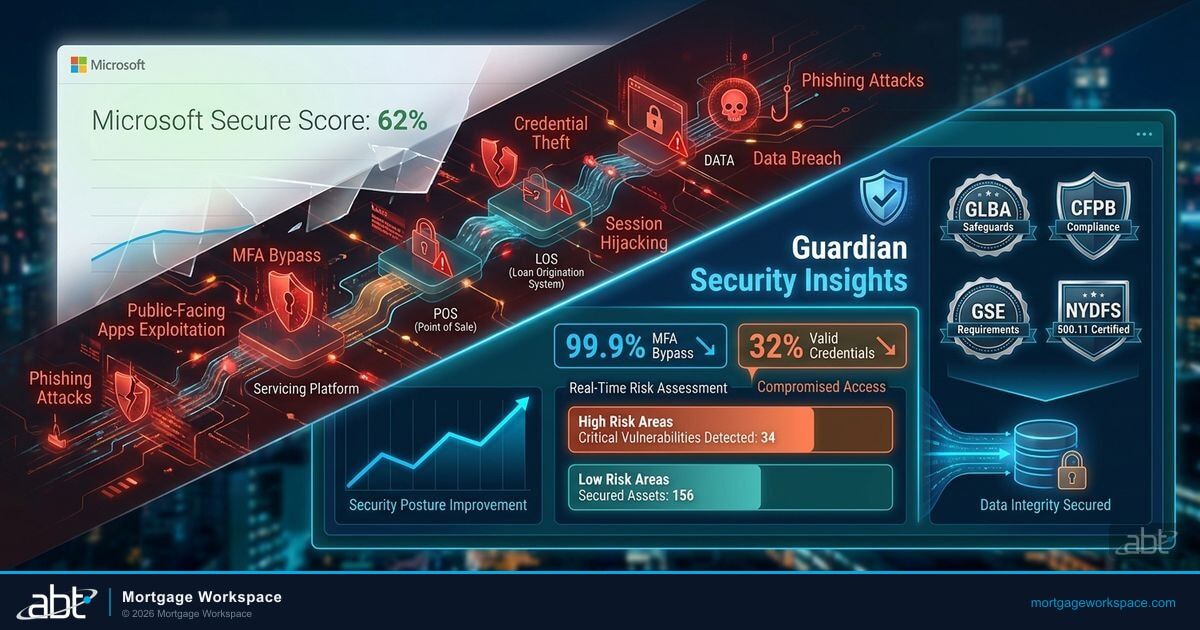
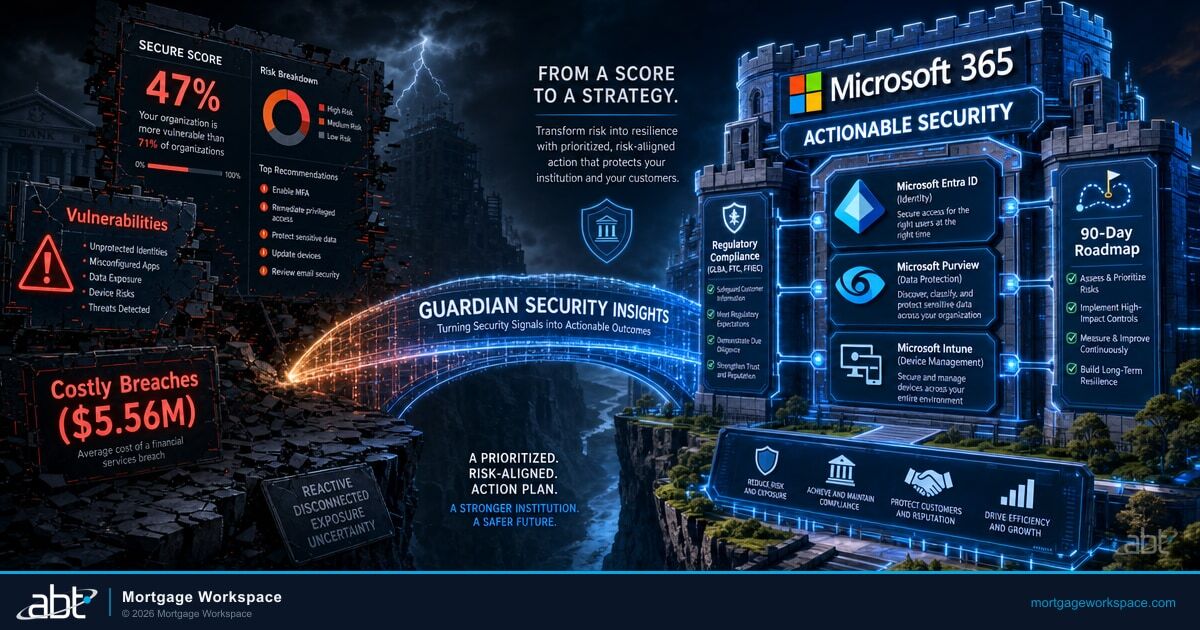
Access Business Technologies operates Microsoft 365 tenants for 750+ financial institutions as a Tier-1 Direct-Bill Microsoft Cloud Solution Provider. M365 Guardian is ABT's operating model on top of Microsoft 365 for regulated lenders. Guardian Security Insights is the layer inside that operating model that takes a Microsoft Secure Score and turns it into a prioritized cybersecurity roadmap built for mortgage companies and other financial institutions, with Microsoft Defender, Microsoft Purview, and Microsoft Sentinel deployed under a single managed configuration.
What ABT Brings to Microsoft Secure Score
- Mortgage-industry risk weighting. Guardian re-ranks Microsoft's generic Secure Score recommendations against actual FTC Safeguards, NCUA, and state lender expectations rather than vendor SMB defaults.
- Microsoft Defender and Microsoft Purview deployed as one configuration. Defender for Office 365, Defender for Endpoint, and Defender for Identity feed the same telemetry that Purview Audit, Purview DLP, and Purview Information Protection retain as audit evidence.
- Executive trend lines, not engineer dashboards. Letter grades, weekly snapshots, and board-ready reports translate the Defender portal into language a CFO and a board IT subcommittee can act on.
Where Microsoft Secure Score Falls Short
Microsoft Secure Score does three things well: it measures tenant configuration, compares the score to industry benchmarks, and lists recommended actions. But it has real limitations for lenders sitting under federal and state cybersecurity supervision:
- No prioritization by business risk. Microsoft Secure Score weights actions by security impact. It does not know that FTC Safeguards Rule compliance hinges on specific MFA configurations in Microsoft Entra ID, or that NYDFS Part 500 requires multi-factor authentication for any individual accessing the lender's internal networks from an external network. Every recommendation looks equally important.
- Engineer-first interface. The Microsoft Defender portal is built for security engineers. Executives, internal auditors, and board IT subcommittee members who need to understand posture cannot navigate it without IT translation, and translation slows decisions.
- Static snapshots. Microsoft Secure Score shows where the tenant stands today. It does not show whether the lender is improving, stagnating, or regressing over time, and a single snapshot is not the evidence an examiner asks for.
- False confidence at 65%. A passing score creates complacency. The 2025 CISO Benchmark Report found that 82% of companies lack strong security maturity in their digital core. Many of those companies thought their scores were "good enough." See Microsoft Secure Score for Financial Executives for the executive view of why the number matters and what a healthy trend line looks like.
How Guardian Turns a Score Into a Roadmap
Guardian Security Insights, inside the M365 Guardian operating model, takes the raw Microsoft Secure Score signal and turns it into a prioritized cybersecurity roadmap. The lender experiences five outcomes:
Category-Specific Dashboards
Guardian breaks Microsoft Secure Score into its four components: Identity, Devices, Apps, and Data. If the Identity score is 82% but Devices sits at 35%, the gap is visible immediately. Microsoft Secure Score alone buries this detail in a combined number that does not tell the CIO where to spend the next week of staff time.
Secure Score Simulator
Before the lender commits staff time or budget, Guardian simulates the impact of each proposed change. "Enabling Microsoft Entra ID Conditional Access for admin accounts raises the score by eight points, closes a Microsoft Defender for Identity gap, and satisfies the institution's NYDFS Part 500 multifactor authentication requirement." That is a roadmap item with stated business value, not a recommendation in isolation.
Risk-Ranked Action Queue
Guardian does not just list recommendations. It ranks them by risk reduction, compliance impact, and implementation complexity. The institution's team tackles the highest-value actions first instead of working through an alphabetical list, and the ranking accounts for the lender's specific regulatory regime, not a generic SMB profile.
Trend Tracking
Weekly score snapshots create a visible trajectory. A rising trend line proves the roadmap is working. A flat or declining line triggers investigation before small problems become audit findings. The trend line itself becomes part of the institution's audit evidence under FTC Safeguards Rule periodic risk-assessment expectations.
Automated Alerts
When a score drops because Microsoft adds a new recommendation or someone changes a Microsoft Entra ID policy, Guardian alerts the institution's team immediately. Drift detection replaces surprise findings during quarterly compliance reviews.
The M365 Guardian Stack: Defender, Purview, and Sentinel in One Operating Model
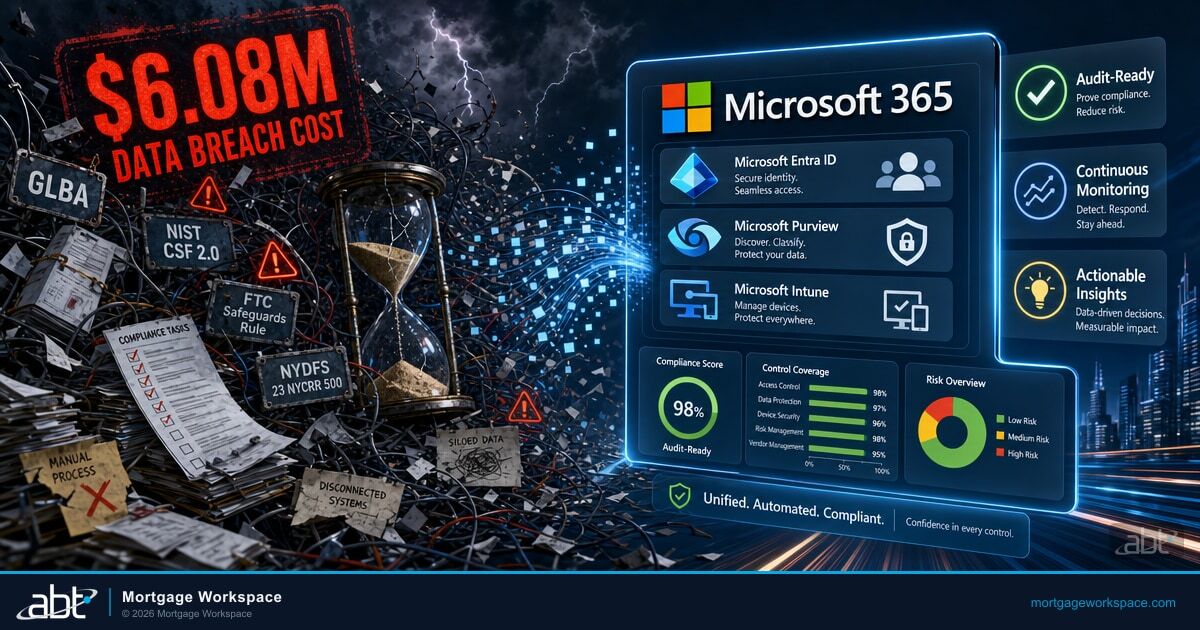
Microsoft Secure Score is the meter. The actual security controls live in Microsoft Defender, Microsoft Purview, Microsoft Entra ID, Microsoft Intune, and Microsoft Sentinel. The reason scores stay flat at most lenders is not because the controls are missing. They sit inside a reasonably licensed Microsoft 365 tenant already. The reason scores stay flat is that the controls are deployed inconsistently, configured against vendor defaults instead of mortgage-specific risk, and operated by IT teams who are already running the help desk and rolling out laptops. M365 Guardian closes that gap by treating Defender, Purview, and Sentinel as one configuration ABT manages across the institution's full Microsoft 365 footprint.
Microsoft Defender for Office 365 handles email phishing, impersonation, Safe Attachments, and Safe Links across every mailbox in the institution's tenant. Microsoft Defender for Endpoint covers the device side, including loan officer laptops, branch workstations, and home-office machines that touch borrower NPI. Microsoft Defender for Identity watches for risky sign-in patterns inside Microsoft Entra ID. Microsoft Purview Audit retains the time-stamped trail of every create, modify, and delete action across Exchange Online, SharePoint Online, OneDrive, and Microsoft Teams, with Audit Premium extending retention to a year or longer for the records subject to FTC Safeguards Rule oversight. Microsoft Purview Data Loss Prevention stops borrower NPI from leaving the tenant through email, OneDrive sharing, or unmanaged endpoint copies. Microsoft Sentinel aggregates the Defender, Purview, and Microsoft Entra ID signals into a single incident timeline that doubles as the evidence trail for FTC Safeguards Rule incident notification and state-level cybersecurity rule reporting. ABT manages every layer under the M365 Guardian operating model so the institution receives one configuration, one monitoring posture, and one set of audit reports rather than five disconnected portals.
Microsoft Secure Score is the public-facing meter the institution and the examiner can read. M365 Guardian is the operating model that produces the underlying configuration. Every action item Guardian Security Insights ranks in the roadmap maps back to a specific Defender control, a specific Purview policy, or a specific Microsoft Entra ID Conditional Access rule, and ABT applies it across the tenant under delegated administrative access so the institution's IT staff is not chasing five portals to close one finding.
Bridging the IT-Executive Gap
One of the biggest barriers to effective cybersecurity at lenders is the communication gap between IT teams and executive leadership. IT speaks in policies and configurations. Executives speak in risk, cost, and compliance. Examiners speak in evidence.
Guardian Security Insights bridges that gap with two modes that read the same Microsoft Secure Score data through two different lenses:
For IT Professionals
- Automated alerts on score changes and new Microsoft Defender vulnerabilities
- Prioritized action queue with Microsoft Entra ID, Intune, Defender, and Purview implementation guidance
- Technical detail on each recommendation, including the Microsoft documentation reference
For Executives
- Letter grades and visual trend lines that fit on a single board slide
- Business-impact summaries for each risk item in language a non-technical audit committee can read
- Automated reports ready for board presentations and audit preparation under FTC Safeguards Rule annual reporting
Both audiences look at the same underlying configuration. Guardian translates it for each audience. This alignment is critical. The Deloitte-FS-ISAC survey found that organizations with higher cybersecurity maturity had boards and management committees that were more engaged in nearly all areas of cybersecurity. For the executive-facing companion to this article, see Simplifying Cybersecurity for Executives.
Productivity for the IT team is the lead. Audit evidence is the byproduct. Both show up on the same dashboard.
Building Continuous Improvement Into the Security Program
A roadmap only works if the institution follows it. Guardian builds accountability into the process:
- Set a target score. ABT recommends 90%+ for managed institutions. The target should reflect the lender's regulatory obligations, risk appetite, and current baseline.
- Assign ownership. Each action item gets assigned to a specific role inside the institution. No "the team will handle it" ambiguity that examiners flag during interviews.
- Track weekly. Review the Guardian Security Insights dashboard every Friday. Celebrate progress. Investigate stalls before they reach quarter-end.
- Report quarterly. Present trend lines, completed actions, and remaining gaps to the board and the IT audit committee. Guardian generates these reports automatically from the same configuration data, with no separate slide deck to build by hand.
- Adjust as threats change. Microsoft updates Secure Score recommendations regularly. Guardian integrates new recommendations into the existing roadmap without starting over, so an examiner asking "how did the institution respond to the most recent Microsoft guidance" has a documented answer in the trend line.
Real-World Applications
MFA Compliance Acceleration
A financial institution with low Microsoft Entra ID MFA adoption used Guardian Security Insights to identify every gap. The roadmap prioritized admin accounts first, then regular users, then service accounts. The institution reached 97% MFA coverage within months and satisfied both its cyber insurer and the FTC Safeguards Rule access-control expectations.
Resource Optimization
A mortgage company used the Secure Score Simulator to model three improvement scenarios. The lender chose the path that delivered a 25% posture improvement in three months with the smallest budget allocation. Without the simulator, the same lender would have overspent on lower-impact changes that did not move the Microsoft Defender or Microsoft Purview signals examiners look at.
Stakeholder Confidence
A mortgage company used Guardian Security Insights' executive reports to show its warehouse lender a 40-point score improvement over six months. That transparency strengthened the relationship and smoothed the approval process for expanded credit lines. The broader operations frame for this kind of work lives in Beyond Microsoft Secure Score: Building a Mortgage Operations Security Program.
Key Takeaway
Microsoft Secure Score is a starting point. M365 Guardian, with Guardian Security Insights as the roadmap layer, is the operating model that turns the score into a managed configuration across Microsoft Defender, Microsoft Purview, Microsoft Entra ID, and Microsoft Sentinel. ABT applies the configuration under delegated administrative access, surfaces drift before examiners do, and produces the trend lines a CFO and a board IT subcommittee can hand to their FTC Safeguards or NCUA examiner without three weeks of spreadsheet work.
Turn Your Secure Score Into a Cybersecurity Roadmap
ABT runs the M365 Guardian operating model described in this article for mortgage companies, community banks, and credit unions. A 30-minute conversation maps the institution's current Microsoft Secure Score, surfaces the highest-risk gaps under FTC Safeguards Rule and state cybersecurity expectations, and outlines what an ABT-managed Microsoft Defender, Microsoft Purview, and Microsoft Sentinel deployment would cover. No commitment, no quote, no obligation.
Frequently Asked Questions
Microsoft Secure Score measures tenant configuration and lists recommended actions. Guardian Security Insights, the M365 Guardian layer ABT manages on top of it, adds risk-based prioritization tuned to mortgage and financial-services examiners, trend tracking over time, a Secure Score Simulator for planning, executive-friendly dashboards, and automated compliance reporting. Microsoft Secure Score tells the institution where it stands. Guardian tells the institution what to do next, in what order, and produces the trend lines that prove progress to executives and regulators. ABT applies the underlying Microsoft Defender, Microsoft Purview, and Microsoft Entra ID configurations across the institution's tenant under delegated administrative access.
ABT recommends targeting 90%+ for managed institutions. At minimum, mortgage companies, community banks, and credit unions under the FTC Safeguards Rule should aim for 75% or higher. Scores below 60% often indicate gaps in MFA enrollment, Microsoft Intune device compliance, or Microsoft Purview data protection policies that regulators and cyber insurers will flag. The Microsoft Security Intelligence Report correlates scores above 80% with 67% fewer security incidents, and the trend line of how a lender got there is the evidence most examiners ask for.
Yes. Cyber insurers now require live endpoint telemetry and real-time posture data during renewals. Guardian Security Insights generates reports showing the institution's current Microsoft Secure Score, MFA enrollment status from Microsoft Entra ID, Microsoft Intune device compliance rate, and Microsoft Defender risk remediation history. These reports document the security controls that insurers evaluate when setting premiums. Institutions with higher documented scores and a clean trend line typically qualify for lower premiums and avoid the supplemental questionnaires insurers send to higher-risk applicants.
ABT manages the institution's Microsoft 365 tenant under delegated administrative access as a Tier-1 Direct-Bill Microsoft Cloud Solution Provider. Inside that tenant, Microsoft Defender for Office 365, Microsoft Defender for Endpoint, and Microsoft Defender for Identity provide the threat detection across email, devices, and Microsoft Entra ID. Microsoft Purview Audit retains the time-stamped audit trail, Microsoft Purview Data Loss Prevention stops borrower NPI from leaving the tenant, and Microsoft Purview Information Protection labels and protects sensitive data. Microsoft Sentinel aggregates the signals into a single incident timeline. M365 Guardian is the operating model where ABT applies, monitors, and documents the deployment so the institution receives one consistent configuration rather than five disconnected portals.
Microsoft updates Secure Score recommendations on a rolling basis as new security features are released and threat intelligence evolves. These updates can cause an institution's score to drop even if the configuration has not changed. Guardian Security Insights tracks these updates nightly and integrates new recommendations into the existing improvement roadmap so the institution's team can respond quickly rather than discovering score drops weeks later during a quarterly review. The integration also ties new recommendations back to the Microsoft Defender, Microsoft Purview, or Microsoft Entra ID control that produced the change, so the action item lands in the right portion of the roadmap from the first day.