In This Article
- The Board-Level Cybersecurity Problem
- What Mortgage Executives Actually Need From Cybersecurity Reporting
- How M365 Guardian Translates Defender and Sentinel for Executives
- Microsoft Sentinel and Microsoft Defender as the Evidence Layer
- Proving ROI on Cybersecurity Spend
- Executive-Level Results
- Frequently Asked Questions
A mortgage company CEO walks into the quarterly board meeting and gets handed a 40-page cybersecurity PDF the IT team pulled together over the weekend. By page three the board is lost. By page ten the CFO is asking whether the firm is safe. By page twenty the conversation has turned into a debate about why the technology budget keeps growing without anyone able to say whether it is working. The chief compliance officer cannot help. The chief risk officer cannot help. The IT team built the report for IT, not for executives. Access Business Technologies operates Microsoft 365 tenants for 750+ financial institutions, and this conversation plays out, with minor variations, in mortgage banks, community banks, and credit unions every quarter.
Why ABT Built M365 Guardian for Mortgage Executives
- Microsoft Defender and Microsoft Sentinel produce the signals. They are the detection and SIEM engines inside Microsoft 365 and Azure that every modern security program runs on. They were not built for boards. They were built for security analysts. The output looks like alerts, queues, and analytic rules, not like ROI evidence.
- M365 Guardian is ABT's operating model on top of Microsoft Defender, Microsoft Sentinel, Microsoft Purview, Microsoft Intune, and Microsoft Entra ID. The configuration work, the analytic-rule tuning, the 24x7 monitoring, and the board-ready reporting come from the Guardian layer. Mortgage companies, banks, and credit unions experience the outcomes: a single Secure Score view, prioritized risk, trend lines, and the evidence a board needs to approve next year's security budget.
- Executive-ready reporting is the lead reason firms move to a managed Guardian deployment. Audit readiness is the byproduct. Both show up on the same dashboard.
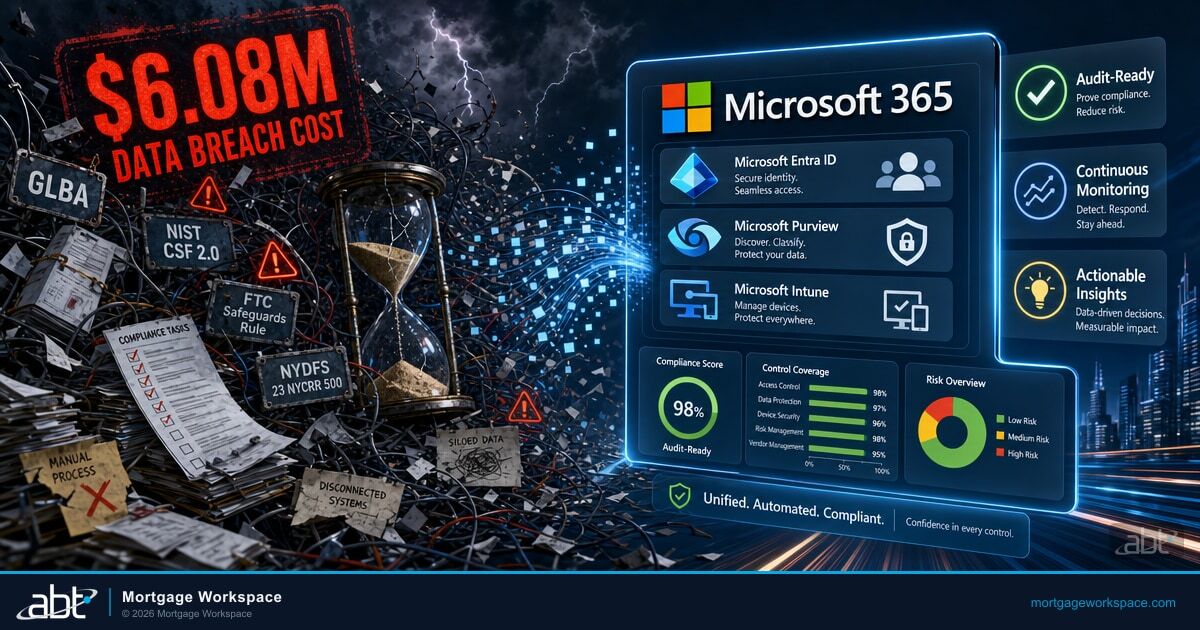
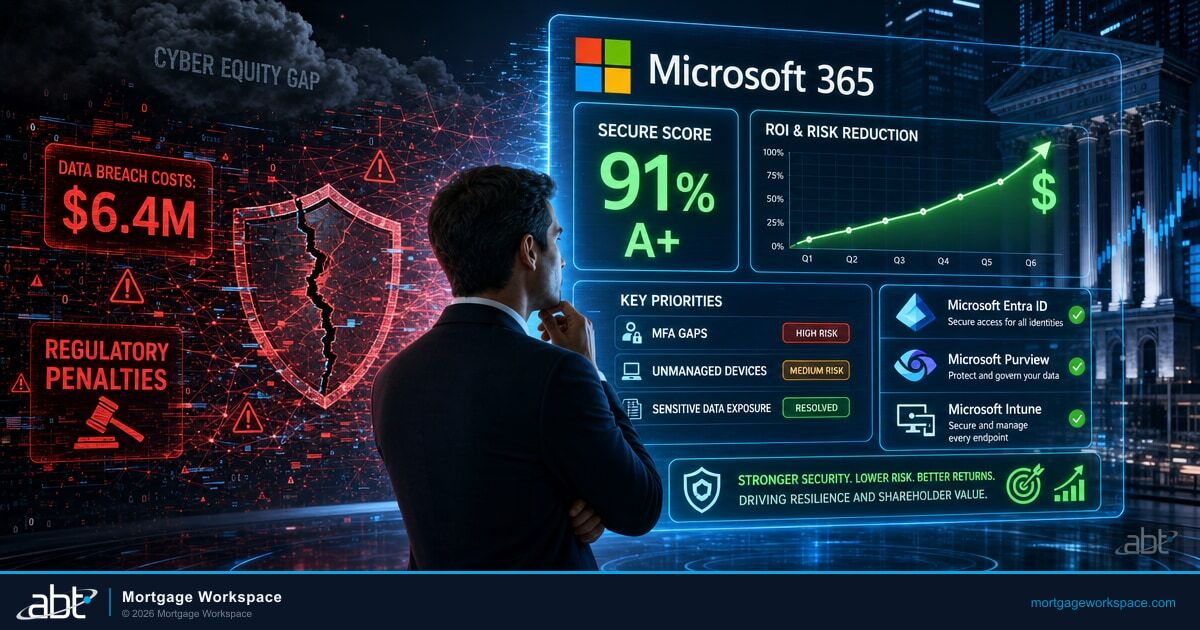
The global average cost of a data breach dropped to $4.44 million in 2025, according to the IBM Cost of a Data Breach Report. The financial services average sits higher, around $6.4 million, driven by cloud forensics costs, third-party vendor exposure, and regulatory penalties. For mortgage company executives, the problem is not that cybersecurity matters. The problem is that the existing reporting layer does not translate the technical signal into the business language a board needs to make a decision. This article describes how M365 Guardian translates Microsoft Defender and Microsoft Sentinel output into executive-grade reporting, what an ABT-managed deployment covers, and what mortgage executives should expect from the conversation.
The Board-Level Cybersecurity Problem
Mortgage company executives face three recurring problems with the cybersecurity reporting they get today.
Technical reports that do not translate. The IT team delivers a 40-page PDF full of CVEs, CVSS scores, MFA exception lists, and configuration screenshots. The board wants to know three things: are we safe right now, are we compliant with the FTC Safeguards Rule and applicable state privacy law, and is the technology spend producing measurable risk reduction. None of those three questions are answered by a CVE list. The reporting layer is built for the wrong audience.
Reactive visibility. Most executives only hear about cybersecurity when something breaks. That is the worst time to learn. The 2025 IBM report found that breaches taking over 200 days to identify cost $5.01 million on average, while breaches caught early cost $3.87 million. The gap between those two numbers is roughly the cost of a full year of a managed detection-and-response program. Executives who lack continuous visibility are paying the breach-cost premium without realizing it.
Regulatory stakes that keep climbing. The amended FTC Safeguards Rule requires a Qualified Individual to oversee the information security program and report to the board annually. NYDFS Part 500 requires annual chief information security officer certification. The amended SEC Regulation S-P requires a written incident response program and 30-day customer notification on unauthorized access to sensitive customer information. Non-compliance penalties run into six and seven figures per violation, and the personal liability exposure for officers and directors is real. Executives who cannot demonstrate a current view of the firm's security posture cannot sign those certifications honestly.
The World Economic Forum's 2025 Global Cybersecurity Outlook flagged an expanding "Cyber Equity Gap." The largest banks are hardening their defenses with mature security operations centers and threat intelligence programs. Community banks, regional credit unions, and mid-size mortgage companies are falling behind because the staffing model that supports a mature security program is out of reach. The firms that close the gap do it through a managed partner relationship, not by hiring a 12-person internal security operations center.
What Mortgage Executives Actually Need From Cybersecurity Reporting
Executives do not need more data. They need clarity on four questions a board can act on in a single meeting:
- What is our security posture right now? A single score, grade, or trend arrow that an executive can understand in ten seconds and explain to the board in thirty.
- What are our biggest risks? The top three to five vulnerabilities the firm carries, ranked by business impact, not by CVSS score.
- Are we getting better or worse? Trend lines covering weeks and months that show whether the security program is producing measurable progress.
- Is the investment working? ROI evidence that ties security spend to specific risk reduction, fewer incidents, lower cyber insurance premiums, faster examination cycles, and reduced manual audit preparation hours.
Most cybersecurity tools were built for security analysts. They answer analyst questions in analyst language. M365 Guardian is the ABT operating model that translates the same underlying Microsoft Defender, Microsoft Sentinel, Microsoft Purview, and Microsoft Entra ID data into the executive questions above without dumbing it down. We cover Guardian Security Insights in a companion piece.
How M365 Guardian Translates Defender and Sentinel for Executives
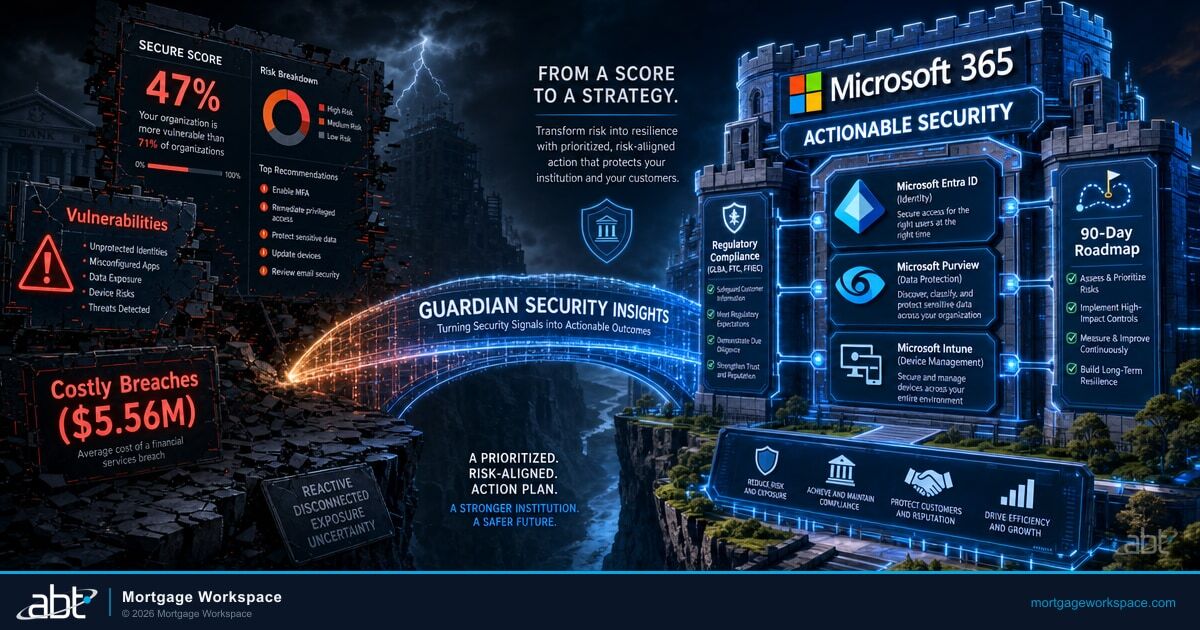
M365 Guardian is ABT's operating model on top of the Microsoft security stack. The model has four layers a mortgage executive will recognize. The configuration layer applies a financial-services-tuned baseline across Microsoft Entra ID, Microsoft Intune, Microsoft Defender, and Microsoft Purview. The monitoring layer ingests every signal into Microsoft Sentinel, where ABT's analytic rules surface what matters for mortgage operations rather than vendor-default SMB alerts. The reporting layer produces executive dashboards and board-ready summaries on a weekly and monthly cadence. The advisory layer puts an ABT account team in the room with the firm's CFO, CIO, and CCO so the data has context, not just numbers.
Microsoft Secure Score, Translated
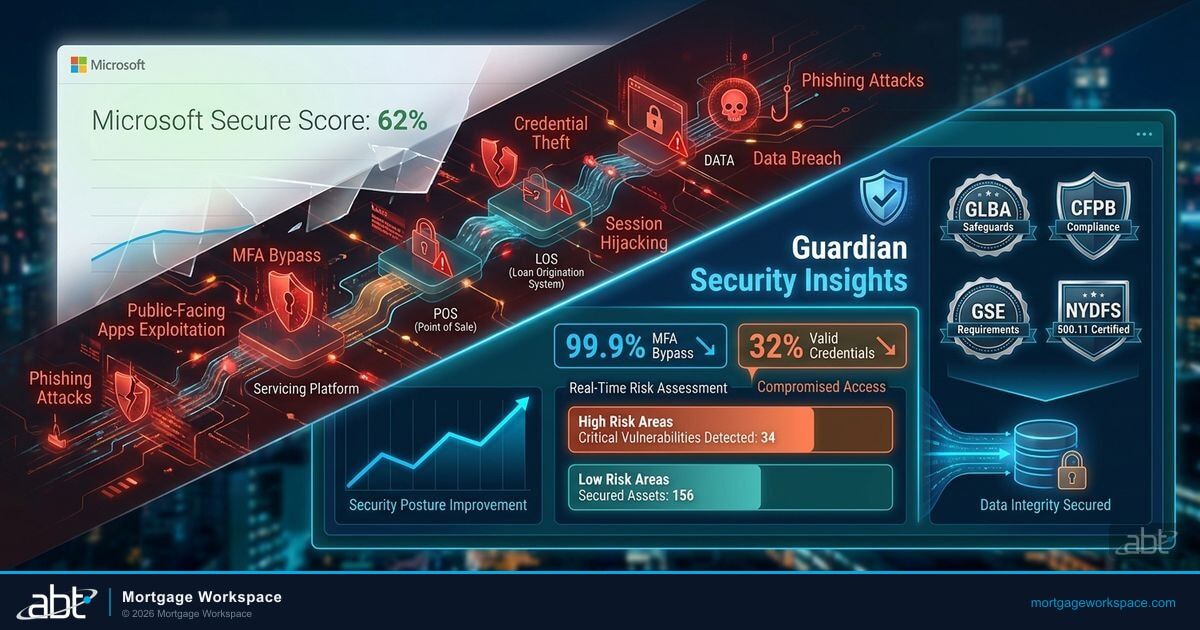
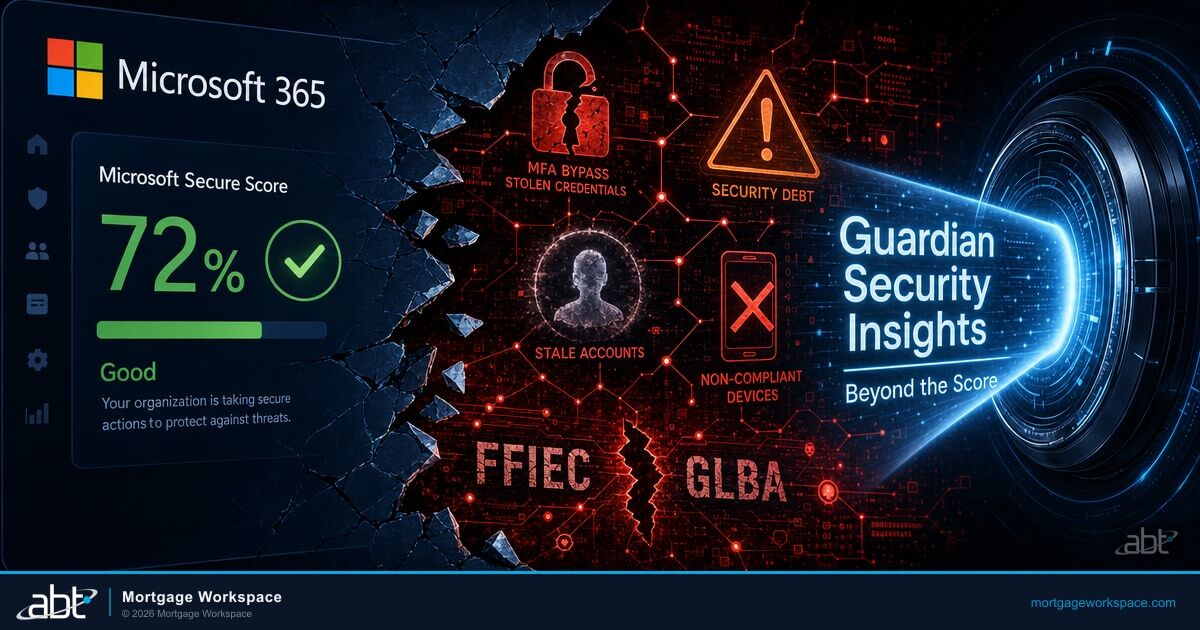
Guardian surfaces the firm's Microsoft Secure Score with category breakdowns covering Identity, Devices, Apps, and Data. The raw Secure Score sits inside the Microsoft 365 admin center and looks like a percentage. Guardian translates that percentage into a letter grade, a trend arrow, and a one-paragraph plain-English summary that an executive can drop into a board pre-read without rewriting it.
Secure Score Simulator
Guardian models the impact of proposed security changes before the firm commits the budget. The simulator answers questions like "if we implement these three Conditional Access policies, what does our Secure Score look like, and which compliance gap closes?" Sample sentence the simulator produces: the firm's Identity score rises from 55% to 72%, the FTC Safeguards Rule access control gap closes, and the change requires no new licenses. That is a board-ready sentence. This connects closely to Guardian Security Insights.
Risk Prioritization Dashboard
Guardian highlights the specific vulnerabilities that create the most exposure for a mortgage operation. MFA gaps on registered representatives or licensed loan officers, stale accounts left enabled after offboarding, unmanaged devices used to access borrower documents, legacy authentication still allowed for a third-party integration, sign-in risk alerts from countries the firm does not operate in. Each item includes the business risk in one sentence and the recommended fix in one sentence. No jargon. No ambiguity.
Automated Executive Reports
Guardian delivers weekly or monthly executive reports to the CFO, CIO, and CCO without manual assembly. The reports show current Secure Score with category breakdowns, trend lines over the previous twelve weeks, the top five prioritized risks, compliance status against the FTC Safeguards Rule and GLBA, and an open-incident summary. The format is designed for board presentations and audit preparation, and one client cut quarterly compliance preparation time by roughly 50%, which is around ten staff hours per month.
Microsoft Sentinel and Microsoft Defender as the Evidence Layer
The executive-grade reporting layer above is only useful because the evidence layer underneath is real. M365 Guardian does not invent metrics. The metrics come out of Microsoft Defender and Microsoft Sentinel as those products run inside the firm's Microsoft 365 tenants and Azure subscriptions. Guardian is the configuration and operating model that makes the output usable.
Microsoft Defender for Office 365 covers the email channel that handles most customer correspondence in a mortgage operation. Anti-phishing, anti-impersonation, Safe Attachments, and Safe Links policies sit on every inbound message, every external sender pattern, and every URL a loan officer or processor clicks. Microsoft Defender for Endpoint covers the device side, posture-checking every workstation and laptop that touches borrower data and producing detection-and-response signals when something goes wrong. Microsoft Defender for Identity watches sign-in behavior for registered representatives and licensed loan officers, surfaces risky sign-ins, and feeds the data into Microsoft Entra ID Conditional Access for adaptive enforcement. Microsoft Defender for Cloud Apps covers the third-party software the operations team uses outside the Microsoft 365 boundary. ABT manages every one of these Defender products inside the firm's tenant as part of the Guardian operating model.
Microsoft Sentinel is the security-information-and-event-management layer that aggregates the Defender signals, the Microsoft Entra ID sign-in logs, the Microsoft Purview audit logs, the Microsoft Intune device-compliance events, and any third-party connector the firm needs into a single incident timeline. For a mortgage operation, that timeline doubles as the evidence trail for amended SEC Regulation S-P 30-day customer notification analysis, FTC Safeguards Rule incident reporting, and state-level breach notification statutes. ABT hosts the Sentinel workspace inside the firm's Azure subscription, tunes the analytic rules to mortgage-specific attack patterns rather than vendor SMB defaults, and produces the cross-tenant reports that a CCO can hand to an examiner without spending three weeks pulling screenshots.
Microsoft Defender catches the threat. Microsoft Sentinel records the evidence. M365 Guardian turns both into a board pre-read your CFO can read in three minutes.
The mortgage-industry version of an executive-ready security posture has a fixed shape. Microsoft Entra ID supplies the identity layer with MFA, Conditional Access, sign-in risk, and Identity Protection. Microsoft Intune covers every device that handles borrower data. Microsoft Defender for Office 365 and Microsoft Defender for Endpoint handle the active threat detection on email and devices. Microsoft Purview Audit, Information Protection, and DLP hold up the books-and-records and customer-NPI side. Microsoft Sentinel aggregates the signals into a single incident timeline that satisfies FTC Safeguards Rule and SEC Regulation S-P incident response expectations. M365 Guardian is the ABT operating model on top of those Microsoft tools, with mortgage-industry-tuned configurations and 24x7 monitoring so a community-bank or independent-mortgage-bank executive team gets enterprise-grade outcomes without an enterprise-grade in-house security operations center.
Proving ROI on Cybersecurity Spend
Cybersecurity spending at financial institutions keeps rising. The Deloitte-FS-ISAC industry survey found that cyber monitoring, endpoint security, and identity management collectively absorb more than 50% of the cybersecurity budget at mid-size financial institutions. Executives need evidence that the spend is working, not just bigger.
M365 Guardian makes the ROI visible in four lines a CFO can defend:
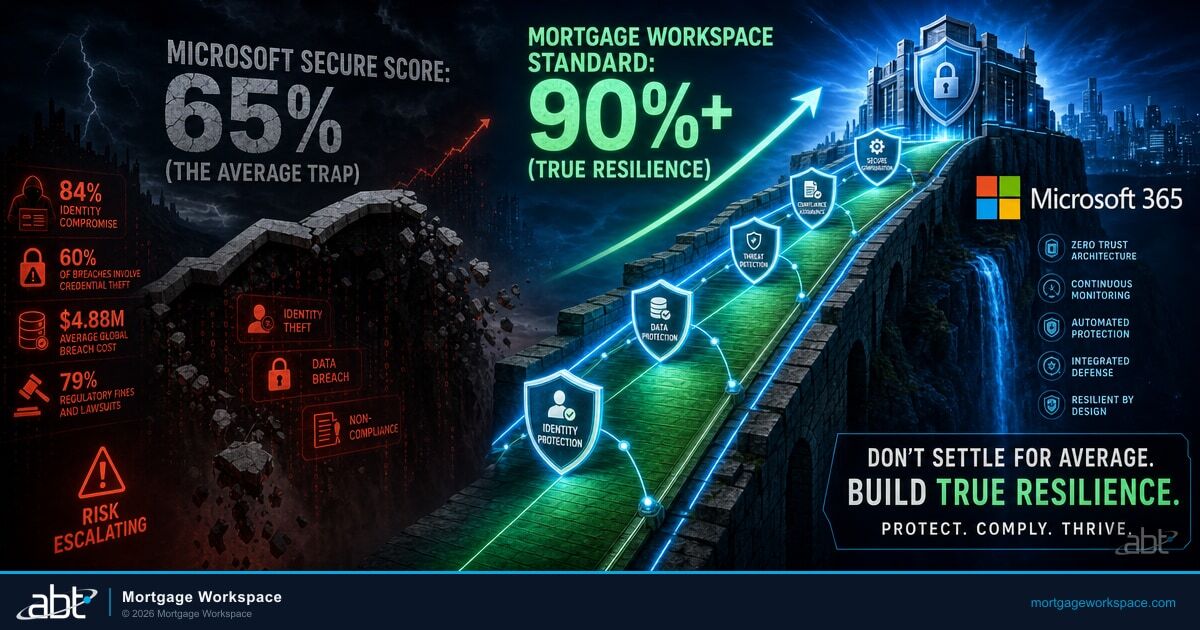
- Secure Score improvement over time. A trend line moving from 40% to 85% over twelve months is concrete evidence of progress, and the dashboard shows which configuration changes drove the improvement.
- Risk reduction metrics. "We closed 47 prioritized vulnerabilities this quarter" is measurable output. The Guardian dashboard ties each closed vulnerability to the underlying Microsoft Defender or Microsoft Sentinel signal that flagged it.
- Compliance preparation cost savings. Automated reporting from M365 Guardian replaces manual audit preparation. The 50% reduction in quarterly compliance preparation time mentioned above is roughly ten staff hours per month at a typical mortgage operation, which scales with firm size.
- Cyber insurance premium impact. A higher Microsoft Secure Score, documented Microsoft Defender deployment, and active Microsoft Sentinel monitoring correlate with lower cyber insurance premiums on renewal. That saving hits the P&L directly and is documented in the renewal underwriting questionnaire.
Executive-Level Results From Mortgage Companies
From 40% to 91% Secure Score in Six Months
A mid-size independent mortgage bank started with a Microsoft Secure Score of 40%. After six months of M365 Guardian configuration, monitoring, and remediation, the firm reached 91%, achieved full MFA enforcement across registered representatives and licensed loan officers, and cut monthly compliance reporting time by roughly twenty hours. The improvement came from Microsoft Entra ID Conditional Access tuning, Microsoft Intune device enrollment, Microsoft Defender for Office 365 policy hardening, and Microsoft Sentinel analytic-rule deployment, all configured and operated through the Guardian model.
Bridging the IT-Executive Communication Gap
An executive team at a community bank struggled with IT reports filled with technical language the board could not act on. M365 Guardian translated those reports into visual dashboards showing priority, progress, and risk in the format the board's audit committee uses for credit and operational risk reviews. The leadership team could identify the top three security priorities at a glance and align security investments with business goals for the next budget cycle.
$30,000+ in Annual Microsoft Licensing Savings
A regional mortgage company discovered unused Microsoft 365 licenses through Guardian's tenant-level visibility tools. Right-sizing the license allocation while improving the security baseline saved over $30,000 annually, which paid for the managed Defender and Sentinel monitoring work the firm had previously deferred for budget reasons.
Key Takeaway
Microsoft Defender and Microsoft Sentinel produce the signals every modern mortgage company needs for board-grade cybersecurity reporting. They were not built for executives. M365 Guardian is ABT's operating model on top of those Microsoft products, configured and operated as a Tier-1 Direct-Bill Cloud Solution Provider for 750+ financial institutions, that translates the underlying detection and SIEM output into the Secure Score, trend, risk-priority, and ROI evidence a mortgage company CFO and board need to make confident decisions. The technical work happens inside the firm's Microsoft 365 tenant and Azure subscription. The executive-grade reporting comes out the other side. For ABT's fuller take, see Proactive Cybersecurity.
Get an Executive Cybersecurity Readiness Review
ABT runs the M365 Guardian operating model described in this article for mortgage banks, community banks, and credit unions that need executive-grade visibility into their Microsoft Defender, Microsoft Sentinel, and Microsoft 365 security posture. A 30-minute conversation maps your current tenant footprint, surfaces the executive-reporting gaps your board is most likely to push back on, and outlines what an ABT-managed Guardian deployment would cover. No commitment, no quote, no obligation.
Frequently Asked Questions
Mortgage executives should track Microsoft Secure Score trend lines, MFA enrollment percentage, stale account count, device compliance rate, and time to remediate critical findings. These five metrics provide a clear picture of security posture without requiring technical expertise. M365 Guardian surfaces all five in automated executive dashboards designed for board-level reporting, pulled directly from Microsoft Defender, Microsoft Sentinel, Microsoft Entra ID, and Microsoft Intune data inside the firm's Microsoft 365 tenant.
The FTC Safeguards Rule requires covered financial institutions to designate a Qualified Individual who oversees the information security program and reports to the board annually. Executives bear responsibility for ensuring the program exists, is maintained, and is documented in a form regulators can examine. Non-compliance can result in fines up to $100,000 per violation for the institution and $10,000 for individuals found in violation, plus personal-liability exposure for officers and directors. M365 Guardian produces the documentation a Qualified Individual needs to support an annual board report without manual screenshot assembly.
Financial services data breaches cost an average of $6.4 million in 2026, according to industry analysis based on IBM Cost of a Data Breach Report data. Mortgage-specific breaches have cost significantly more in recent years. Mr. Cooper's 2023 breach cost at least $25 million in direct response and remediation. LoanDepot estimated recovery costs between $12 million and $17 million for its 2024 incident. Beyond direct costs, mortgage breaches trigger customer churn rates of 18-25%, regulatory scrutiny that lasts years, and cyber insurance premium increases on renewal. Microsoft Defender, Microsoft Sentinel, and the M365 Guardian operating model are designed to reduce the breach-likelihood input to that calculation and shorten the detection-to-containment window when an incident does happen.
Yes. M365 Guardian produces automated reports designed for non-technical audiences. Each report includes the firm's current Microsoft Secure Score with category breakdowns covering Identity, Devices, Apps, and Data, trend lines showing improvement over time, a prioritized risk list with business-impact context drawn from Microsoft Defender and Microsoft Sentinel signals, and compliance status against FTC Safeguards Rule and GLBA requirements. The reports are formatted for board presentations and audit committee reviews and can be delivered weekly or monthly. ABT operates the underlying Microsoft 365 tenant under a Tier-1 Direct-Bill Cloud Solution Provider relationship, which is why the reports can pull from the full Microsoft security stack rather than from a third-party point tool.
Microsoft Defender is the family of detection-and-response products that watch specific surfaces inside Microsoft 365 and on devices: Defender for Office 365 covers email, Defender for Endpoint covers workstations and laptops, Defender for Identity covers sign-in behavior, and Defender for Cloud Apps covers third-party software. Microsoft Sentinel is the security-information-and-event-management layer that aggregates all of the Defender signals, plus Microsoft Entra ID and Microsoft Purview logs, into a single searchable incident timeline. Mortgage executives need both because Defender alone covers detection on specific surfaces, while Sentinel produces the cross-surface evidence trail that examiners, cyber insurance underwriters, and the firm's board all expect. M365 Guardian is the ABT operating model that configures, tunes, and monitors both products inside the firm's Microsoft 365 tenant and Azure subscription so the data reaches an executive in the form an executive can act on.
ABT manages the firm's Microsoft 365 tenant. Microsoft owns and runs the underlying Microsoft 365 infrastructure. ABT manages the firm's tenant configuration, Microsoft Defender deployment, Microsoft Entra ID Conditional Access policies, Microsoft Purview retention, Microsoft Intune device posture, and 24x7 monitoring inside that tenant under a Tier-1 Direct-Bill Cloud Solution Provider relationship. For Azure environments, including the Microsoft Sentinel workspace and any hosted application infrastructure, ABT hosts and operates the Azure subscription on behalf of the firm. The distinction matters because examiners and cyber insurance underwriters routinely ask which party is responsible for which layer of the stack, and the answer affects vendor oversight documentation and incident response liability.