TL;DR
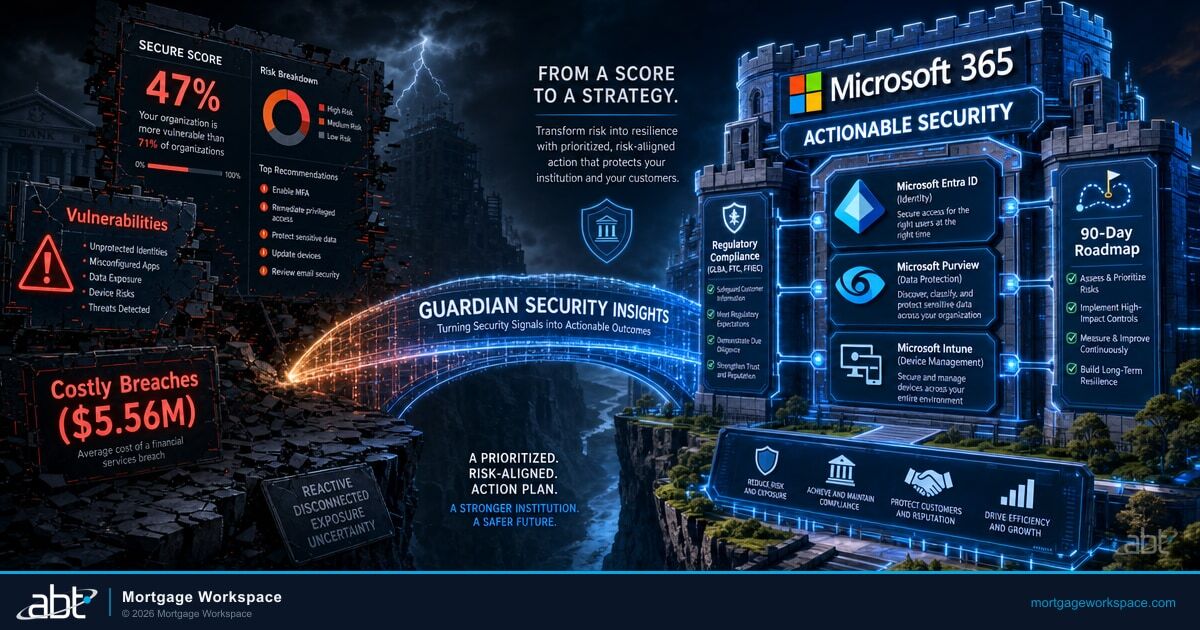
- Microsoft Secure Score reports posture on a 0–100 percent scale by pillar. CSI's 2026 Banking Priorities Survey found 85 percent of community banking leaders agree AI adoption gives a competitive advantage; the same survey shows boards now expect named, quantified posture data.
- Fannie Mae's Information Security and Business Resiliency Supplement (effective August 12, 2025) requires annual officer attestation across 14 security domains plus 36-hour breach reporting. The FTC Safeguards Rule still requires a Qualified Individual to report to the board annually.
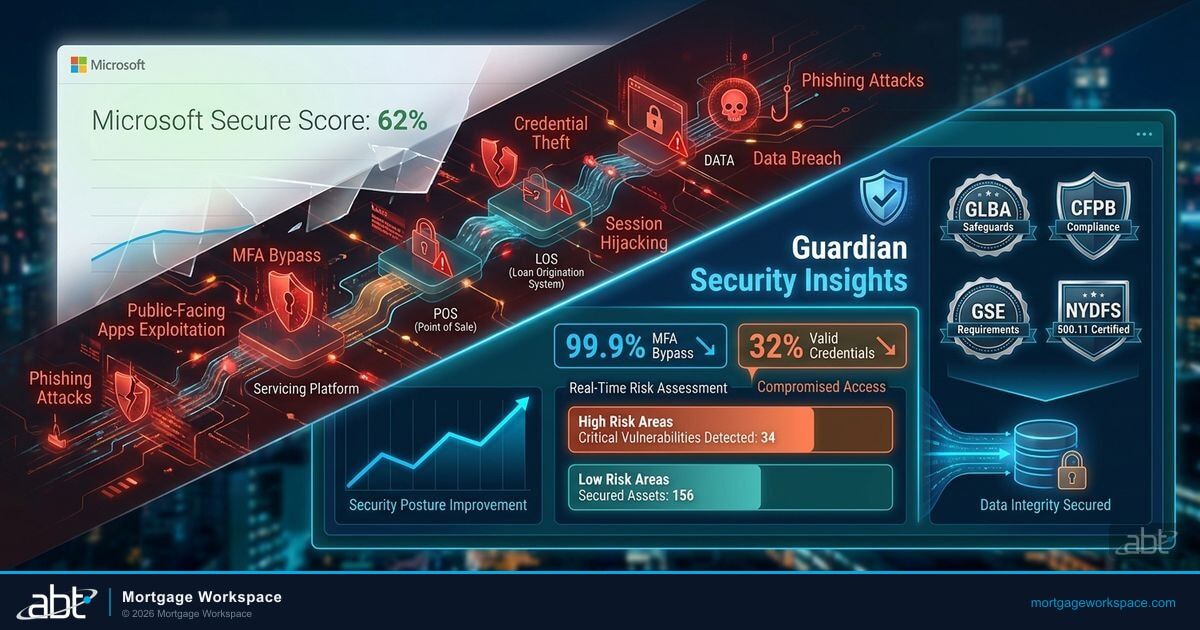
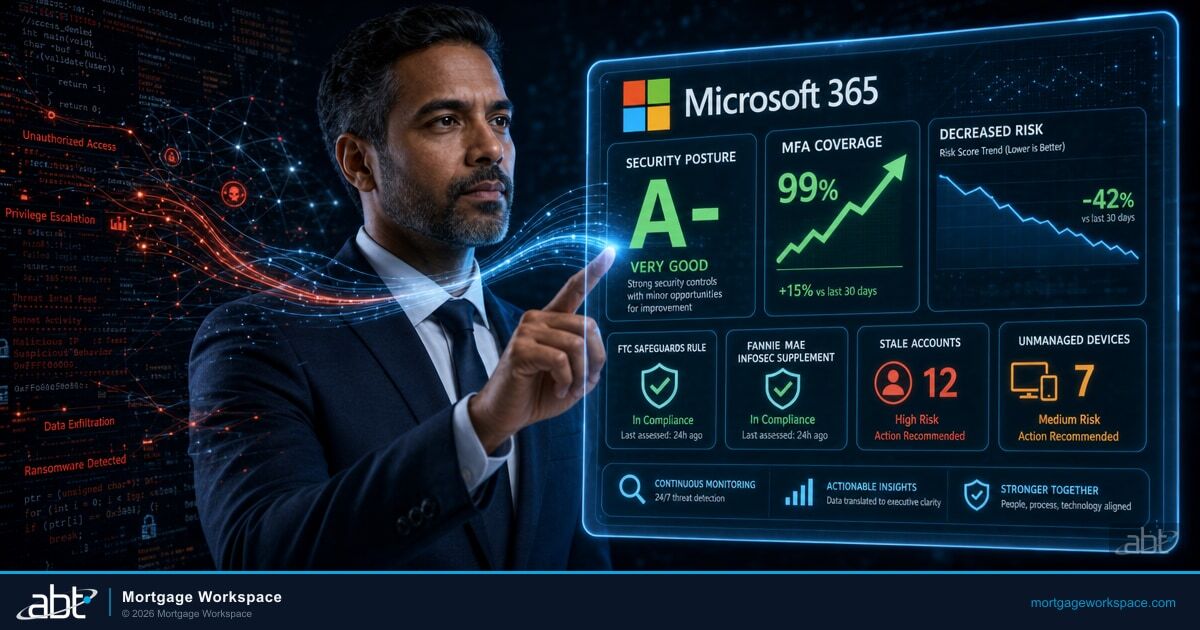
- Guardian Security Insights is the visibility layer inside ABT's M365 Guardian operating model. It translates Microsoft 365 telemetry into board-ready scorecards, MFA enrollment counts, stale-account inventories, and trend lines so credit unions, banks, and mortgage companies can answer specific board questions with data.
In This Article
Eighty-five percent of community banking leaders surveyed by CSI in its 2026 Banking Priorities Executive Report agreed that institutions adopting AI will gain a significant competitive advantage. The same report found cybersecurity confidence is rising as AI-driven defenses mature, but boards are asking sharper, more specific questions about MFA enrollment, stale accounts, and unmanaged devices. Mortgage executives, community bank CFOs, and credit union CEOs are caught between two realities: the technology that drives growth also drives the regulator's scrutiny.
You do not need to become a cybersecurity expert. You need a system that translates your security posture into language you can act on. Guardian Security Insights, the visibility layer inside ABT's M365 Guardian operating model, does exactly that.
Why Executives Need Visibility Into Cybersecurity
Most mortgage executives, bank presidents, and credit union CEOs receive security updates that fall into one of two categories. The first is silence. Nothing is reported until something breaks. The second is jargon: a 40-page report full of CVE numbers, firewall logs, and acronyms that require a decoder ring.
Neither works. Here is why visibility matters in 2026:
Regulatory accountability is personal
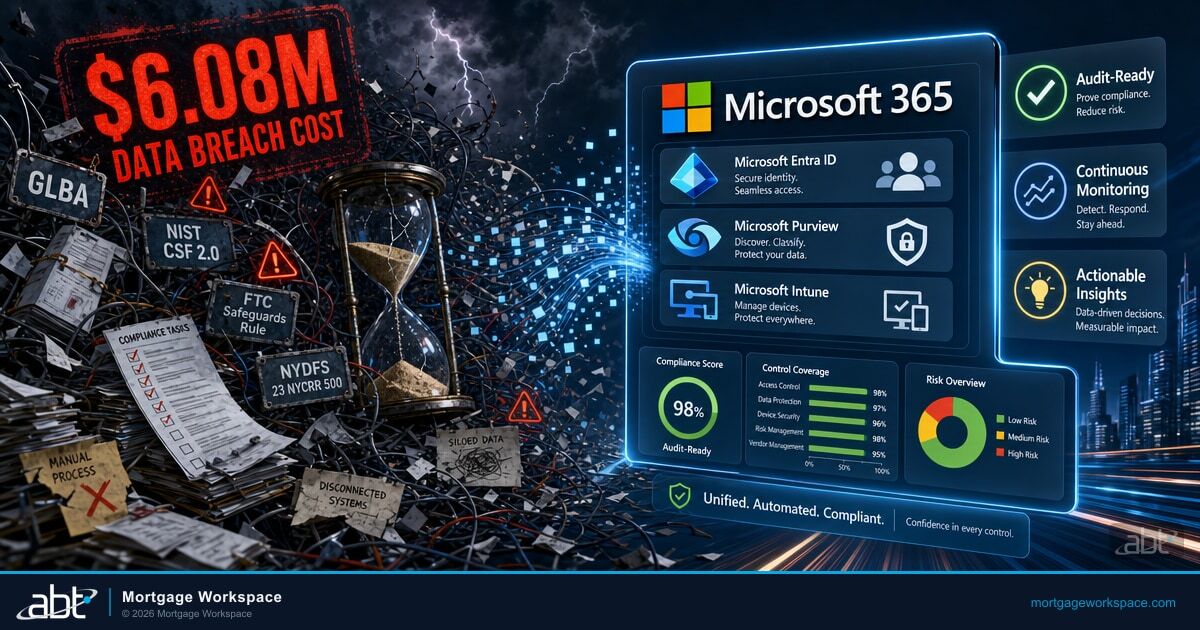
The FTC Safeguards Rule requires your Qualified Individual to report compliance status to the board in writing at least annually. Fannie Mae's Information Security and Business Resiliency Supplement (effective August 12, 2025) requires officer attestation across 14 security domains and cyber breach reporting within 36 hours of identification. Executives who sign attestations they do not understand carry real legal exposure.
Cyber insurance pricing is tied to control evidence
Delinea's 2026 cyber insurance trends report found 70 percent of respondents saw cost increases at application or renewal, up from 50 percent the year before. Underwriters now treat phishing-resistant MFA, 24/7 endpoint detection and response, and tested incident response plans as required, not recommended. Weak documentation means higher premiums or denied claims.
Board questions are getting specific
"Are we secure?" is no longer the question. Boards now ask: "What percentage of our users have completed MFA enrollment? How many unmanaged devices connected to our network this quarter? What changed since last audit?" The IBM Security 2025 Cost of a Data Breach Report put the average financial services breach at $5.56 million, the second-highest industry behind healthcare, which sharpens every board-level question.
The Communication Gap Between IT and Leadership
Your IT team works hard. They configure Conditional Access policies, respond to alerts in Microsoft Defender, manage Intune device baselines, and audit Microsoft 365 settings against Microsoft Secure Score recommendations. But the reports they produce are built for technical audiences.
A typical IT report might say: "Conditional Access policy CA-003 excludes 12 service accounts from MFA enforcement due to legacy authentication requirements." An executive reads that and has no idea whether it is a minor technicality or a critical exposure. Continuous monitoring closes the time gap, but it does not close the language gap.
Guardian Security Insights bridges the gap by presenting the same underlying data in two views. IT receives the technical detail. Executives receive a percentage-based scorecard, named gaps, and trend lines they can repeat to a board.
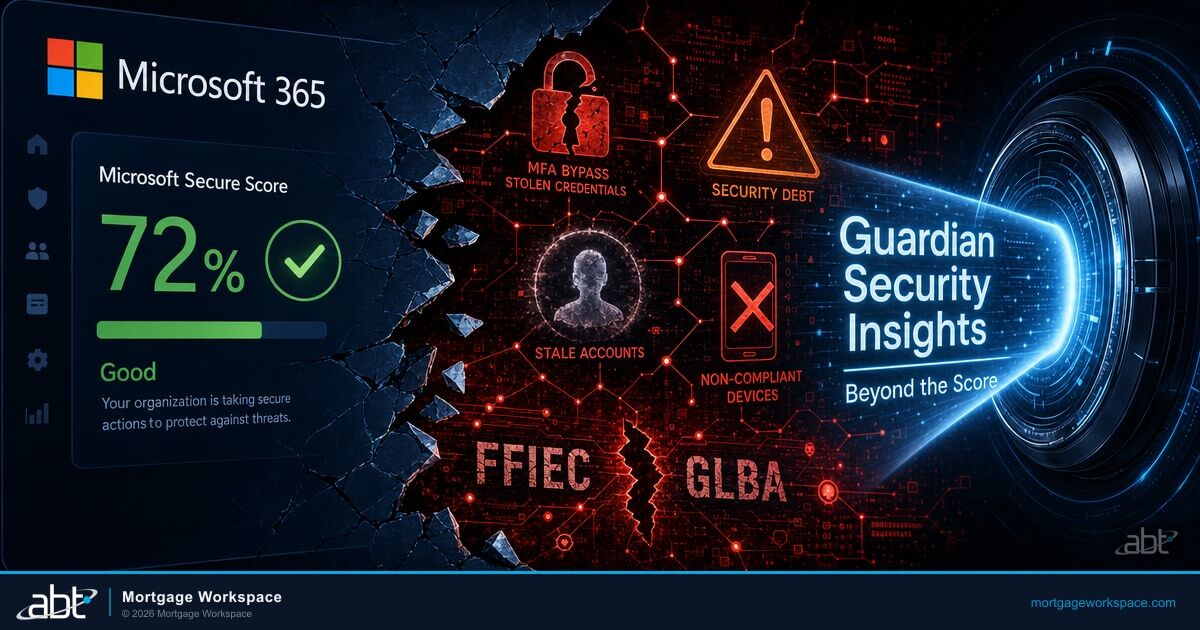
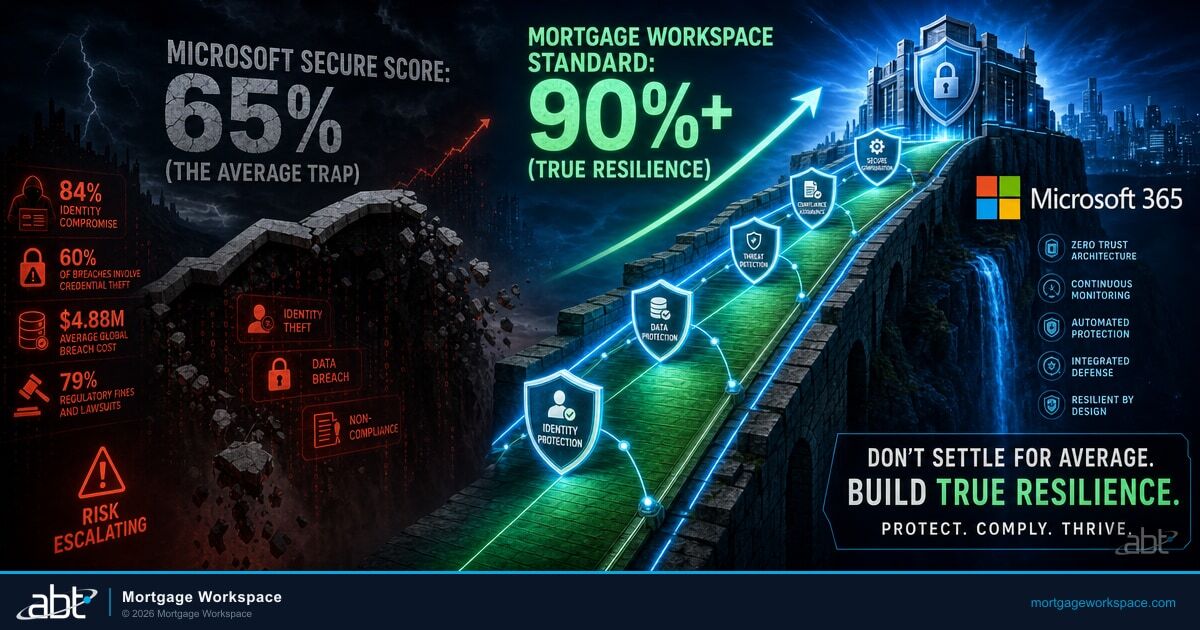
Microsoft Secure Score itself reports posture on a 0–100 percent scale by pillar, and the underlying telemetry feeds every Guardian Security Insights view. The Microsoft Learn page on Secure Score describes the five posture pillars (Identity, Devices, Apps, Data, Infrastructure). Guardian inherits those pillars and adds the executive-friendly layer on top.
Microsoft's published data on multi-factor authentication is unchanged in 2026: enabling MFA blocks more than 99.9 percent of identity-based account compromise attempts at the protocol layer. The variable is not whether MFA works. It is whether your tenant has enforced it on every active user, with no legacy-protocol carve-outs and no orphaned service accounts. The Guardian Security Insights enrollment view names the users who still have policies applied but have not completed enrollment, so the gap closes rather than persists.
Source: Microsoft Entra ID engineering blog and Microsoft Secure Score documentation. Stats refer to the pre-onboarding state observed across the broader FI market, not the managed M365 Guardian footprint.
What Guardian Security Insights Shows Executives
1. Security Posture at a Percentage
Guardian translates your Microsoft 365 security configuration into a percentage-based scorecard. Categories include Identity, Devices, Apps, Data, and Infrastructure, the same five pillars Microsoft uses to compute Secure Score. Each category shows its current percentage and a trend arrow. You see immediately whether your organization is improving, holding steady, or drifting backward, and how you compare to the financial services peer cohort. Peer comparison is presented as grading on a curve: above-average is meaningful only if the curve itself meets a defensible threshold for credit unions, banks, and mortgage companies.
2. MFA Coverage: The Number That Matters Most
Multi-factor authentication blocks more than 99.9 percent of account compromise attempts at the protocol layer, but "MFA enabled" and "MFA enrolled" are different things. Guardian shows the gap. If 200 users have Microsoft Entra ID Conditional Access policies applied but 23 have never completed enrollment, Guardian names those 23 users. That number belongs in every board presentation.
3. Stale Accounts and Unmanaged Devices
Former employees who still have active accounts. Contractors whose access was never revoked. Personal devices that connect to your network but bypass your Microsoft Intune baselines. Guardian quantifies these risks against your Microsoft Entra ID and Intune data and tracks remediation progress over time. The categories map cleanly to the regulators' control families covered in our Guardian Security Insights compliance walkthrough.
4. Historical Trend Analysis
A single snapshot tells you where you are. A six-month trend tells you whether your investments are working. Guardian tracks posture month over month using Microsoft Defender XDR and Microsoft Purview Audit data. When a board member asks "what did we get for the $200,000 we spent on security this year?" you have a documented, source-attributable answer.
5. Compliance Readiness Scoring
GLBA, FTC Safeguards Rule, NYDFS Part 500 (with the third-party service provider clarifications NYDFS issued in its October 21, 2025 Industry Letter), and Fannie Mae's 2025 InfoSec Supplement. Guardian maps your current configuration against each framework and shows where you meet the standard and where gaps remain. No guesswork. No scrambling before an audit.
See your own posture, not a generic benchmark
ABT's Microsoft Secure Score walkthrough turns your tenant's actual configuration into a percentage, names the highest-impact missing controls, and shows the trend line your next examiner will ask about. No commitment beyond the session.
Request a posture walkthroughHow ABT's Approach Differs From Standard MSP Reporting
Most managed service providers deliver monthly reports that summarize tickets closed, patches applied, and uptime percentages. Those numbers describe activity. They do not describe security posture.
ABT takes a different approach. As a cloud-first managed service provider and Tier 1 Microsoft Cloud Solution Provider serving more than 750 financial institutions, ABT operates a pure Microsoft technology stack. No ConnectWise. No Kaseya. No SolarWinds. When those platforms suffer breaches or supply-chain incidents, ABT's clients have zero exposure to the affected tooling. Guardian Security Insights pulls its data directly from your Microsoft 365 tenant through native Microsoft Graph and Microsoft Defender XDR APIs. The insights are first-party. The remediation path is direct.
How ABT positions Microsoft 365 vs. Azure
ABT manages your Microsoft 365 tenant under the Tier 1 CSP delegated-admin model. Microsoft owns the underlying infrastructure; ABT operates the tenant against the Guardian operating model. For Azure-hosted environments and applications such as Calyx PointCentral, ABT hosts the workload in a dedicated subscription. That precision matters when an examiner asks who controls what.
Making Security a Board-Level Conversation
KPMG's 2025 Banking Survey: Technology found that security and fraud prevention remain a top investment priority among banking leaders, with 74 percent of respondents working on AI-enabled payments modernization tied explicitly to fraud and security outcomes. Cybersecurity is no longer a back-office IT problem. It is a strategic function with quarterly board attention.
The question is whether your board is making those decisions with real data or with assumptions. Guardian gives you the data, presented at the altitude a board can act on: percentage-based posture by pillar, named users in the MFA gap, named devices outside Intune baselines, mapped compliance state by framework, and historical trend lines that survive turnover on both the IT side and the executive side. The deeper "what changed and why" view sits next to the cybersecurity-as-competitive-advantage framing many of our credit union, bank, and mortgage company customers already use with their own boards.
Bottom line for executives
If your current MSP cannot hand you, in under five minutes, a percentage-based Microsoft Secure Score by pillar, the count of named users in the MFA gap, the count of unmanaged devices, and a trend line for the last six months, your board is making decisions in the dark. That is the gap Guardian Security Insights was built to close, and it is what the M365 Guardian operating model is built around.
Frequently Asked Questions
Credit union, bank, and mortgage company executives should track MFA enrollment completion rates, the number of stale or orphaned accounts in Microsoft Entra ID, unmanaged device connections outside the Microsoft Intune baseline, external data-sharing incidents flagged by Microsoft Purview, compliance posture against the FTC Safeguards Rule and Fannie Mae's 2025 InfoSec Supplement, and historical trend data showing month-over-month changes. These metrics directly affect audit outcomes, cyber insurance pricing, and personal regulatory exposure for the named Qualified Individual.
Guardian Security Insights presents security data in two views from the same underlying Microsoft 365 dataset. IT teams receive detailed technical findings with specific user names, Conditional Access policy configurations, and remediation steps. Executives receive a percentage-based scorecard by Secure Score pillar (Identity, Devices, Apps, Data, Infrastructure), trend arrows showing month-over-month change, and plain-language summaries of what improved and what needs attention. Microsoft Secure Score itself reports on a 0 to 100 percent scale by pillar, and Guardian inherits that scale. Both views update nightly from the same automated tenant scan.
The FTC Safeguards Rule requires every covered financial institution, including credit unions, banks, and mortgage lenders, to designate a Qualified Individual responsible for overseeing and implementing their information security program. The Qualified Individual does not need to be an employee but must have appropriate training and expertise. They are required to report in writing at least annually to the board of directors covering compliance status, risk assessment outcomes, security events, and program recommendations. Guardian Security Insights produces the data the Qualified Individual needs to deliver that report.
Cyber insurance underwriters use security posture evidence to assess risk and set premiums. Microsoft Secure Score gives them a percentage-based posture baseline by pillar. Underwriters then ask for proof of phishing-resistant MFA enforcement, endpoint detection and response coverage, and tested incident response plans. Delinea's 2026 cyber insurance trends report found 70 percent of respondents saw cost increases at application or renewal, up from 50 percent the year before, largely because insurers are now technically verifying these controls rather than accepting attestations. Guardian Security Insights produces the documented, named-user, named-device evidence underwriters demand.
M365 Guardian is ABT's operating model for managing Microsoft 365 tenants for financial institutions. Inside that operating model, Guardian Protect prevents incidents through identity, device, and data policies. Guardian MxDR detects and responds to incidents that get past prevention. Guardian Security Insights is the visibility layer that reports on both, translating Microsoft 365 telemetry into board-ready percentage scorecards, named user and device gaps, and historical trend lines. The three feature families share a single tenant of truth, so the executive view and the IT view always reconcile.
Give your board answers, not assumptions
Your next board meeting will include a cybersecurity question. ABT's Microsoft 365 specialists will walk you through what Guardian Security Insights would show for your tenant, with named users in the MFA gap, named devices outside Intune baselines, and the percentage-based posture by Secure Score pillar your auditors and underwriters now expect.
Talk to a Microsoft 365 specialist