In This Article
- The Cost of Manual Mortgage Data Handling
- How Automated Data Transfer Works in Mortgage Lending
- MortgageExchange: The Best-Kept-Secret Integration Layer
- Five Business Impacts of Automation
- A Practical Implementation Sequence
- Mortgage BI and M365 Guardian: Measuring and Securing the Flow
- Frequently Asked Questions
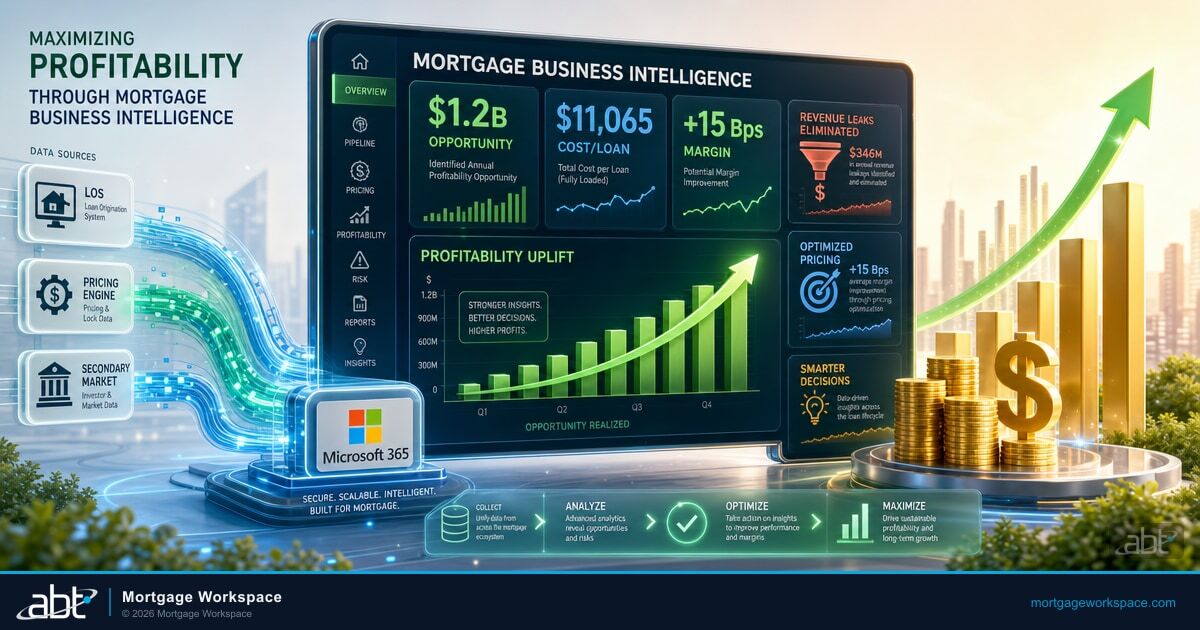
Mortgage origination costs exceed $11,000 per loan. A chunk of that cost comes from manual data handling: processors re-entering borrower information into the LOS, the core, the AUS, and the CRM; verifiers calling employers; and underwriters waiting for documents that should already be in the file. Automated data transfer cuts through all of it, when the integration layer between systems is built to carry it. That integration layer is the part most lenders underestimate, and it is what Access Business Technologies has built and operated for more than 750 financial institutions through a product called MortgageExchange.
Why This Matters for Lenders Right Now
- Manual re-entry between the LOS, core banking, AUS, and CRM is the hidden cost in a $11,000 per-loan origination number, and the single biggest driver of compliance gaps that auditors flag.
- Equifax's February 2026 Market Pulse ties strategic verification automation directly to recovering a meaningful share of the industry's 45% loan fallout rate.
- The integration layer is the bottleneck, not the verification vendors themselves. Lenders that solve the integration layer pull days out of time-to-close. Lenders that do not solve it stay stuck in spreadsheet-and-email reentry between systems they already paid for.
This guide explains how automated data transfer works in mortgage lending, what it replaces in your current process, and how ABT runs the integration layer that connects your LOS to your core, your AUS, your CRM, and your verification services without forcing your team to maintain custom code.
The Cost of Manual Mortgage Data Handling
Manual mortgage processing has four recurring cost centers that automation eliminates.
Document Collection Delays
Borrowers receive a list of required documents: pay stubs, W-2s, bank statements, tax returns. They dig through email, download PDFs from their bank's website, and forward everything piecemeal. Some documents arrive day one. Others take a week. Processing stalls until the file is complete. Every day a loan sits waiting is a day of locked-in rate risk and delayed revenue. For lenders with rate lock periods, document delays can push loans past their lock expiration and trigger costly extensions.
Verification Bottlenecks
Employment verification requires contacting employers directly. Income verification means cross-referencing pay stubs against tax returns. Asset verification demands matching bank statement balances to application claims. Each verification step involves phone calls, emails, and waiting periods. Equifax's analysis shows that full verification at application is one of the primary drivers of the 45% loan fallout rate. Borrowers abandon the process because it takes too long. Strategic timing of verifications can recover a meaningful portion of those lost loans.
System-to-System Reentry
This is the cost center most lenders never put a dollar amount on, because nobody has the time to measure it. A processor types borrower information into the LOS. Then again into the core banking system to set up the account. Then again into the AUS to run the eligibility check. Then again into the CRM so the loan officer can see the status. Every system has its own field structure. Every keystroke is a chance to misspell an employer name, transpose a digit in a Social Security number, or enter monthly income where annual income belongs. These errors compound through the pipeline and surface later as underwriting conditions, compliance flags, and re-disclosures.
Compliance Documentation Gaps
When data enters the loan file through manual channels, the audit trail depends on whoever handled the data that day. Automated transfers create machine-generated logs that show exactly when data was retrieved, from which source, and what values were returned. Manual reentry creates gaps that auditors flag under GLBA, the FTC Safeguards Rule, and state-level requirements like NYDFS 23 NYCRR 500.
How Automated Data Transfer Works in Mortgage Lending
Automated data transfer connects your loan origination system to authoritative data sources through APIs and to the rest of your stack through an integration layer. The two are different problems. Verification vendors give you the data. The integration layer carries it.
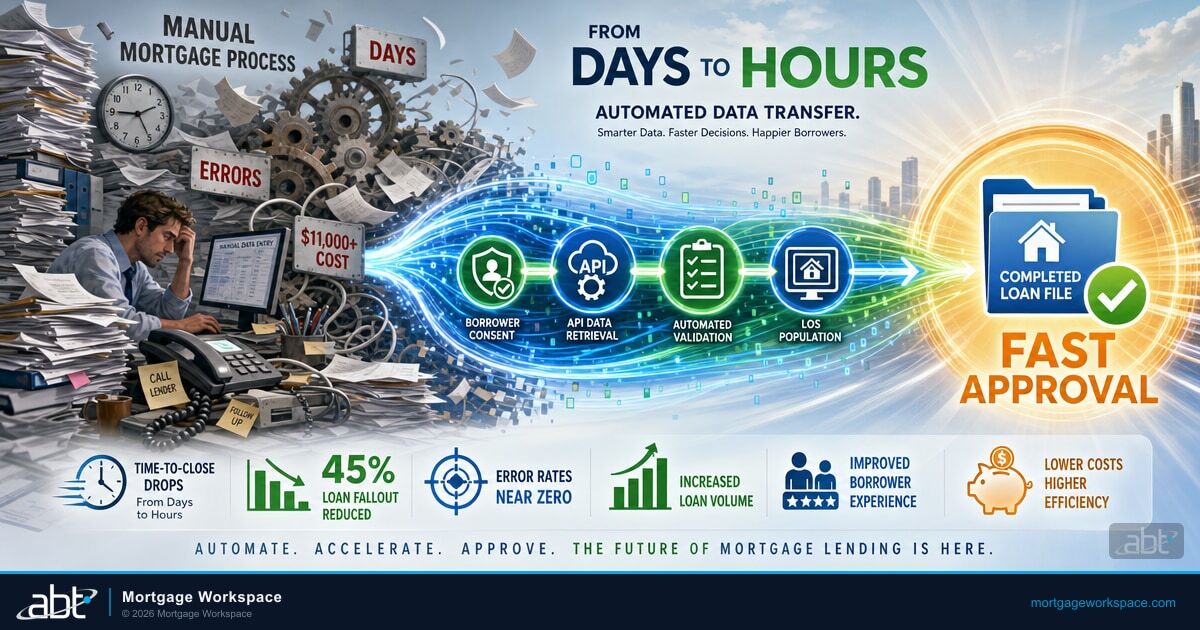
The Core Flow
- Borrower consent: The applicant authorizes data retrieval through a secure portal. Consent is logged and timestamped for compliance.
- Direct source retrieval: The system pulls data from payroll providers, bank account aggregators, tax transcript services, and employment databases.
- Automated validation: Retrieved data is cross-referenced against application claims. Income matches. Employment dates align. Asset balances are confirmed.
- System-to-system propagation: Verified data flows directly into the loan file in the LOS and from there into the core, the AUS, and the CRM through the integration layer. No spreadsheets, no email handoffs, no manual reentry.
What Gets Automated
- Income verification: Direct connections to payroll providers (The Work Number, ADP, Gusto) retrieve current pay data without employer phone calls.
- Asset verification: Bank account aggregation services (Plaid, Finicity, Yodlee) pull real-time account balances and transaction history.
- Employment verification: Automated database queries confirm current employment status, start dates, and job titles.
- Tax transcript retrieval: IRS 4506-C processing and automated transcript delivery replace weeks-long manual requests.
- Identity verification: Automated ID checks cross-reference application data against credit bureau records and government databases.
- System-to-system propagation: Verified data is carried from the LOS into the core, the AUS, and the CRM through a maintained integration layer rather than spreadsheet exports or email attachments.
MortgageExchange: The Best-Kept-Secret Integration Layer
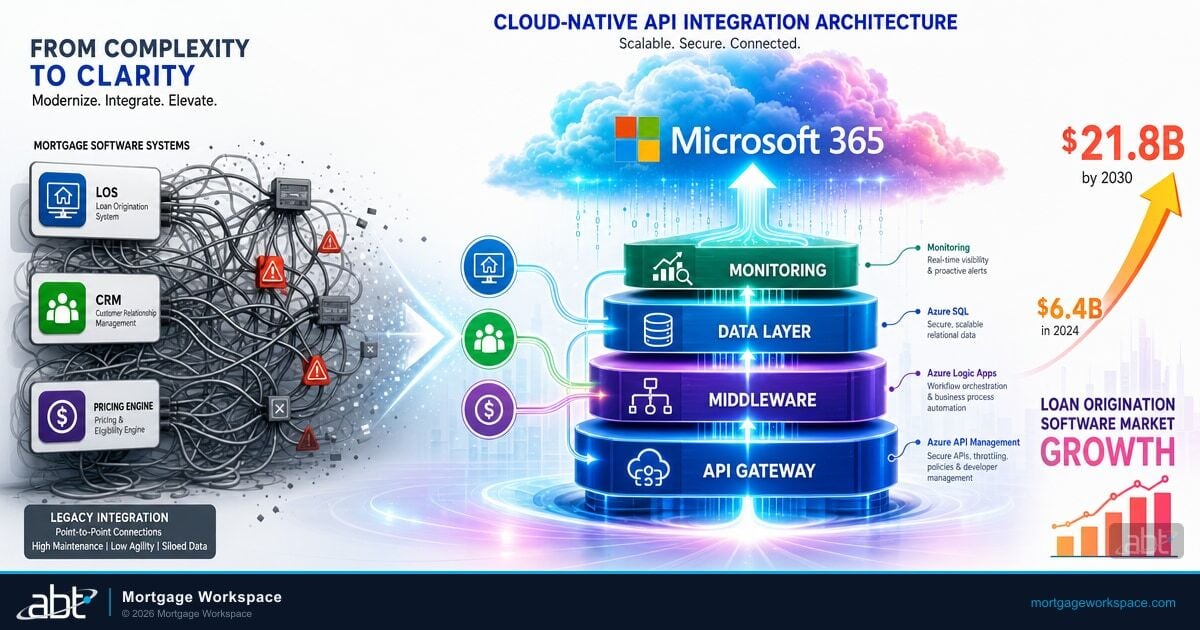
The data-transfer story most lenders hear from vendors covers the verification step only. The verification vendor pulls payroll data, asset data, or tax transcripts into the LOS. That is one hop. The actual mortgage operation has several more hops: from the LOS into the core banking system so the borrower's account is set up, from the LOS into the AUS so the eligibility decision can run, and from the LOS into the CRM so the loan officer's pipeline reflects the status. Each of those hops is where most lenders fall back into manual reentry, spreadsheet exports, and email handoffs.
MortgageExchange is the integration layer ABT has built and operated for that gap. It is a managed interface product that connects loan origination systems like Encompass to core banking systems, automated underwriting systems, customer relationship management platforms, document repositories, and the verification services that feed the LOS in the first place. The lender does not maintain the integration code. ABT does. When a payroll vendor changes its API, when Encompass releases a Developer Connect update, when the core banking platform pushes a schema change, MortgageExchange absorbs the change so the data flow keeps running. The name "MortgageExchange" reflects what it does: it is the exchange layer that moves mortgage data between systems that otherwise would not talk to each other reliably. For lenders that have spent years stitching their stack together with custom code and brittle exports, the realization that ABT has been quietly operating this layer for 750+ institutions is the part Justin Kirsch has called the mortgage industry's best-kept secret. For ABT's fuller take, see Tracking Your Mortgage Pipeline Like a Pro.
Five Business Impacts of Automated Data Transfer
1. Time-to-Close Drops Measurably
Lenders using automated verification and a maintained integration layer report cutting days from their average time-to-close. The biggest time savings come from eliminating the document collection wait and the system-to-system reentry that follows it. Instead of chasing pay stubs for three days and then re-typing the verified data into three downstream systems, the borrower consents once and the data lands everywhere it needs to be.
2. Error Rates Fall to Near Zero on Automated Fields
Data pulled directly from sources and propagated by a managed integration layer arrives in the exact format each downstream system expects. No transposition errors. No wrong income period. No misspelled employer names across four systems. The error rate on automated fields drops to the reliability of the source data itself.
3. Loan Volume Capacity Increases Without Headcount
When processors spend less time collecting documents and re-entering data into the core, the AUS, and the CRM, they handle more files. Lenders with automated pipelines absorb volume increases without proportional headcount growth. That is the productivity unlock and it is the lead reason loan operations directors call ABT in the first place.
4. Borrower Experience Improves
Borrowers who authorize automated data retrieval skip the document hunt. No digging through tax records. No scanning pay stubs. No photographing bank statements. The application process feels modern and fast. That experience drives referrals and repeat business.
5. Compliance Audit Trail Strengthens
Every automated data retrieval and every cross-system propagation generates a timestamped log: source, date, time, data returned, consent record, and destination system. When regulators review loan files under GLBA, the FTC Safeguards Rule, or state-level requirements, the automated trail is what the examiner asks for.
Verification vendors give you the data. The integration layer carries it. MortgageExchange is the layer most lenders did not know existed.
A Practical Implementation Sequence
Step 1: Assess Your Current Verification and Reentry Process
Map the time each verification step takes in your current workflow, then add the time spent on system-to-system reentry after verification completes. Measure document collection time, verification turnaround, and the hours per loan spent typing the same data into the LOS, the core, the AUS, and the CRM. This baseline defines your ROI targets.
Step 2: Select Your Verification Partners
Choose providers for each verification type. Some LOS platforms include built-in connections to verification services. Others require middleware. Key vendors include Equifax (income and employment), Plaid and Finicity (assets), and FormFree (income and asset aggregation).
Step 3: Decide Who Maintains the Integration Layer
Verification connections plug into the LOS. The integration layer that moves verified data from the LOS into the core, the AUS, the CRM, and the document repository is a different problem. Lenders that maintain that layer in-house pay engineers to keep up with schema changes across every system they touch. Lenders that buy that layer as a managed service pay a single integration partner. ABT operates MortgageExchange as that managed-service layer for 750+ financial institutions.
Step 4: Configure Verification Timing
Not every verification needs to happen at application. Equifax's research suggests delaying some verifications until loan commitment to reduce costs on loans that would fall out anyway. Configure your workflow to run credit and basic eligibility checks first, then trigger full income and asset verification when the loan reaches a meaningful milestone.
Step 5: Pilot and Measure
Run 50 to 100 loans through the automated pipeline. Compare time-to-underwriting, error rates, and borrower satisfaction against your manual baseline. Adjust verification timing and integration triggers based on the results.
Step 6: Scale and Monitor
Roll out automation across the full loan pipeline. Monitor daily error rates, API uptime, and verification turnaround. Set alerts for service degradation so the team can fall back to manual verification when a vendor has an outage. With MortgageExchange in the middle, that monitoring is part of the managed service.
Mortgage BI and M365 Guardian: Measuring and Securing the Flow
The integration layer is the first half of the value. The second half is making the time savings visible to the loan operations leader and making the data flow secure enough that the chief compliance officer can defend it under examination. ABT runs both of those layers as a managed service. This connects closely to The Secret to Effective Mortgage Operations.
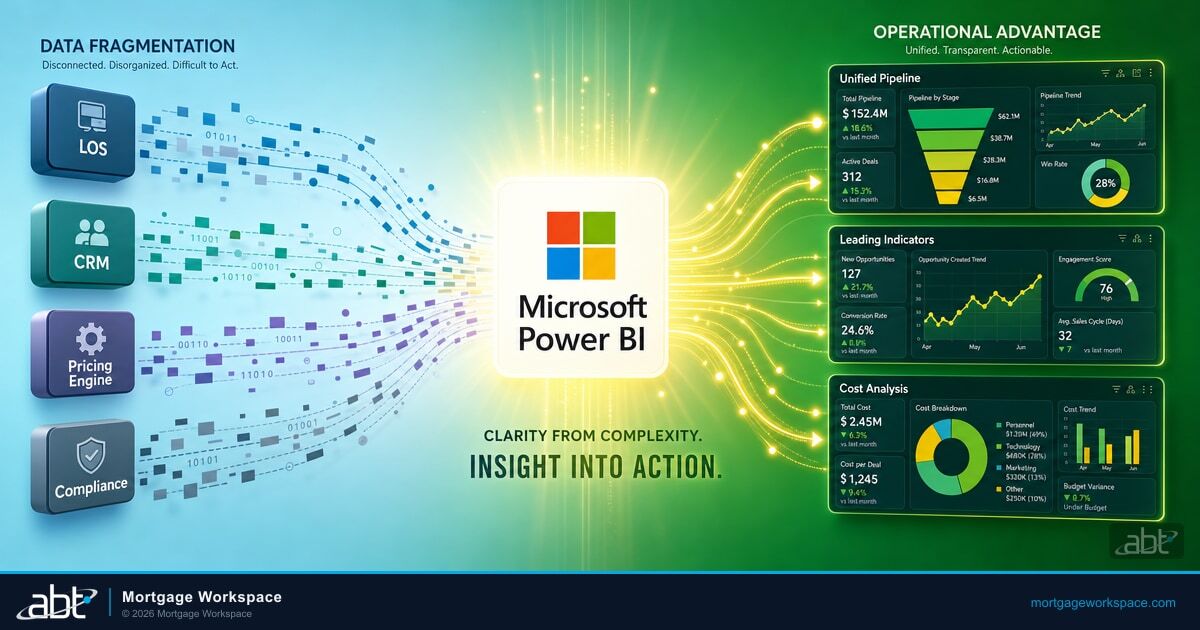
Mortgage BI is ABT's mortgage-specific business intelligence layer. It pulls operational data from MortgageExchange, the LOS, the core, and the verification services, and produces the dashboards a director of mortgage operations actually uses: time-to-close trended over the last 12 weeks, verification turnaround by vendor, fallout rate by loan officer, file-touch counts per processor, and the error rates that show whether a recent schema change has broken something upstream. The time savings from automation only land on the P&L if leadership can see them. Mortgage BI makes them visible.
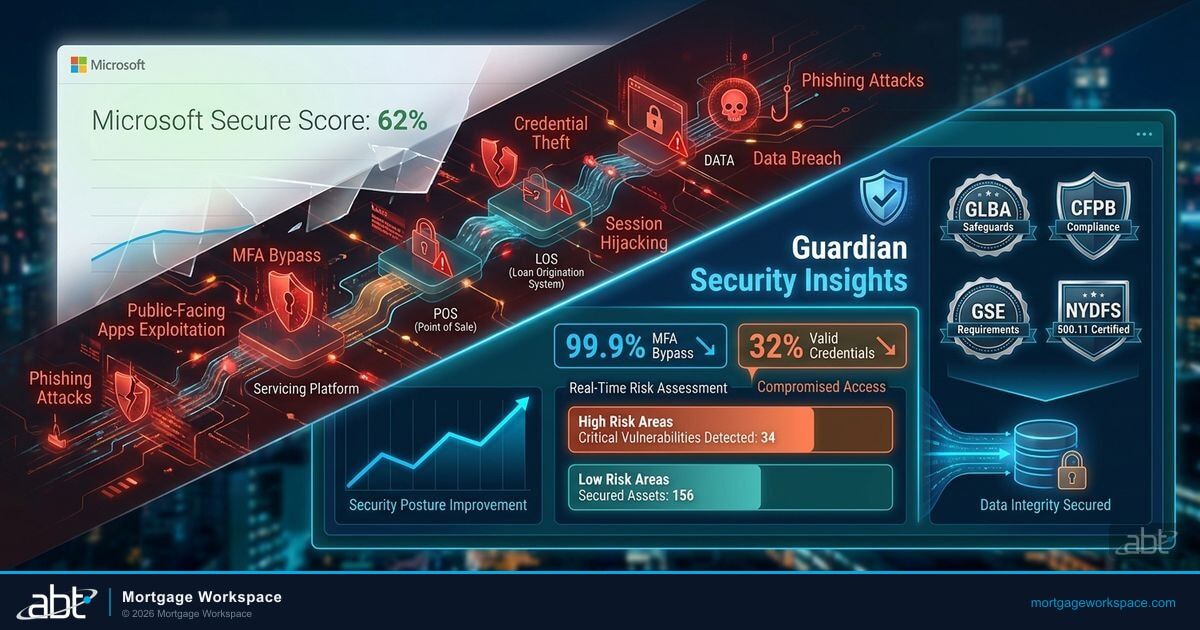
M365 Guardian is ABT's managed operating model on top of Microsoft 365 and the integration layer. The verified borrower data flowing between systems is nonpublic personal information under GLBA and protected data under the FTC Safeguards Rule. M365 Guardian governs that flow with Microsoft Entra ID Conditional Access for identity, Microsoft Purview retention and audit for the data the integration layer touches, Microsoft Defender for Office 365 and Defender for Endpoint for the endpoints and inboxes where borrower records land, and Microsoft Sentinel for the SIEM that aggregates signals from all of it. The data-transfer automation makes the lender faster. M365 Guardian keeps the faster operation defensible when an examiner asks how the data is protected from collection to retention. See also our breakdown of Microsoft 365 for Mortgage Industry.
A processor receives a verified income return from the payroll vendor through Encompass. The processor then types the verified income figure into the core banking system, the AUS, and the CRM. Two of the four entries are slightly different because the source system rounds to whole dollars and the CRM displays cents. Underwriting opens a condition. The loan officer's CRM pipeline shows a different DTI than the AUS. The borrower notices the inconsistency and calls. Two hours of operations time later, the discrepancy is resolved.
The same verified income return arrives in Encompass. MortgageExchange propagates the value, in the source format, to the core, the AUS, and the CRM in the same transaction. Mortgage BI shows the entry in all four systems with a single timestamp. The compliance audit trail logs the source, the destination, and the user who initiated the data flow. M365 Guardian protects the data at rest and in transit. The processor moves on to the next file.
Talk to a Mortgage Integration Specialist
ABT runs MortgageExchange, Mortgage BI, and M365 Guardian for more than 750 financial institutions, including independent mortgage banks, credit union mortgage divisions, and bank mortgage subsidiaries. A 30-minute conversation maps how the integration layer would connect your current LOS, core, AUS, and CRM, what the integration assessment looks like, and what an ABT-managed deployment covers. No commitment, no quote, no obligation.
Key Takeaway
Automated verification is the headline story most lenders hear. The integration layer that carries verified data from the LOS into the core, the AUS, and the CRM is the part that actually returns time to operations. MortgageExchange is the managed integration layer ABT has run for 750+ financial institutions, Mortgage BI surfaces the productivity gain to leadership, and M365 Guardian governs the data flow so the faster pipeline holds up under GLBA, the FTC Safeguards Rule, and state-level scrutiny.
Frequently Asked Questions
Automated data transfer speeds up the verification process from days to minutes, keeping borrowers engaged instead of losing them to frustration or competing offers. By timing verifications strategically, lenders avoid spending resources on loans likely to fall out early. A managed integration layer like MortgageExchange compounds the gain by eliminating the system-to-system reentry that absorbs the time saved at the verification step. Faster processing also compresses the window where rate changes or life events cause borrowers to abandon applications.
MortgageExchange is ABT's managed integration layer that connects the loan origination system to the core banking platform, the automated underwriting system, the customer relationship management platform, the document repository, and the verification services that feed the LOS. A verification vendor like Equifax, Plaid, or FormFree retrieves source data into the LOS. MortgageExchange carries that verified data into every other system in the lender's stack so the value lands without manual reentry. ABT maintains the integration code so the lender does not pay engineers to keep up with schema changes across every system the loan touches.
GLBA requires protection of borrower nonpublic personal information during collection, transfer, and storage. The FTC Safeguards Rule mandates specific security controls for financial data handling. State regulations like NYDFS 23 NYCRR 500 add encryption and access requirements. Automated systems must log borrower consent, encrypt all data in transit and at rest, and maintain audit trails for every data retrieval and every cross-system propagation. ABT's M365 Guardian model layers Microsoft Entra ID, Microsoft Purview, Microsoft Defender, and Microsoft Sentinel on top of MortgageExchange so the integration layer carries data inside the same governance perimeter the rest of the lender's Microsoft 365 footprint runs in.
MortgageExchange has been operated across Encompass and other modern LOS platforms with API frameworks, and across the core banking platforms most common in the credit union and community bank market. Older systems without API support may require additional middleware as part of the integration assessment. The first conversation in any ABT engagement maps the lender's actual stack so the integration scope is clear before a quote.
Mortgage BI pulls operational data from MortgageExchange, the LOS, the core, and the verification services and produces dashboards that a director of mortgage operations actually uses. The dashboards trend time-to-close over rolling 12-week windows, surface verification turnaround by vendor, attribute fallout to source, and count file touches per processor so leadership can see whether the automation is returning the hours it promised. Time savings only land on the P&L when leadership can see them. Mortgage BI is the layer that makes them visible.
Implementation costs include verification service fees billed per transaction by the vendors, integration scope by the partner running the integration layer, and configuration time inside the LOS. Lenders that maintain the integration layer in-house pay engineers to keep up with schema changes across every system the loan touches. Lenders that engage ABT for MortgageExchange pay a managed-service fee that covers ongoing integration maintenance, Mortgage BI dashboards, and the M365 Guardian governance layer over the data flow. Most lenders recover implementation cost within three to six months through reduced processing labor and faster closings.
Automated verification replaces most traditional document collection for standard loan types. Income, employment, and asset data can be retrieved directly from sources, then carried into the rest of the lender's stack by an integration layer like MortgageExchange. Some loan programs and investor requirements still mandate original documents for specific conditions. A well-designed workflow uses automated verification and propagation as the default and falls back to document collection only when program guidelines require it.