In This Article
- Why Microsoft 365 Is the Standard for Mortgage Email
- A Mortgage-Office Email Configuration Pattern
- Microsoft Defender for Office 365 and Microsoft Purview for Mortgage NPI
- Best Practices for Ongoing Email Management
- Why Secure Email Is Non-Negotiable
- M365 Guardian and MortgageWorkSpace as the Mortgage Email Baseline
- Frequently Asked Questions
The FBI logged over 859,000 internet crime complaints in 2024 with reported losses exceeding $16 billion. Financial services phishing accounts for 27.7% of all phishing attempts. For mortgage offices handling Social Security numbers, bank statements, pay stubs, and loan applications, email is the primary attack surface and the surface examiners look at first. Access Business Technologies manages Microsoft 365 tenants for 750+ financial institutions, and mortgage shops are a core part of that footprint.
Why ABT Manages Mortgage Email on Microsoft 365
- Mortgage-specific DLP and sensitivity-label policies tuned to borrower NPI patterns (Social Security numbers, loan numbers, bank statement attachments, pay stub uploads) rather than generic SMB templates.
- Microsoft Defender for Office 365 anti-impersonation policies configured for the actual roles attackers target in mortgage shops: loan officers, processors, closing coordinators, and the title or wire transfer contacts that handle settlement funds.
- SPF, DKIM, and DMARC enforcement deployed and monitored across the firm's primary and branch sending domains, with quarterly review against the latest authentication failure reports.
Microsoft 365 ships the controls. The work is configuring them for a mortgage office: tuning data loss prevention to borrower information patterns, hardening identity with Microsoft Entra ID Conditional Access, applying Microsoft Purview retention to the right mailboxes, and pointing Microsoft Defender for Office 365 at the impersonation patterns that hit lenders specifically. This article walks through the configuration pattern a Tier-1 Cloud Solution Provider applies for mortgage shops, then explains how M365 Guardian and MortgageWorkSpace combine into ABT's productized email + security baseline for the industry.
Why Microsoft 365 Is the Standard for Mortgage Email
Microsoft 365 is more than an inbox. It is a compliance-ready platform with built-in security controls that map directly to mortgage regulatory requirements under the FTC Safeguards Rule, the GLBA Safeguards Rule, and the state-level frameworks lenders operate inside (NYDFS Part 500, the FFIEC Information Security Booklet for federally examined institutions, and the state mortgage examiner frameworks that look to those models). Our guide to Microsoft 365 Copilot Buyer's Guide for Mortgage Lenders goes deeper on this.
Built-In Compliance and Security
Mortgage offices handle vast amounts of sensitive financial information. Microsoft 365 ships with encryption in transit and at rest, advanced threat protection through Microsoft Defender for Office 365, and compliance frameworks aligned with GLBA, SOC 2, and ISO 27001. Microsoft Purview Compliance Manager includes regulatory templates specifically for GLBA and the FFIEC Information Security Booklet, and produces the gap reports a compliance officer can hand to an examiner.
Real-Time Collaboration Without Compliance Risk
Loan officers and processors share documents throughout the origination process. OneDrive and SharePoint provide secure file storage with version history and access controls. Microsoft Teams replaces unsecured email threads for internal coordination on borrower files. Every document edit is tracked, creating audit trails that survive regulatory review.
Access from Anywhere, Secured Everywhere
Remote and hybrid work is standard in mortgage operations. Microsoft 365 cloud-based access works across desktop, tablet, and mobile. Conditional Access policies in Microsoft Entra ID restrict access based on device compliance, location, and risk level. A loan officer reviewing a borrower file from home gets the same security enforcement as someone in the branch office.
Integration with Mortgage Software
Microsoft 365 connects with loan origination systems through APIs and Power Automate workflows. Borrower communications, document routing, and compliance notifications flow through a unified platform rather than disconnected point solutions, and the audit trail stays inside the firm's Microsoft 365 footprint. This connects closely to Microsoft 365 for Mortgage Industry.
A Mortgage-Office Email Configuration Pattern
The configuration pattern below is what a Tier-1 Cloud Solution Provider applies for a mortgage shop on Microsoft 365 Business Premium or higher. The order matters: identity has to settle before mailbox-level policies are meaningful, mailbox policies have to settle before threat-detection rules become signal rather than noise, and the audit layer has to be in place before the firm produces evidence to examiners.
Loan officers, processors, closers, and managers each get their own Microsoft 365 account. Shared logins destroy audit trails and violate the FTC Safeguards Rule access control requirements. Distribution lists handle internal routing; borrower-facing communication stays on individual mailboxes for traceability.
Set impersonation protection for the roles attackers actually target in mortgage shops: the CEO, the CFO, the controller, and the wire-transfer and title coordinators. Wire fraud against mortgage borrowers consistently shows up in FBI Internet Crime Report data, and impersonation policies catch the messages that look like they came from the inside.
Build DLP policies that detect Social Security numbers, bank account details, loan numbers, and loan application data in outbound mail. The policies alert the sender before the message leaves the tenant, route the message through Microsoft 365 message encryption if the recipient is external, or block delivery outright for the highest-risk patterns.
Sensitivity labels travel with the document and the email body. Apply labels for "Borrower NPI", "Internal Only", and "External Authorized" so the same protection follows the loan file whether it lives in Outlook, OneDrive, or a SharePoint loan-file library, and so the encryption is enforced at the file level instead of relying on the sender to remember to encrypt.
Outlook Message Encryption keeps loan documents and borrower correspondence confidential in transit. External recipients open encrypted email through a secure portal, which doubles as the audit trail showing who accessed the file and when.
These email authentication protocols stop attackers from spoofing the firm's domain in phishing campaigns aimed at borrowers and title companies. DMARC enforcement tells receiving mail servers to reject or quarantine messages that fail authentication checks. Most mortgage shops have one primary sending domain and several branch or DBA domains; every one needs the full SPF + DKIM + DMARC stack.
The FTC Safeguards Rule requires MFA for anyone accessing customer information, including desktop access, not just web applications. Deploy Microsoft Authenticator for push-based MFA at minimum. For high-risk accounts (administrators, finance, wire-transfer roles), implement FIDO2 security keys that resist phishing proxy attacks. NYDFS Part 500 amendments require universal MFA for all system access with first certification due April 2026.
Microsoft Defender for Office 365 and Microsoft Purview for Mortgage NPI
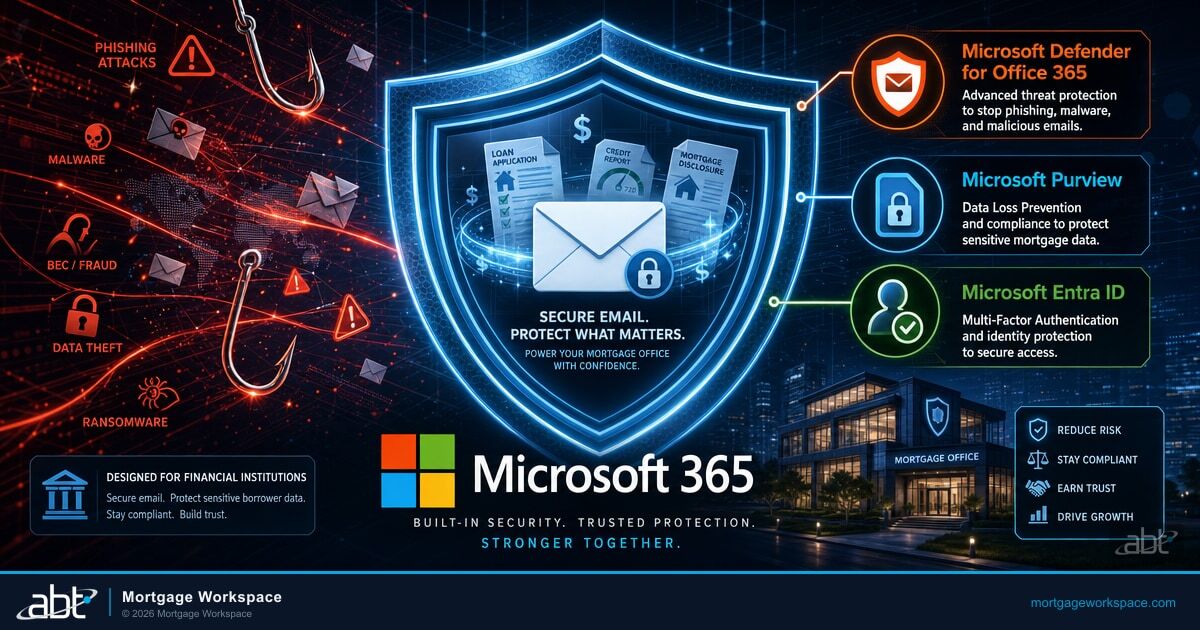
The two Microsoft services that carry the most weight in mortgage email security are Microsoft Defender for Office 365 and Microsoft Purview. Both ship with Microsoft 365 in the appropriate license tier, and both need configuration tuned to the mortgage shop's actual risk profile rather than vendor SMB defaults. Microsoft Defender for Office 365 handles the active threat side: anti-phishing, anti-impersonation, Safe Attachments, and Safe Links policies tuned to the wire-fraud and title-spoof patterns mortgage offices see in real attacks. Microsoft Purview handles the data-protection and audit side: Data Loss Prevention rules calibrated to borrower NPI patterns (Social Security numbers, bank account formats, loan numbers, pay stub keywords), sensitivity labels that follow the loan file from Outlook to OneDrive to SharePoint, and Microsoft Purview Audit producing the time-stamped trail of who touched what and when.
The combination is the point. Microsoft Defender for Office 365 stops the message before it hits the loan officer's inbox; Microsoft Purview Data Loss Prevention stops the borrower NPI before it leaves the tenant unencrypted; Microsoft Purview sensitivity labels keep the borrower file protected after it lands outside Outlook in OneDrive or SharePoint; and Microsoft Purview Audit produces the evidence a state mortgage examiner or an FTC Safeguards Rule auditor accepts. None of this works at vendor defaults. The configuration has to map to mortgage-specific data patterns, role-based impersonation profiles, and the retention windows that GLBA and state mortgage regulators expect. That mapping is the operating work a managed Microsoft 365 partner does for the firm.
Microsoft ships the controls. The configuration tuned to mortgage NPI, role-specific impersonation patterns, and the firm's actual sending domains is the operating work.
A configured Microsoft 365 email environment for a mortgage shop ties together five Microsoft surfaces. Microsoft Entra ID supplies the identity layer (MFA, Conditional Access, sign-in risk, device-compliance gating). Microsoft Defender for Office 365 handles anti-phishing, anti-impersonation, Safe Attachments, and Safe Links for the inbound side. Microsoft Purview Data Loss Prevention rules detect borrower NPI patterns in outbound mail and sensitivity labels keep the protection on the loan file after it leaves Outlook. Microsoft Purview Audit produces the time-stamped trail across Exchange Online, SharePoint Online, OneDrive, and Teams that a state mortgage examiner or an FTC Safeguards Rule audit expects. Microsoft Intune closes the device-compliance loop so unmanaged personal devices cannot pull a borrower file from the tenant. ABT applies, monitors, and documents the full configuration across every Microsoft 365 tenant in the mortgage industry footprint we manage, and layers M365 Guardian on top as our mortgage-tuned operating model.
Best Practices for Ongoing Email Management
Establish Retention Policies
Mortgage offices must retain emails for legal and regulatory compliance. Microsoft Purview retention policies archive mail automatically based on content type and age. GLBA, the FTC Safeguards Rule, and state mortgage regulators specify minimum retention periods. Automated policies prevent accidental deletion and reduce storage clutter, and the policies travel with the mailbox if a loan officer moves between branches.
Run Monthly Security Audits
Email security is not a one-time configuration.
- Review Microsoft Secure Score recommendations in the Microsoft 365 admin center monthly.
- Audit administrator privileges quarterly. Remove accounts that no longer need elevated access.
- Check for inactive accounts and deactivate them. Dormant accounts are attack targets.
- Review email forwarding rules. Unauthorized auto-forwarding to external addresses is a hallmark of compromised mortgage email accounts.
Train Staff with Real Phishing Simulations
Annual compliance videos do not change behavior. Monthly phishing simulations using Microsoft Attack Simulation Training give staff hands-on experience spotting targeted emails. Scenarios should include invoice fraud, vendor portal updates, title-company impersonation, and wire-transfer requests specific to mortgage workflows.
Integrate with Mortgage-Specific Tools
- Electronic signature platforms like DocuSign or Adobe Sign deliver loan document signatures directly through Outlook with the audit trail preserved in Microsoft 365.
- Power Automate workflows route loan status updates, compliance reminders, and borrower notifications without manual email handling.
- MortgageWorkSpace, ABT's mortgage industry brand, layers mortgage-specific monitoring and reporting on top of the configured Microsoft 365 environment.
Why Secure Email Is Non-Negotiable
The average cost of a data breach in financial services is $4.4 million. For a mid-size mortgage company, that figure can mean closure.
In November 2025, the SitusAMC breach exposed mortgage loan data across hundreds of financial institutions through a single vendor compromise. The attack vector: unauthorized access to systems that processed email, documents, and accounting records. Every mortgage office that relied on that vendor's security was exposed by extension.
A properly configured Microsoft 365 email environment reduces that risk at every layer. Encryption protects data in transit. Microsoft Purview Data Loss Prevention prevents accidental exposure of borrower NPI. Conditional Access in Microsoft Entra ID restricts who can reach the tenant. Microsoft Defender for Office 365 catches threats before they reach inboxes. The configured baseline is the difference between a firm that demonstrates control to examiners and a firm that is one shared password away from an FTC referral.
Configuration alone is not the full picture. Ongoing monitoring, policy tuning, and incident response require dedicated expertise.
A state mortgage examiner asks for a 12-month email retention configuration history, DLP policy match logs for borrower NPI, and Microsoft Defender for Office 365 phishing-block evidence. The compliance officer emails IT. IT exports settings screenshots and Defender threat reports across three different admin portals. The exam stretches into a second review cycle. The firm receives a finding for inconsistent retention and incomplete DLP coverage. See also our breakdown of Migrating to Microsoft 365.
The same exam opens. The Tier-1 CSP partner pulls the consolidated configuration report covering Microsoft Purview retention, Microsoft Purview DLP policy matches, Microsoft Defender for Office 365 blocked-message counts, and Microsoft Entra ID Conditional Access posture for every mailbox in the firm's footprint. The compliance officer produces the audit log extracts on demand. The exam closes on time with no findings on the email surface.
M365 Guardian and MortgageWorkSpace as the Mortgage Email Baseline
ABT manages Microsoft 365 tenants for mortgage companies under the MortgageWorkSpace brand. MortgageWorkSpace is the mortgage industry presentation of the same Microsoft 365 + security baseline ABT operates for 750+ financial institutions. It exists because mortgage shops have a different threat model than community banks and credit unions: more borrower NPI passing through email, more wire-transfer fraud risk at the closing table, more branch-level sending domain sprawl, more interaction with title companies and external borrowers, and a different regulatory geometry that spans the FTC Safeguards Rule, state mortgage regulators, NYDFS Part 500 where applicable, and the GLBA framework that underlies all of it.
That mortgage-tuned baseline has a name: M365 Guardian. Microsoft 365 is the platform. M365 Guardian is ABT's operating model on top of it for mortgage shops. The Guardian layer includes mortgage-specific Conditional Access policies tuned to branch geography and loan officer roles, borrower-NPI DLP and sensitivity-label policies built against actual borrower file patterns rather than generic SMB defaults, Microsoft Defender for Office 365 anti-impersonation profiles configured for the roles attackers target in mortgage shops, retention policies aligned to GLBA and state mortgage regulator expectations, SPF + DKIM + DMARC enforcement across every sending and DBA domain in the firm's footprint, and the monitoring that watches the Microsoft Defender and Microsoft Sentinel signals every day. Together, M365 Guardian and MortgageWorkSpace are ABT's productized email and security baseline for the mortgage industry. The firm keeps its Microsoft 365 licensing and tenant ownership. The Guardian layer is added through the partner relationship.
ABT manages the Microsoft 365 tenants that mortgage shops operate. The firm continues to own its regulatory relationships, its loan officers, and its borrower files. The partner relationship is set up under Granular Delegated Administrative Privileges (GDAP) with least-privilege role grants, an executed vendor oversight agreement that satisfies the FTC Safeguards Rule third-party expectations, and a documented review cadence that produces the evidence the firm's compliance officer needs for examination prep.
Get Your Mortgage Email Environment Reviewed
ABT runs the Microsoft 365 email configuration pattern described in this article for mortgage shops across the United States under the MortgageWorkSpace brand. A 30-minute conversation maps your current tenant configuration, surfaces the gaps a state mortgage examiner is most likely to find, and outlines what an M365 Guardian-managed deployment would cover. No commitment, no quote, no obligation.
Key Takeaway
Microsoft 365 ships the controls a mortgage office needs for email compliance. Microsoft Defender for Office 365 handles the inbound threat surface. Microsoft Purview Data Loss Prevention and sensitivity labels keep borrower NPI protected on the outbound side. Microsoft Entra ID Conditional Access governs identity. Microsoft Purview Audit produces examiner-grade evidence. M365 Guardian is ABT's operating model that applies, tunes, and monitors those controls for mortgage shops, packaged as MortgageWorkSpace for the industry. The firm walks into the next examination with the configuration already mapped to FTC Safeguards Rule, GLBA, NYDFS Part 500, and state mortgage regulator expectations.
Frequently Asked Questions
The FTC Safeguards Rule requires mortgage lenders to encrypt customer information in transit and at rest, implement multi-factor authentication for anyone accessing customer data including desktop and server access, conduct regular penetration testing of applications that handle customer information, and maintain access controls that are periodically reviewed. Lenders must also deploy monitoring and logging to track user activity and detect unauthorized access to email systems containing borrower data. On Microsoft 365, that maps to Microsoft Entra ID Conditional Access for MFA, Microsoft Purview message encryption and DLP for data protection, and Microsoft Purview Audit plus Microsoft Defender for Office 365 for the monitoring trail.
Microsoft Purview Data Loss Prevention scans outbound emails and attachments for patterns matching sensitive data types like Social Security numbers, bank account numbers, loan numbers, and credit card details. When a match is detected, the DLP policy can block the email, require Microsoft 365 message encryption, or notify the sender with a warning before the message is sent. Mortgage offices configure custom DLP policies tuned to loan application data types and borrower NPI patterns rather than relying on the vendor-default SMB rules, so the firm prevents accidental disclosure of borrower information to unauthorized recipients. Sensitivity labels extend the protection by following the loan file from Outlook to OneDrive to SharePoint, so the same encryption stays applied even after the file leaves email.
SPF, DKIM, and DMARC are email authentication protocols that prevent attackers from spoofing the firm's domain in phishing emails aimed at borrowers, title companies, and warehouse lenders. SPF verifies the sending server is authorized. DKIM adds a digital signature that confirms the email was not altered in transit. DMARC ties SPF and DKIM together with a policy that tells receiving servers to reject or quarantine emails that fail authentication. For mortgage companies, domain spoofing is a primary vector for wire fraud and business email compromise schemes targeting closing transactions, and authentication coverage must extend across every primary and DBA sending domain in the firm's footprint.
Microsoft Purview Compliance Manager provides a compliance score for the organization and offers regulatory assessment templates for frameworks including GLBA, the FFIEC Information Security Booklet, the FTC Safeguards Rule, and NYDFS Part 500. It identifies gaps in current configuration, recommends specific improvement actions, and tracks progress toward compliance targets. For mortgage companies, Compliance Manager maps Microsoft 365 settings directly to regulatory requirements and generates documentation useful during state mortgage examinations and FTC Safeguards Rule audits. The score and the gap report are particularly useful when the firm needs to demonstrate continuous improvement to an examiner across cycle reviews.
Microsoft Defender for Office 365 anti-impersonation policies catch the most common wire-fraud pattern in mortgage offices: an attacker spoofs the email display name or domain of an executive, a title company contact, or the closing coordinator and sends payoff or wire-instruction messages that look like they came from a trusted source. The impersonation policy is configured with the specific user and domain pairs that attackers target (the CEO, the CFO, the controller, the wire desk, the title and closing partners the firm works with most often), and Microsoft Defender for Office 365 quarantines or flags messages that match the impersonation pattern before they reach the loan officer or closer. Safe Attachments and Safe Links extend the protection to attachments and embedded URLs that may carry credential-harvesting pages. The configuration must be tuned to the firm's actual executives and partner contacts; vendor defaults catch generic spam but miss the mortgage-specific patterns.
M365 Guardian is ABT's operating model on top of Microsoft 365 for regulated financial services firms, including the mortgage industry under the MortgageWorkSpace brand. Microsoft 365 ships the controls. Guardian is the configured baseline, the monitoring discipline, and the audit-evidence production that turns the controls into an operating posture a mortgage examiner accepts. For mortgage shops, Guardian includes mortgage-specific Microsoft Purview DLP and sensitivity-label policies tuned to borrower NPI, Microsoft Defender for Office 365 impersonation profiles aligned to the roles attackers actually target, SPF plus DKIM plus DMARC enforcement across every sending domain, retention policies mapped to state mortgage regulator and GLBA expectations, and the ongoing monitoring that catches drift before an examiner does. The firm keeps Microsoft 365 licensing and tenant ownership; ABT operates the configured baseline through a Granular Delegated Administrative Privileges (GDAP) partner relationship.