In This Article
- Why Manual Document Processing Breaks at Scale
- How Real-Time Document Uploads Actually Work
- DocumentGuardian: ABT's OCR-Plus-LLM Extraction Pipeline
- MortgageExchange: Routing Verified Data Into the LOS
- App Pilot and Microsoft 365 Copilot: The Managed Operating Model
- Compliance Automation Through Document Intelligence
- ROI Framework for Document Automation
- Frequently Asked Questions
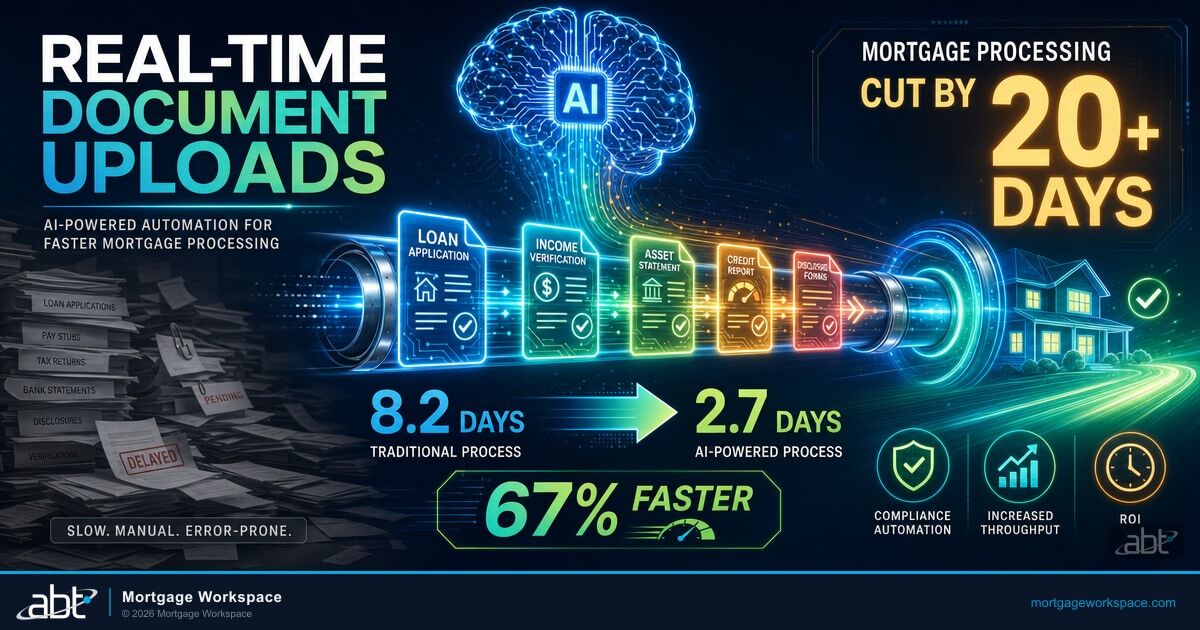
A peer-reviewed study published in late 2025 tested an AI document automation system across 1.2 million mortgage pages spanning 700 document types. Average processing time dropped from 8.2 days to 2.7 days. Loans processed per month jumped from 11,500 to 26,300. Compliance errors fell 78 percent. Those numbers come from a production deployment, not a vendor demo. They reflect a broader shift Gartner projects will pull more than 70 percent of document-heavy financial services workflows into AI automation by 2026.
What This Article Covers
- Why manual intake, classify, extract, and route cycles break once a loan file passes 300 pages and what real-time document uploads replace inside that cycle.
- How ABT DocumentGuardian pairs modern OCR with large language model extraction and rule-driven verification so the data the underwriter sees is already calculated, cross-referenced, and stamped with provenance.
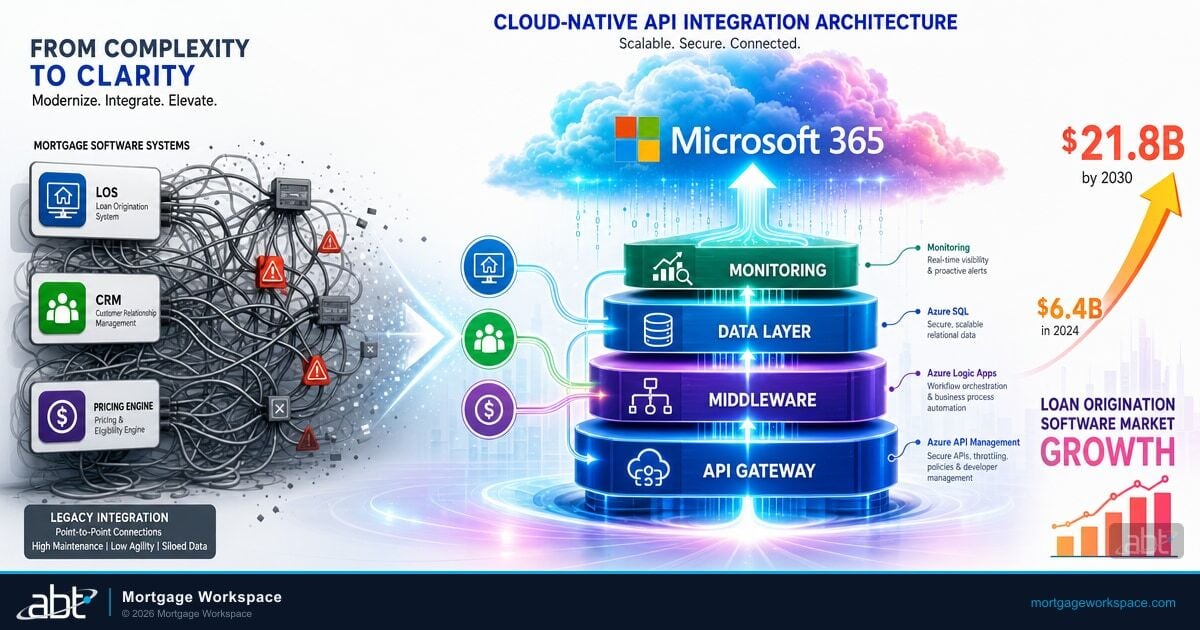
- How MortgageExchange routes the verified data into the loan origination system and on to the core banking platform, closing the integration gap Microsoft does not ship.
- How App Pilot operates the managed pipeline day to day and how Microsoft 365 Copilot surfaces document findings inside Outlook, Teams, and Word where loan officers and processors already work.
For mortgage operations still routing pay stubs, tax returns, and bank statements through manual review queues, the gap between you and your AI-enabled competitors is widening every quarter. The technology to close that gap is production-ready. The harder question is whether the document infrastructure, the loan origination system integration, the security perimeter, and the day-to-day operating model are ready to support it. Access Business Technologies packages that infrastructure as MortgageWorkSpace and manages Microsoft 365 tenants for more than 750 financial institutions, including community banks, credit unions, and independent mortgage banks.
Why Manual Document Processing Breaks at Scale
The average mortgage file holds more documents every year. Expanded borrower verification rules, multi-channel submission methods, and tighter regulatory expectations push a 2026 loan file to roughly double the document count of a file from five years ago. Manual processing cannot keep up. Studies from Deloitte put manual mortgage workflow error rates between 10 and 15 percent. Those errors trigger rework, buybacks, and audit findings that cost more than the processing did.
The bottleneck is not the document. It is the human in the middle. Someone has to open each file, identify what it is, extract the relevant data, verify it against other sources, and route it to the right person. That workflow made sense when loan files were 50 pages. At 300 to 500 pages it is a staffing problem hiring cannot solve. ABBYY documented one global financial institution that found 550,000 hours of rework buried in its mortgage operations once the audit trail came into view.
The fix is not faster typing. The fix is replacing the intake, classify, extract, verify, and route cycle with an automated pipeline that hands the underwriter a complete, verified data set instead of a stack of pages. That pipeline is the subject of the rest of this article.
How Real-Time Document Uploads Actually Work
A real-time document upload system replaces the manual cycle with three layered capabilities operating in seconds rather than days. A borrower uploads a pay stub from their phone. Within seconds the system identifies the document type, extracts the income figures, validates them against data already on the file, and routes the verified data into the loan origination system. The borrower gets immediate confirmation and a specific request for any missing item rather than a vague "please upload additional documentation" message three days later.
The three capabilities behind the pipeline:
| Capability | What it does | What it replaces |
|---|---|---|
| Intelligent Document Processing (IDP) | Classifies incoming documents by type, including multi-page PDFs with mixed content. Modern platforms handle 600 to 700 mortgage document types without manual tagging. | The processor who opens each file, scans it, and labels it before any extraction happens. |
| AI-Powered Extraction | Multi-modal transformer models read the document and understand what the data means, not just what it says. Calculates qualifying income from a Schedule C, validates bank statement transactions add up, and cross-references pay stub amounts against W-2 totals. | The processor who keys data into the loan file by hand and the second processor who checks it. |
| Automated Validation | Flags missing documents, inconsistent data, and potential fraud in real time. Borrowers see what is needed inside the upload experience instead of waiting for a callback. | The phone call three days later asking for a missing W-2 page. |
Modern platforms achieve 95.4 percent extraction accuracy and 97.8 percent classification accuracy in production environments. The exceptions route to human review with the system's analysis attached, so a reviewer spends minutes per file instead of hours. The structural difference between this pipeline and legacy OCR is that the pipeline understands context. Legacy OCR reads text on a page. The pipeline reads the Schedule C, applies the correct GSE qualifying income formula, flags the inconsistency between reported income and bank deposits, and hands the underwriter a complete analysis with provenance attached.
DocumentGuardian: ABT's OCR-Plus-LLM Extraction Pipeline
ABT DocumentGuardian is the document intelligence layer ABT runs for mortgage operations inside a MortgageWorkSpace deployment. It pairs modern optical character recognition with large language model extraction and rule-driven verification, then stamps every output with provenance so an auditor or underwriter can trace any number on the file back to the source document, the extraction logic, and the validation checks it passed. The platform is not a generic IDP product layered on top of a mortgage company's existing chaos. It is configured against mortgage-specific document types, mortgage-specific extraction rules, and mortgage-specific compliance checkpoints, then operated day to day by ABT engineers.
What DocumentGuardian does inside the pipeline:
| DocumentGuardian capability | What it solves for mortgage operations |
|---|---|
| Modern OCR with layout understanding | Reads scanned pages, mobile-phone photos, structured PDFs, and faxed documents. Handles tables, multi-column layouts, and the marginalia mortgage documents carry without losing the data. |
| Large language model extraction | Understands what the data means in context. Calculates qualifying income from a Schedule C using the correct GSE formula. Cross-references pay stub amounts against W-2 totals. Validates bank statement totals against transaction lists. Flags the inconsistency that a manual processor would have caught on a good day. |
| Rule-driven verification | Applies the mortgage-specific validation logic that turns extracted text into usable underwriting data. Identifies expired documents before they cause closing delays. Confirms the borrower on the W-2 matches the borrower on the application. |
| Provenance and audit trail | Every classification, every extraction, and every validation decision is logged with the source document, the model version, the rule applied, and the time stamp. When an auditor asks why a specific income figure was used, the answer is one click, not a three-day search. |
| Exception routing with context | When a document fails validation, the exception goes to a human reviewer with the AI's analysis already attached. The reviewer is doing judgment work on the residual two to five percent, not the rote work on the other 95. |
The reason this matters: a generic IDP product gets a mortgage company to 80 percent accuracy. The remaining 20 percent is mortgage-specific context an off-the-shelf platform does not carry. DocumentGuardian closes that gap because the validation rules, the extraction prompts, and the routing logic are written by mortgage engineers who have done this for hundreds of lending shops. The Document Security for Remote Mortgage Teams guide covers the protection side of the same pipeline.
MortgageExchange: Routing Verified Data Into the LOS
Document automation only delivers ROI if the verified data flows into the origination system without manual re-entry. The peer-reviewed study cited at the top of this article reported a 90 percent processing time reduction and $100,000 in annual savings on a single workflow once the integration between document processing and the LOS landed. Without that integration the AI pipeline is producing clean data the staff then types into Encompass by hand, which defeats most of the point.
MortgageExchange is ABT's custom interface product. It is the largest interface ABT builds and the integration most mortgage companies otherwise pay six figures to write themselves. Inside a MortgageWorkSpace deployment, MortgageExchange takes the verified data DocumentGuardian produces and routes it into ICE Mortgage Technology Encompass, Byte Software, LoanSoft, Mortgage Cadence, or the LOS the mortgage company actually uses. Then it pushes the resulting funded-loan data through to the core banking system on the other side of the loop.
| From DocumentGuardian | Into the LOS (via MortgageExchange) | And on to the core |
|---|---|---|
| Verified pay stub income, qualifying income from Schedule C, calculated debt-to-income inputs | 1003 income and employment fields populated automatically in Encompass or the LOS in use | Borrower-as-member or depositor record updated in Fiserv DNA, Symitar Episys, Jack Henry SilverLake, or Corelation KeyStone once the loan funds |
| Asset verification data extracted from bank statements and brokerage accounts | Asset section of the loan file populated with reconciled balances, transaction context, and the underlying source documents linked | Funded-loan asset record created on the core balance sheet with the LOS source data attached |
| Underwriting conditions cleared by document arrival and rule-based verification | Conditions on the LOS file marked cleared with the source document, extraction record, and validation log attached | Servicing data flows back to the LOS once the loan is on the books, closing the refinance and cross-sell loop |
The reason this matters: 40 percent of mortgage loans receive a "Refer" decision from automated underwriting, sending them to manual review. These complex files (self-employed borrowers, jumbo loans, investment properties) are where the AI-extraction-plus-LOS-routing pipeline delivers the biggest impact. Automating the analysis for a Refer file does not replace the underwriter. It prepares the complete analysis so the underwriter can make a fast, informed decision instead of a three-day pull-the-source-documents decision. The Managing Encompass Mortgage Pricing with Real-Time Market Integrations article covers the pricing side of the same Encompass integration.
App Pilot and Microsoft 365 Copilot: The Managed Operating Model
A document automation pipeline is not software the mortgage company installs and walks away from. The validation rules drift as borrower documents evolve. The extraction prompts need tuning when a new pay stub format appears at scale. The exception queues need monitoring so a quiet failure does not pile up overnight. Something has to operate the pipeline. That something has a name inside an ABT MortgageWorkSpace deployment.
App Pilot is ABT's application management product. Inside a MortgageWorkSpace deployment, App Pilot operates DocumentGuardian and the MortgageExchange integration day to day. ABT engineers tune the extraction prompts when document patterns change, monitor the validation rules against actual exception data, manage the application lifecycle when document types are added, and handle the in-app analytics that show whether the pipeline is delivering. The mortgage company gets the productivity outcome of a tuned pipeline without staffing the application management work that keeps it tuned.
Microsoft 365 Copilot is where the pipeline meets the loan officer, processor, and underwriter in their existing tools. Microsoft 365 Copilot surfaces DocumentGuardian findings inside Outlook (the borrower email thread that triggered the upload), inside Microsoft Teams (the loan channel where the processor is working), and inside Microsoft Word (the underwriter's case file). Instead of switching to a separate document-intelligence portal, the loan officer reads a Copilot-generated summary of what arrived on a file, what validated, what flagged, and what the borrower still owes, all inside the application already open in front of them.
Inside Outlook, Microsoft 365 Copilot drafts the borrower email asking for the missing W-2 page DocumentGuardian flagged. Inside Microsoft Teams, Copilot summarizes which conditions a freshly uploaded document just cleared and which still need attention. Inside Microsoft Word, Copilot pulls together the verified data, the extraction provenance, and the validation log into an underwriter-ready case file. Underneath, the M365 Guardian operating model holds borrower NPI inside the audit perimeter the FTC Safeguards Rule and GLBA expect: Microsoft Entra ID Conditional Access for identity, Microsoft Intune for device posture, Microsoft Defender for Office 365 for the email channel, Microsoft Purview for retention and Audit Premium evidence, and Microsoft Sentinel as the SIEM of record. The productivity capability is Copilot. The compliance posture is Guardian. Both belong in the same deployment.
The productivity unlock is the verified data showing up where the loan officer already works. The audit-ready evidence is the byproduct of the same pipeline.
Compliance Automation Through Document Intelligence
Every document in a mortgage file is a compliance checkpoint. Disclosures must be delivered within TRID timing requirements. Income documentation must meet investor requirements. Identity verification must satisfy KYC and AML expectations. Manual tracking of these requirements at scale is where compliance failures happen. A document intelligence pipeline builds compliance into the intake process instead of bolting it on afterward.
The pipeline verifies that disclosures were delivered within TRID timing, flags expired documents before they cause closing delays, and maintains the audit trails the FTC Safeguards Rule (revised 2023) and GLBA expect. The audit trail matters as much as the processing speed. Every document classification, every extraction, and every validation decision is logged automatically through DocumentGuardian's provenance layer. When an auditor asks why a specific income figure was used, the system shows the source document, the extraction logic, and the validation checks it passed. The compliance scorecard tracks document completion rates, condition clearance times, and disclosure timing across the entire mortgage pipeline.
The Guardian layer is what makes any of this safe at scale. Without Conditional Access scoping borrower data to authorized devices, Microsoft Purview DLP preventing NPI from leaving the tenant, and Microsoft Sentinel monitoring the document-intelligence agents for anomalous activity, an AI extraction pipeline with broad document access is an audit finding wearing a friendly face. The Beyond Microsoft Secure Score guide walks through how the Guardian layer goes beyond a tenant-default security baseline for mortgage operations.
ROI Framework for Document Automation
Five metrics matter before and after deploying a document intelligence pipeline. Pull the baseline for each, then compare it to the same measurement 90 days after the pipeline is in production.
Manual baseline is typically 8 to 15 days. The pipeline brings this to 2 to 3 days, a 67 to 70 percent reduction. Measure end-to-end, application to clear-to-close, not just the document-handling slice.
Expect 100 to 130 percent more loans processed per month with the same staff. The peer-reviewed study cited above documented 11,500 to 26,300 loans per month, a 129 percent increase, without adding processors.
Manual processing produces 10 to 15 percent defect rates per Deloitte mortgage operations research. A tuned pipeline reduces errors to below 2 to 3 percent. Track defects that surface during quality control review and in post-closing audits.
Track audit exceptions per quarter. Pipelines with built-in compliance checks (TRID timing, KYC and AML, document expiration) reduce findings by 50 to 78 percent. The 78 percent number comes from the peer-reviewed 2025 study.
Calculate total document-handling cost (staff time, rework, buybacks, audit response) divided by loan volume. Target a 60 to 70 percent reduction. ROI accelerates with volume because the pipeline scales without adding headcount.
Most lenders recover their pipeline investment within a single calendar quarter once volume settles into the new throughput level. The 90-day window is also when the operating model investments (App Pilot tuning, Guardian configuration, MortgageExchange integration depth) start producing the second-order savings: fewer rework loans, faster closings, lower buyback exposure.
Key Takeaway
Real-time document uploads are the productivity unlock. The audit-ready evidence is the byproduct of the same pipeline. For mortgage operations the architecture has four parts that have to land together: a document intelligence layer (ABT DocumentGuardian), an LOS-to-core integration (MortgageExchange), an operating model that tunes the pipeline day to day (App Pilot), and a productivity surface where verified data meets the loan officer in their existing tools (Microsoft 365 Copilot inside Outlook, Teams, and Word). Underneath, the M365 Guardian operating model holds borrower NPI inside the audit perimeter the FTC Safeguards Rule and GLBA expect. Access Business Technologies packages the whole architecture as MortgageWorkSpace and manages the Microsoft 365 tenant as a Tier-1 Direct-Bill Cloud Solution Provider for more than 750 financial institutions.
Stop Sorting Paper, Start Closing Loans
The lenders processing 26,000 loans per month with AI are competing against lenders manually reviewing 11,000 with the same staff count. The technology is production-ready. The harder question is whether the document infrastructure, the LOS integration, and the security perimeter are ready to support it. ABT manages the Microsoft 365 tenants more than 750 financial institutions run on, and packages the connected mortgage document pipeline as MortgageWorkSpace. A 30-minute conversation maps your current LOS, core, and Microsoft 365 footprint and outlines what an ABT-managed deployment would cover. No commitment, no quote, no obligation.
Frequently Asked Questions
Traditional OCR reads text from scanned pages. AI document intelligence understands what the data means in context. It calculates qualifying income from a Schedule C using the correct GSE formula, cross-references pay stub amounts against W-2 totals, validates that bank statement transactions add up, and flags potential fraud. Modern platforms achieve 97.8 percent classification accuracy and 95.4 percent extraction accuracy across 600 to 700 mortgage document types. Inside a MortgageWorkSpace deployment, ABT operates that pipeline as DocumentGuardian, paired with rule-driven verification calibrated to mortgage-specific document types and routed into the loan origination system through MortgageExchange.
Production data shows processing time dropping from 8 to 15 days to 2 to 3 days, a 67 to 70 percent reduction. Loan throughput increases by 100 to 130 percent with the same staff. One peer-reviewed 2025 study documented a jump from 11,500 to 26,300 loans processed per month after deploying AI document automation across 1.2 million pages spanning 700 document types. The end-to-end gain depends on routing the verified data into the LOS without manual re-entry, which is the integration MortgageExchange handles inside an ABT MortgageWorkSpace deployment.
Automated pipelines reduce compliance defect rates from 10 to 15 percent down to below 2 to 3 percent. They enforce TRID disclosure timelines, flag expired documents before closing delays, maintain complete provenance for every classification and extraction decision, and satisfy KYC and AML verification expectations. One financial institution eliminated 550,000 hours of compliance-related rework through automation. Inside a MortgageWorkSpace deployment the audit trail is produced by DocumentGuardian and held inside the M365 Guardian operating model, which layers Microsoft Purview retention and Audit Premium evidence, Conditional Access scoping, and Microsoft Sentinel monitoring on top of the document intelligence pipeline so borrower NPI stays inside the audit perimeter the FTC Safeguards Rule and GLBA expect.
API integration creates a pipeline where verified document data populates loan origination system fields automatically. Income from a pay stub goes into the 1003. Asset data from bank statements feeds the asset section. Underwriting conditions map to specific document requirements the system tracks and clears as documents arrive. Bidirectional sync means updates in either system reflect in the other in real time. Most off-the-shelf platforms get a mortgage company 80 percent of the way to that integration. The remaining 20 percent is mortgage-specific field mapping and the LOS-to-core bridge most off-the-shelf vendors do not solve. MortgageExchange is ABT's productized version of that bridge, connecting Encompass, Byte, LoanSoft, or Mortgage Cadence to Fiserv DNA, Symitar Episys, Jack Henry SilverLake, Corelation KeyStone, and similar cores. Inside a MortgageWorkSpace deployment, MortgageExchange is part of the platform.
Most lenders see processing costs drop 60 to 70 percent, error rates fall from double digits to below 3 percent, and loan throughput double or more. Compliance audit findings decrease 50 to 78 percent. One lender documented $100,000 in annual savings from automating a single document workflow with the pipeline routing verified data into the loan origination system. ROI accelerates with volume because automated pipelines scale without adding headcount. The 90-day window after deployment is when the pipeline tuning work (extraction prompt calibration, validation rule refinement, exception routing logic) starts producing second-order savings: fewer rework loans, faster closings, and lower buyback exposure. Inside an ABT MortgageWorkSpace deployment, ABT's App Pilot product handles that tuning work day to day.
Microsoft 365 Copilot is where the document pipeline meets the loan officer, processor, and underwriter in their existing tools. Inside Outlook, Copilot drafts the borrower email asking for a missing document the pipeline flagged. Inside Microsoft Teams, Copilot summarizes which conditions a freshly uploaded document just cleared on a loan file. Inside Microsoft Word, Copilot pulls verified data, extraction provenance, and the validation log into an underwriter-ready case file. The productivity capability is Copilot. The compliance posture underneath comes from the M365 Guardian operating model, which applies Microsoft Entra ID Conditional Access, Microsoft Purview retention and DLP, and Microsoft Sentinel monitoring so the AI agents handling borrower NPI stay inside the audit perimeter the FTC Safeguards Rule and GLBA expect. Inside an ABT MortgageWorkSpace deployment both layers are configured and operated by ABT.