In This Article
- Document Security for Remote Mortgage Teams
- Faster Loan Processing With Collaboration Tools
- Workflow Automation That Cuts Manual Steps
- Integrated Task Management Across Departments
- Why MortgageWorkSpace Is Microsoft 365 Tuned for Lending
- How M365 Guardian Operates the Tenant for Mortgage Firms
- Frequently Asked Questions
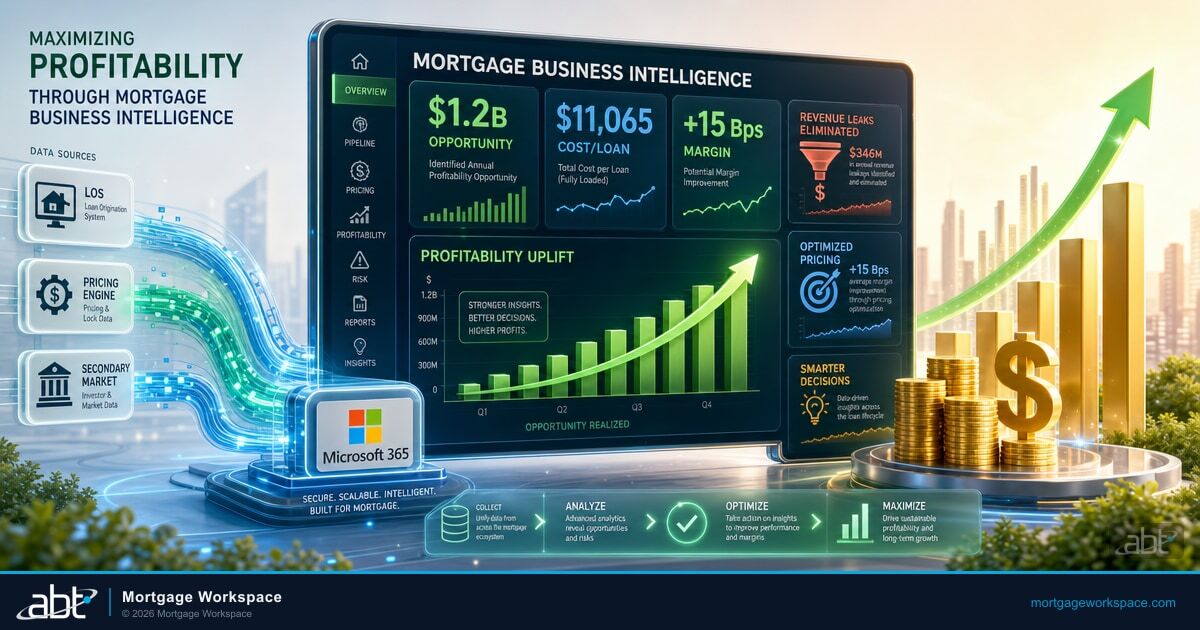
A mortgage firm running Microsoft 365 has every tool it needs to close more loans, protect borrower data, and pass an exam without scrambling. The catch is configuration. A default Microsoft 365 tenant arrives as a productivity platform built for a thousand industries. It does not arrive as a lending platform. The difference between a tenant that closes loans faster and a tenant that just hosts email is the operating model running it. MortgageWorkSpace is Access Business Technologies' Microsoft 365 deployment pattern for mortgage companies. M365 Guardian is the operating model that keeps it tuned. Together they turn a generic productivity tenant into a lending production line.
Why ABT Runs Microsoft 365 for Mortgage Firms
- MortgageWorkSpace tenant baseline ships with sensitivity labels for borrower files, DLP rules tuned to loan data, and Conditional Access policies built around how processors, underwriters, and loan officers actually work. The defaults assume a lending shop, not a generic business.
- M365 Guardian operating model applies, monitors, and documents those controls across every Microsoft 365 tenant ABT manages. The mortgage firm experiences the outcomes: consistent posture, audit-ready evidence, and a 24/7 watch on Defender and Sentinel signals.
- Tier-1 Direct-Bill Cloud Solution Provider means ABT manages the Microsoft 365 tenant under delegated admin. Microsoft hosts the infrastructure. ABT manages the configuration. Mortgage leadership keeps tenant ownership and regulatory accountability.
Microsoft released a new compliance assessment for financial services Copilot deployments in January 2025. The Homebuyers Privacy Protection Act took effect in March 2026. State legislators continue to introduce bills requiring annual AI impact assessments for lending tools. The regulatory ground is shifting, and mortgage firms running Microsoft 365 need their environment configured to keep pace. A tenant that was hardened in 2022 against the threats and rules of 2022 is not the same tenant a 2026 examiner will grade.
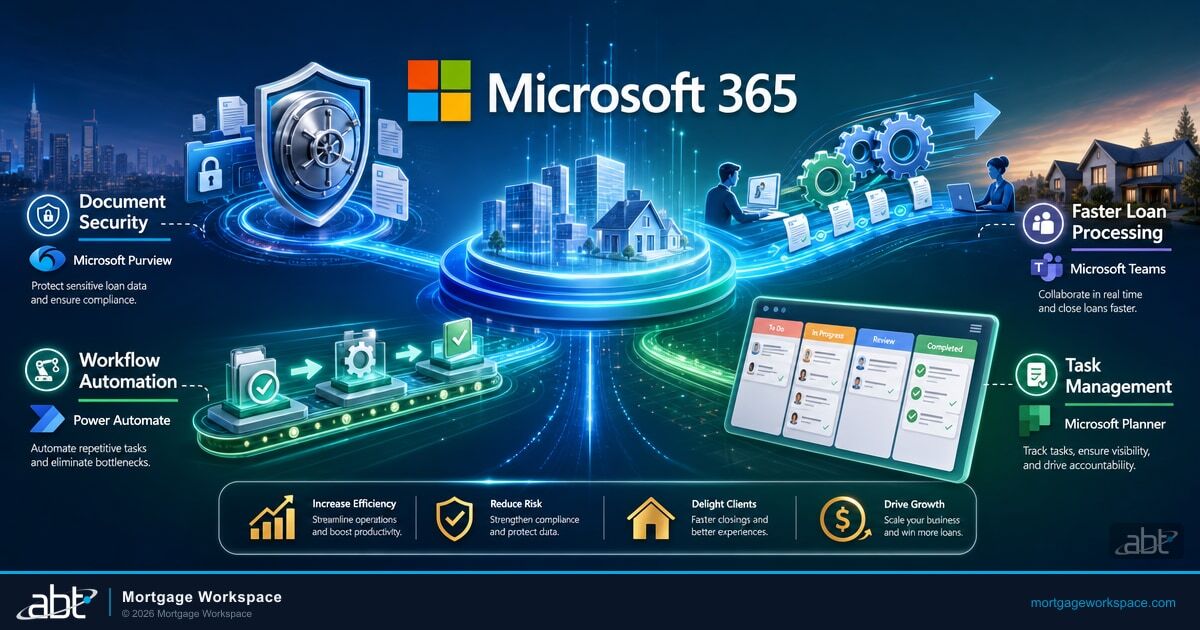
This article covers four areas where Microsoft 365 directly improves mortgage firm operations (document security, loan processing, workflow automation, and task management), then explains how the MortgageWorkSpace baseline and M365 Guardian operating model turn those Microsoft capabilities into the productivity, security, and audit-readiness outcomes mortgage leadership actually buys.
Document Security for Remote Mortgage Teams
Mortgage loan files contain Social Security numbers, bank statements, tax returns, and employment records. Every document must be protected both in transit and at rest. When your team works remotely, the attack surface grows. The borrower's pay stub does not get less sensitive because the processor is opening it from a kitchen table.
Microsoft 365 provides the controls. Configuring them for lending is the work. The MortgageWorkSpace baseline arrives with the configurations already aligned to how loan files actually move through a firm.
Microsoft Purview sensitivity labels. Microsoft Purview Information Protection classifies loan documents by sensitivity level. Confidential borrower files are encrypted automatically and restricted to authorized users. Even if a file is shared accidentally, the encryption travels with the document and prevents unauthorized access wherever it lands.
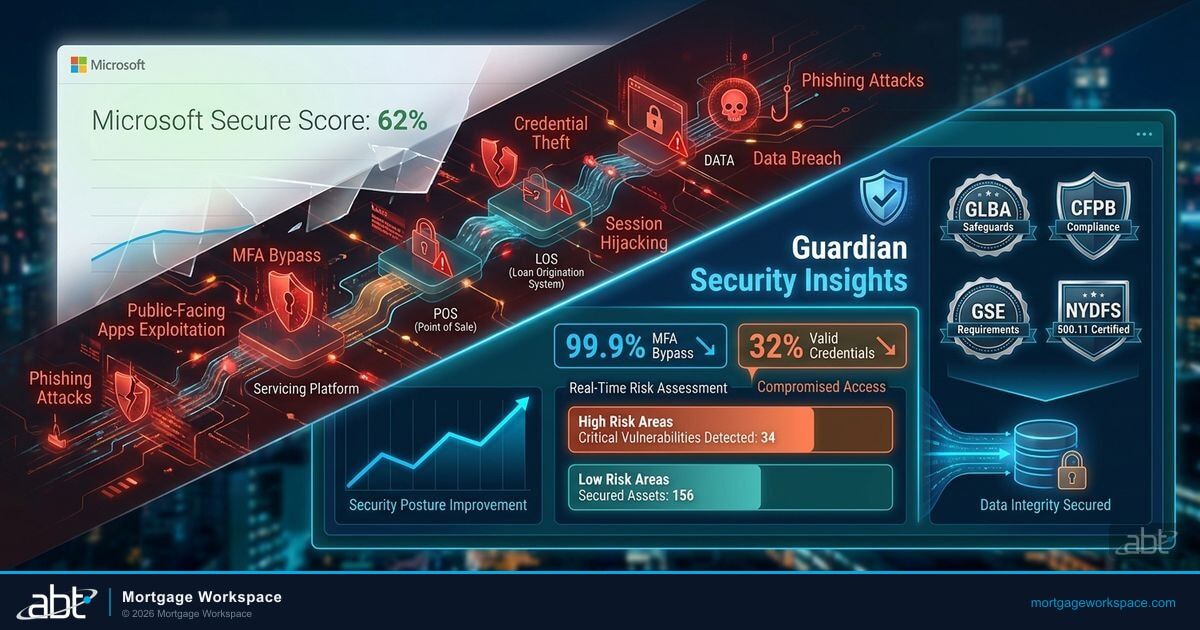
Microsoft Purview Data Loss Prevention. DLP policies detect and block the sharing of borrower Social Security numbers, account numbers, and loan data through Exchange Online, Microsoft Teams, SharePoint, and OneDrive. The mortgage-tuned policies catch mistakes before they become breaches and produce the evidence a Gramm-Leach-Bliley Act safeguards audit asks for.
Microsoft Entra ID Conditional Access and multi-factor authentication. Conditional Access policies in Microsoft Entra ID require a second verification step before users reach loan files, and they restrict access to managed devices. Your firm enforces security by policy, not by depending on each loan officer to make the right call at the wrong moment.
Encryption at rest and in transit. Microsoft 365 encrypts data at rest across SharePoint Online and OneDrive and encrypts data in transit across all services. For mortgage firms, this encryption satisfies baseline requirements under the Gramm-Leach-Bliley Act, the Federal Trade Commission's Safeguards Rule, and the document protection expectations a state regulator brings to a routine examination.
Faster Loan Processing With Collaboration Tools
Loan processing stalls when team members cannot communicate quickly or access the right documents. Microsoft 365 solves both problems when the tenant is configured around the loan, not around generic project work.
Microsoft Teams as the loan processing hub. A Microsoft Teams channel per loan in the pipeline keeps processors, underwriters, and closers working in one place. File attachments live in the channel, not buried in twelve forwarded email threads. Decisions happen in real time. Status questions get answered without anyone hunting for the last email.
SharePoint for document management. A structured SharePoint Online library replaces scattered network folders and personal OneDrive accounts. Loan documents organize by borrower, loan number, or pipeline stage. Version history tracks every change with a time stamp and an author. Permission controls ensure only authorized staff access specific files, with the permission inheritance set so a transferred loan officer loses access automatically.
Co-authoring for faster reviews. Underwriters and processors can work on the same document simultaneously in Word, Excel, or PowerPoint Online. No emailing files back and forth. No version-confusion conversations. The system handles the merge.
These tools work best when configured specifically for mortgage workflows. A generic SharePoint deployment does not have the folder structures, permission levels, retention bindings, or naming conventions that lending operations require. MortgageWorkSpace ships with those defaults already configured for a lending shop, and M365 Guardian keeps them aligned as the firm grows and the loan products change.
Workflow Automation That Cuts Manual Steps
Power Automate, included in Microsoft 365 Business Premium and the licensing tiers ABT typically deploys for mortgage firms, lets teams build automated workflows without writing code.
Practical automation examples for mortgage firms:
- Compliance deadline reminders. Automated alerts notify staff when TRID timing windows approach, preventing the disclosure timing violations that show up as state examination findings.
- Document routing. When a borrower uploads a document to a SharePoint library, a Power Automate flow notifies the assigned processor, moves the file to the correct folder, and updates the loan-tracking list.
- Condition follow-up. When a loan condition is added in your loan origination system, an automated flow sends the borrower an email requesting the specific document needed, with the language pre-approved by the firm's compliance team.
- License expiration tracking. Loan officer licenses, company licenses, and vendor certifications track in a SharePoint list with automated renewal reminders at 90, 60, and 30 days before expiration. Nobody ever closes a loan on an expired license again.
Each automation removes a manual step. Over hundreds of loans a month, those removed steps compound into real productivity gains for processors and reliable compliance outcomes for the firm.

Integrated Task Management Across Departments
Microsoft Planner and Microsoft To Do integrate directly with Microsoft Teams. For mortgage firms, that means task assignment and tracking live inside the same platform where communication happens. The processor does not switch tools to see what is open, and the manager does not switch tools to see what is overdue.
How mortgage firms use Microsoft Planner:
- Create a Planner board for each branch or processing team
- Assign tasks tied to specific loans with due dates aligned to closing timelines
- Track completion across processors, underwriters, and closers in a single view
- Set up buckets that mirror the firm's actual loan pipeline stages
When task management lives inside Teams, nothing falls through the cracks. Managers see what is open, what is overdue, and who needs support. That visibility prevents the last-minute scrambles that blow up closing timelines and erode borrower trust.
Why MortgageWorkSpace Is Microsoft 365 Tuned for Lending
Most mortgage firms run a Microsoft 365 tenant that was set up by a generalist managed service provider, an in-house IT contact, or whoever was available the week the firm migrated off on-premises Exchange. The result is a tenant with default policies, generic naming conventions, and permission structures designed for a marketing agency or a law office. The tenant works. It does not work for lending.
MortgageWorkSpace is Access Business Technologies' Microsoft 365 deployment pattern built specifically for mortgage companies. The tenant arrives with sensitivity labels named for loan documents, DLP policies tuned to borrower data, retention bindings aligned to the document-retention windows mortgage regulators expect, Conditional Access rules built around how loan officers travel between branches, and SharePoint site templates that mirror a real loan pipeline. The branding lives at mortgageworkspace.com because mortgage shops respond to lending-first language, not generic IT-MSP language.
The MortgageWorkSpace baseline is what the tenant ships with. The day-to-day work of keeping it tuned across a growing firm, with changing loan products and new compliance requirements, is the operating-model work. That layer has its own name.
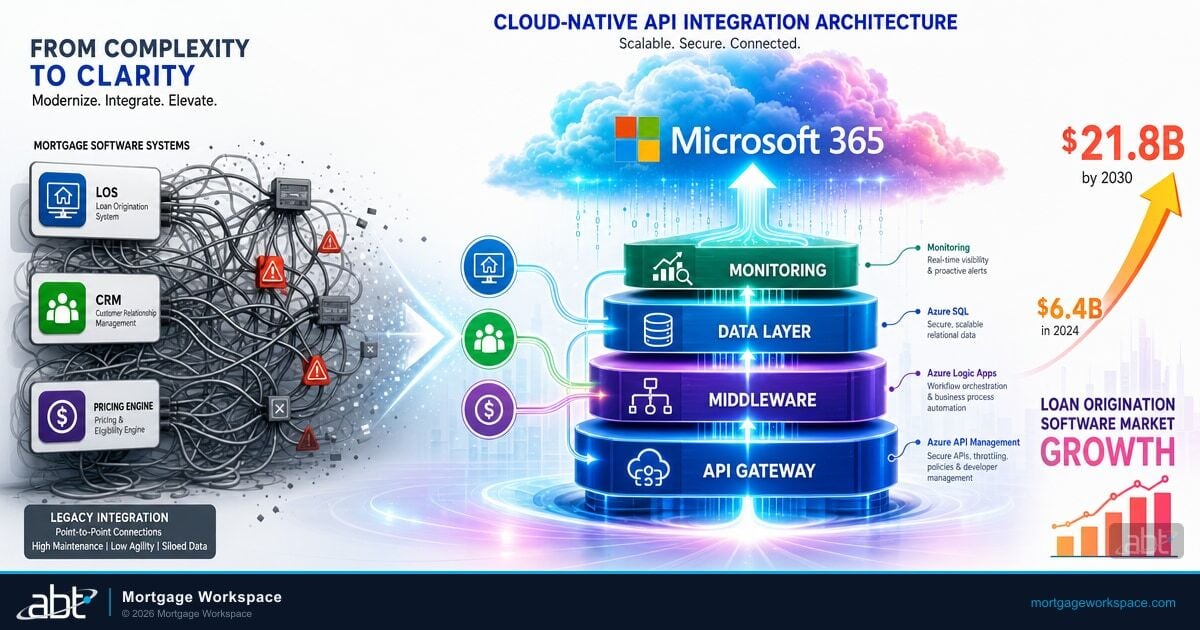
Microsoft 365 is the productivity platform. MortgageWorkSpace is the lending-tuned deployment pattern that ships with sensitivity labels, DLP policies, retention bindings, and SharePoint templates configured for a mortgage shop on day one. M365 Guardian is the operating model on top, where Microsoft Entra ID handles identity (multi-factor authentication, Conditional Access, sign-in risk), Microsoft Intune enrolls and posture-checks every device, Microsoft Defender for Office 365 and Defender for Endpoint handle the active threat side, Microsoft Purview Audit, DLP, Information Protection, and retention hold up the records side, and Microsoft Sentinel aggregates the signals into a security operations center timeline that satisfies the incident response and recordkeeping rules mortgage regulators care about. ABT's Tier-1 Direct-Bill CSP status means Microsoft holds ABT accountable for keeping the deployment inside the operational parameters Microsoft sets for managed tenants.
How M365 Guardian Operates the Tenant for Mortgage Firms
Microsoft 365 ships with powerful tools. Those tools require configuration, monitoring, and ongoing maintenance that most mortgage firms cannot handle with internal IT alone. Loan officer travel changes the Conditional Access pattern. New loan products introduce data types the DLP rules have to learn. Microsoft releases service updates that shift the security baseline. The work never stops, and the work is not what your processors should be doing.
M365 Guardian is the operating model ABT runs on top of the MortgageWorkSpace baseline. It includes mortgage-specific Conditional Access policies tuned to branch geography and loan officer travel patterns, DLP policies extended for new loan products as they enter the firm's pipeline, retention policies bound to Exchange Online mailboxes and SharePoint sites in a way that satisfies the document retention windows state regulators expect, an Intune device compliance baseline covering operating system version, BitLocker encryption, Defender Antivirus status, and patch level, and a Sentinel deployment with analytic rules tuned to mortgage-firm attack patterns rather than vendor SMB defaults. The 24/7 security operations center watches the signals every minute of the day.
ABT manages the Microsoft 365 tenant. Mortgage leadership retains tenant ownership, regulatory accountability, and the customer relationships. The partner relationship is set up under Granular Delegated Administrative Privileges with least-privilege role grants, an executed vendor oversight agreement that satisfies the third-party expectations under the Federal Trade Commission's Safeguards Rule, and an annual independent verification cycle that produces the evidence a firm's compliance officer needs for the firm's own examination prep.

The difference between a managed Microsoft 365 tenant and an unmanaged one is the difference between tools sitting on a shelf and tools actively closing loans, protecting borrower data, and producing audit evidence on demand.
For mortgage firms that already work inside Microsoft 365, the productivity unlock starts when the tenant gets tuned around how lending actually happens. The MortgageWorkSpace baseline handles the configuration. The M365 Guardian operating model keeps it tuned. The Tier-1 Direct-Bill CSP relationship with Microsoft is what makes the whole pattern operationally accountable in a way examiners recognize. ABT's neighboring articles cover the adjacent surfaces of this work: how Encompass and Calyx integrations keep compliance locked down, how Power Automate handles the automated compliance steps, and best practices for configuring Microsoft 365 email for mortgage offices.
Key Takeaway
Microsoft 365 is the productivity platform every mortgage firm already pays for. MortgageWorkSpace is the lending-tuned deployment pattern that turns the platform into a loan production line. M365 Guardian is the operating model that keeps the tenant tuned as the firm grows. Together they let mortgage leadership focus on closing loans, not configuring software, and they produce the audit evidence that a state examiner asks for without a three-week scramble.
Get a MortgageWorkSpace Readiness Review
Access Business Technologies runs the MortgageWorkSpace deployment pattern and M365 Guardian operating model described in this article for mortgage companies of every size, from independent mortgage banks to multi-state broker shops. A 30-minute conversation maps your current Microsoft 365 tenant, surfaces the gaps your next examination will most likely find, and outlines what an ABT-managed deployment would cover. No commitment, no quote, no obligation.
Frequently Asked Questions
Microsoft 365 provides encryption at rest and in transit, multi-factor authentication, Conditional Access policies, Data Loss Prevention rules, and audit logging that address core Federal Trade Commission Safeguards Rule requirements. Microsoft Purview sensitivity labels classify borrower documents by confidentiality level and restrict access automatically. These controls must be configured specifically for mortgage operations to satisfy the rule's requirements for protecting nonpublic personal information. ABT's MortgageWorkSpace baseline arrives with the lending-tuned defaults already configured, and the M365 Guardian operating model keeps those configurations aligned as the firm's pipeline and product mix change.
Mortgage companies should configure Microsoft Purview Data Loss Prevention policies that detect and block sharing of borrower Social Security numbers, bank account numbers, loan application data, and tax return information through Exchange Online, Microsoft Teams, SharePoint Online, and OneDrive. Policies should cover both internal and external sharing. Additional rules should prevent forwarding of documents marked with sensitivity labels containing borrower financial data to personal email accounts or unauthorized external recipients. The MortgageWorkSpace baseline ships with these DLP rules pre-configured for a lending shop, and M365 Guardian extends them as the firm introduces new loan products or expands into new states.
Power Automate handles repetitive compliance tasks including TRID disclosure deadline tracking, document routing and filing, condition follow-up notifications to borrowers, and license expiration reminders. It does not replace compliance judgment or regulatory analysis. The automation handles the mechanical steps so compliance staff can focus on decisions that require human expertise and regulatory knowledge. ABT typically builds the initial set of mortgage-specific Power Automate flows during the MortgageWorkSpace deployment and extends them inside the M365 Guardian operating model as the firm's workflow needs evolve.
The Homebuyers Privacy Protection Act, passed in September 2025 and effective March 2026, restricts credit reporting agencies from sharing consumer credit reports for unsolicited marketing. Mortgage firms using Microsoft 365 should review their Dynamics 365 and customer relationship management integrations to ensure marketing automation workflows do not trigger credit pulls for unsolicited offers. DLP policies should be updated to flag outbound communications that could be interpreted as trigger-lead solicitations. ABT updates the DLP and Communication Compliance configurations under M365 Guardian as new federal and state rules land, so mortgage leadership does not have to chase the policy update cycle.
MortgageWorkSpace is Access Business Technologies' Microsoft 365 deployment pattern built specifically for mortgage companies. A standard Microsoft 365 deployment ships with generic defaults appropriate for a thousand industries. MortgageWorkSpace ships with sensitivity labels named for loan documents, Data Loss Prevention policies tuned to borrower data, retention bindings aligned to the document retention windows mortgage regulators expect, Conditional Access rules built around how loan officers travel between branches, and SharePoint site templates that mirror a real loan pipeline. The pattern is documented at mortgageworkspace.com and is what ABT applies for mortgage firms moving onto the platform.
M365 Guardian is ABT's operating model layered on top of the Microsoft 365 platform and the MortgageWorkSpace baseline. It includes mortgage-specific Conditional Access policies tuned to branch geography and loan officer travel patterns, ongoing Data Loss Prevention extensions for new loan products, retention policies aligned to the document retention windows state regulators expect, an Intune device compliance baseline covering operating system, encryption, antivirus, and patch posture, and a Microsoft Sentinel deployment with analytic rules tuned to mortgage attack patterns. The 24/7 security operations center watches the signals every minute. Mortgage leadership keeps tenant ownership and regulatory accountability; ABT manages the configuration and the watch under Granular Delegated Administrative Privileges.