In This Article
- Why a Digital Mortgage Experience Is Now Mandatory
- Strategy Before Technology
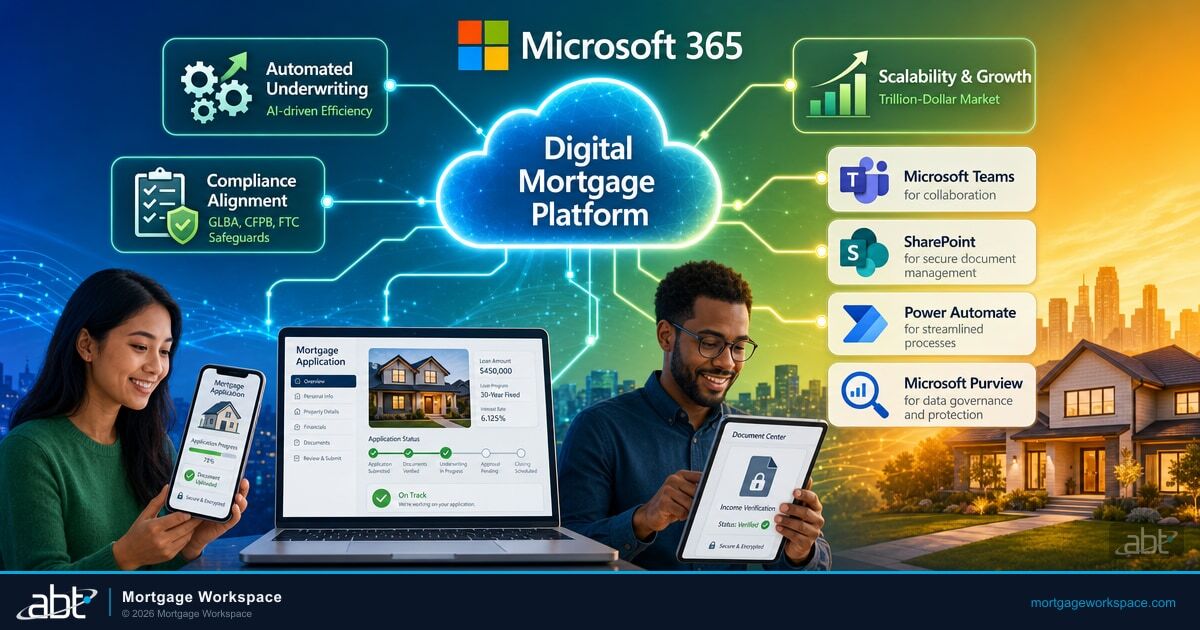
- Core Components of a Digital Mortgage Platform
- The MortgageWorkSpace and MortgageExchange Stack on Microsoft Azure
- Security and Compliance from Day One
- M365 Guardian: The Operating Model for Mortgage Governance
- Scaling Without Losing Control
- How to Start Your Digital Transformation
- Frequently Asked Questions
Fannie Mae projects single-family mortgage originations will reach $2.32 trillion in 2026, up from $1.85 trillion in 2025. Refinance share is expected to climb from 26% to 35%. That volume increase hits every lender at the same time. The ones running digital-first operations on a productized stack will absorb it. The ones still dependent on manual workflows or hand-built integrations will buckle. Access Business Technologies operates Microsoft 365 tenants and the MortgageWorkSpace platform for more than 750 financial institutions, and the difference between firms that scale and firms that stall is the operating model under the technology.
A digital mortgage experience is no longer a competitive advantage. It is the baseline. 90% of homebuyers in 2024 reported interest in a more or fully digital process. Lenders who deliver speed, transparency, and mobile access win borrowers. Those who do not lose them to competitors who do. The question is no longer whether to go digital. The question is whose stack you build on and who keeps it running.
Why a Digital Mortgage Experience Is Now Mandatory
Borrower Expectations Have Changed
58% of borrowers say they are more likely to choose a lender offering a digital mortgage experience. 68% say they would switch lenders entirely for a better digital experience. Millennials and Gen Z, who expect mobile-first processes, now make up a growing share of mortgage borrowers. Meeting these expectations directly influences lender selection and retention.
Cost Reduction and Speed
Digital mortgage processing cuts loan cycle times by 15% to 40% and reduces cost per loan by up to 10%, according to McKinsey. Lenders who cut as much as 40-60% of manual touchpoints through end-to-end automation see even larger gains. Digital platforms have reduced average application processing times by 25 days compared to manual workflows.
Compliance Alignment
Digital platforms automate compliance checks and audit trails. In a sector governed by GLBA, CFPB guidelines, the FTC Safeguards Rule, and state-specific regulations, automated compliance is not a feature. It is a requirement for operating at scale.
Geographic Scale
Cloud-native solutions serve borrowers across states without adding branch locations. Configurable workflows adapt to different state regulations without custom development for each market.
Strategy Before Technology
Lenders who jump straight to tools without a plan waste money. Success starts with a clear digital transformation strategy:
- Map the borrower journey. Where do delays happen? Which steps confuse borrowers? Identify every friction point from application to closing.
- Understand compliance needs by state. Each state has different disclosure requirements, licensing rules, and data privacy mandates. Your tech stack must align with these from day one.
- Align internal teams. Sales, underwriting, compliance, and IT must work from the same plan. Siloed decisions create fragmented borrower experiences.
- Define measurable KPIs. Track loan cycle time, NPS scores, cost per loan, conversion rates, and borrower abandonment rates.
Core Components of a Digital Mortgage Platform
Digital Loan Application Portals
Self-service portals let borrowers upload documents, track progress, and communicate securely. Features that matter: real-time status updates, credit bureau integration, e-signature support, and multi-device access. Platforms delivering these capabilities report application completion rates above 90%.
Automated Underwriting
Intelligent rules engines reduce manual checks, flag risks, and speed approvals. AI-driven underwriting models analyze thousands of data points including alternative data. One mid-sized lender increased underwriting productivity by 40% and expanded processing capacity by 3,000 applications per month after deploying AI assistance.
Cloud-Based Document Management
Cloud storage eliminates paper, strengthens data protection, and enables remote access. Key capabilities include automatic document classification, version control, encryption, and compliance with GLBA and CFPB archiving requirements. 85% of mortgage data is now stored in cloud-based systems.
CRM and Communication Tools
A responsive digital experience requires automated communication. Chatbots handle common borrower questions. Secure messaging connects borrowers and loan officers. CRM-triggered reminders and milestone notifications keep the pipeline moving without manual follow-up. Lenders integrating CRM with their LOS report 20% higher client satisfaction. See also our breakdown of Securing Client Data.
Analytics and Reporting Dashboards
Data drives optimization. Track processing bottlenecks, conversion rates, and borrower behavior patterns. Role-based dashboards give underwriters, loan officers, and compliance leads the specific information they need.
The MortgageWorkSpace and MortgageExchange Stack on Microsoft Azure
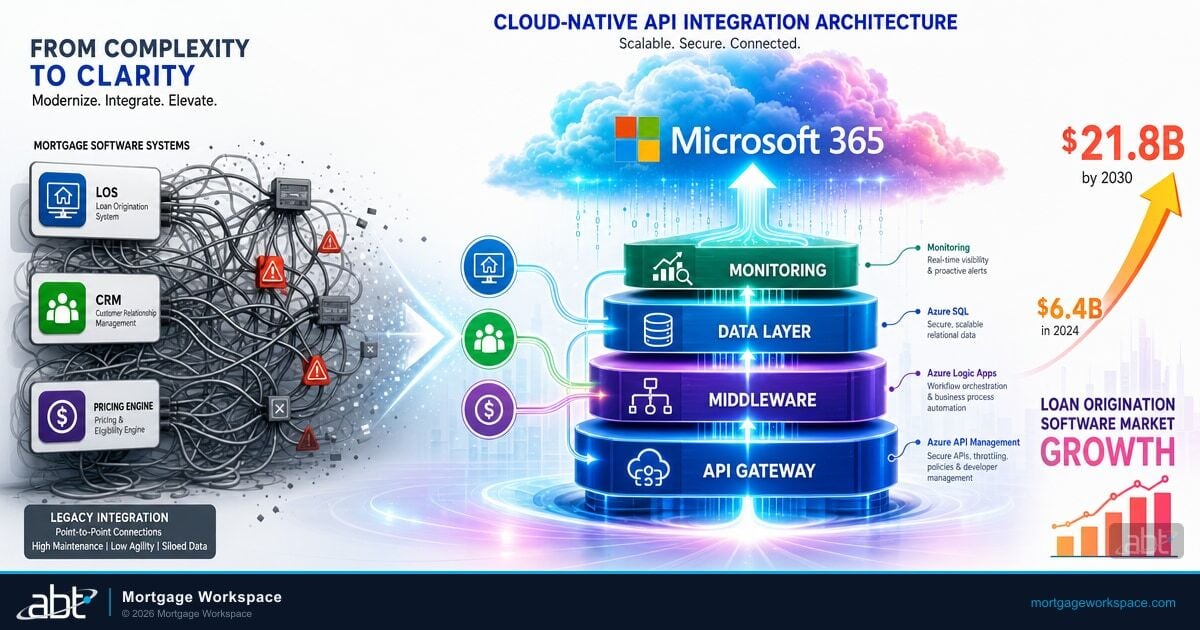
Most lenders evaluating a digital transformation start with the components above and then ask the harder question: who assembles them, who keeps them running, and who owns the integration plumbing between the loan origination system, the core banking system, and the Microsoft 365 tenant where the team actually works? MortgageWorkSpace and MortgageExchange are ABT's productized answer to that question. MortgageWorkSpace is the managed Microsoft 365 platform purpose-built for mortgage operations, with Teams channels, SharePoint sites, Power Automate flows, and Microsoft Purview policies pre-configured for the way mortgage teams actually work across loan officers, processors, underwriters, closers, and compliance. MortgageExchange is the LOS-to-core interface layer that connects Encompass, Calyx, or your other origination system to the core banking platform without hand-built point-to-point integrations that break on every vendor release. Both products run on Microsoft Azure, hosted by ABT as the partner of record, so the firm gets enterprise-grade hosting, redundancy, and disaster recovery without standing up its own Azure tenancy or managing the underlying infrastructure. The lender keeps its LOS contract, keeps its core relationship, keeps its Microsoft 365 licensing, and gets a productized stack that scales from a 25-person broker shop to a 500-employee independent mortgage bank without re-architecting at every step. For ABT's fuller take, see User Experience in Online Mortgage Banking.
Security and Compliance from Day One
Mortgage data is sensitive. Security cannot be an afterthought.
Non-negotiable security features:
- End-to-end encryption for data at rest and in transit
- Role-based access control with least-privilege principles
- Real-time threat monitoring and incident response
- Multi-factor authentication and single sign-on
Regulatory compliance requirements:
- Gramm-Leach-Bliley Act (GLBA)
- FTC Safeguards Rule
- Fair Credit Reporting Act (FCRA)
- CFPB guidelines and state-specific rules
- Fannie Mae Selling Guide information security requirements (updated for August 2026)
Roughly half of all mortgage firms do not regularly test their IT infrastructure for security weaknesses. That gap creates risk for internal operations and for every third-party connection in the lending chain.
M365 Guardian: The Operating Model for Mortgage Governance
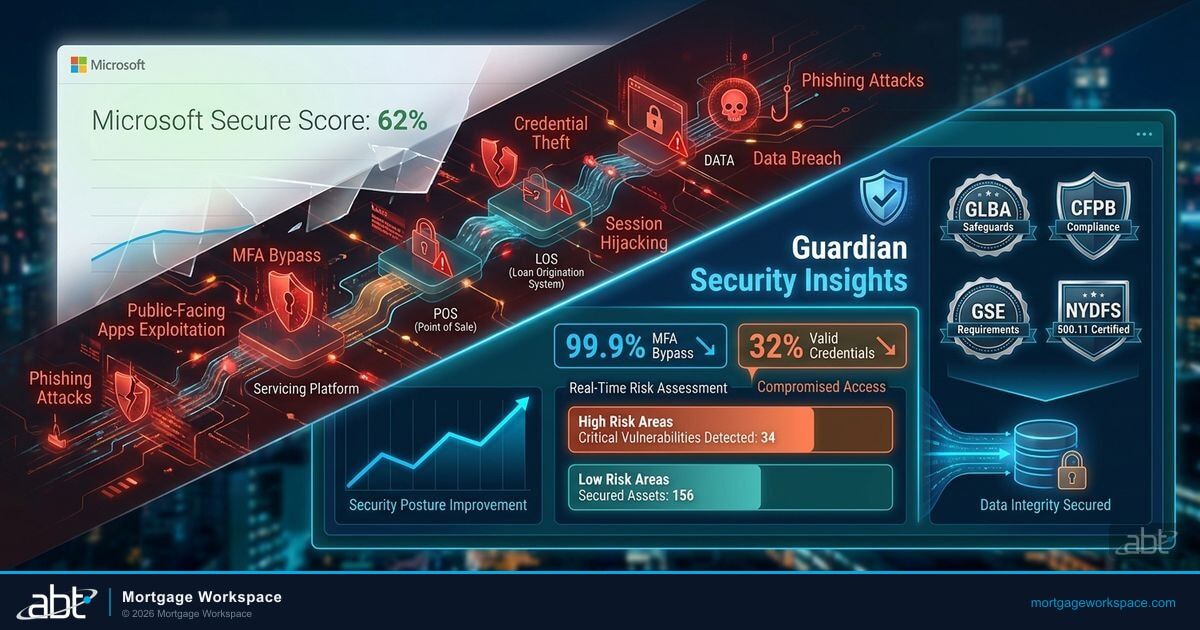
Security tooling without an operating model is shelfware. The lender pays for Microsoft Entra ID, Microsoft Defender for Office 365, Microsoft Purview, Microsoft Intune, and Microsoft Sentinel, but the team configures them once during onboarding and never tunes them again. Drift sets in. A new branch joins the firm and inherits a six-month-old baseline. A loan officer's device falls out of compliance. A retention policy stops binding to a new SharePoint site. By the time the next CFPB exam or state audit opens, the firm is reassembling evidence by hand. M365 Guardian is ABT's productized operating model that turns those Microsoft tools into a continuously monitored governance layer for mortgage operations. Guardian applies a mortgage-tuned security baseline across the firm's Microsoft 365 tenant, monitors for drift against that baseline daily, surfaces audit-ready evidence on demand for GLBA, CFPB, and Fannie Mae information security reviews, and runs a 24/7 security operations center that watches the Defender and Sentinel signals so the firm's IT and compliance staff can focus on the higher-judgment work examiners actually want them doing. The lender retains tenant ownership. ABT operates the operating model. The result is governance the firm can demonstrate, not promise. This connects closely to Building a Compliant IT Framework for Mortgage Companies.
Scaling Without Losing Control
Growth adds complexity. The right architecture turns that complexity into efficiency.
- Modular architecture. Choose tools with API integration, not locked ecosystems. Modular systems let you swap components without rebuilding the stack.
- Automation at every stage. Pre-qualification through post-closing. Automate repetitive tasks without removing human oversight on complex decisions.
- Configurable workflows. Different states require different rules. Configurable workflows scale across jurisdictions without custom code for each market.
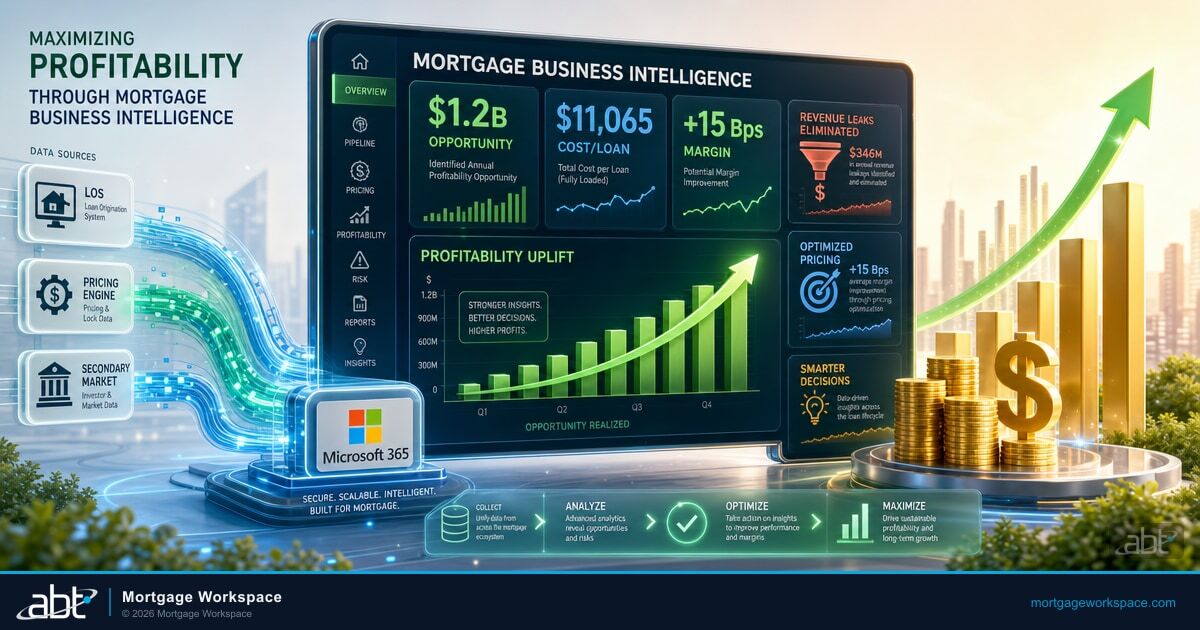
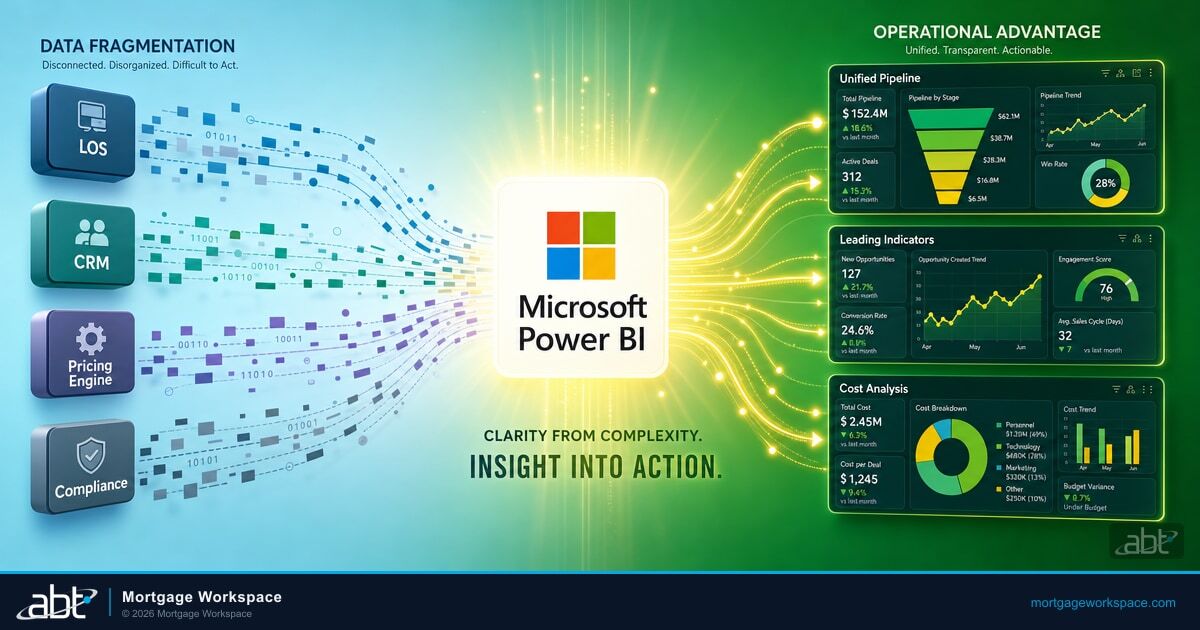
- Centralized dashboards. Manage all processes, pipelines, and performance metrics from one view.
How to Start Your Digital Mortgage Transformation
- Assess current processes. Document every step in your loan lifecycle from application to post-closing.
- Identify bottlenecks. Where do delays occur? What creates duplicate work?
- Choose a scalable tech stack. Cloud-based, API-friendly tools with proven mortgage applications.
- Get stakeholder buy-in. Operations, compliance, and IT leaders must align before implementation.
- Start with a pilot. Measure impact on a small subset before full rollout.
Get a MortgageWorkSpace Readiness Review
ABT runs the MortgageWorkSpace, MortgageExchange, and M365 Guardian operating model described in this article for more than 750 financial institutions. A 30-minute conversation maps your current LOS, core, and Microsoft 365 footprint, surfaces the gaps your next regulator is most likely to find, and outlines what an ABT-managed deployment would cover. No commitment, no quote, no obligation.
Frequently Asked Questions
A digital mortgage experience uses technology to handle every step from application through closing without paper-based manual processes. It includes digital loan portals, automated underwriting, cloud document management, CRM integration, and e-closing capabilities. The goal is faster cycle times, lower costs, and a borrower experience that matches the speed of other digital financial services.
Small pilot implementations can go live in six to eight weeks. Full enterprise rollouts connecting LOS, CRM, document management, and compliance systems typically take three to six months. Starting with a pilot lets lenders measure ROI on a subset of loans before committing to a full transformation.
Cloud platforms with proper encryption, access controls, and compliance tooling can be more secure than on-premise systems. 85 percent of mortgage data is already stored in cloud-based systems. The key is choosing providers that meet GLBA, CFPB, and Fannie Mae information security requirements and implementing role-based access controls with multi-factor authentication.
Automation supports underwriters rather than replacing them. It handles repetitive document verification, flags risks, and speeds routine approvals. Complex cases involving non-standard income, unique property types, or exception scenarios still require human judgment. The industry projects fully automated loans will grow to 30-40 percent of volume, with the remaining cases benefiting from AI-assisted human review.
MortgageWorkSpace is the managed Microsoft 365 platform that ABT pre-configures for mortgage operations. The Teams channels, SharePoint document libraries, Power Automate workflows, and Microsoft Purview retention policies arrive tuned for the way mortgage teams actually work across loan officers, processors, underwriters, closers, and compliance. A lender deploying generic Microsoft 365 spends months configuring each surface from defaults and tuning policies for state-specific compliance. MortgageWorkSpace starts from a mortgage-ready baseline, hosted on Microsoft Azure by ABT as the partner of record, and is governed continuously by the M365 Guardian operating model.