In This Article
- What Is Technical Due Diligence in Fintech?
- Why Mortgage Fintech Faces a Higher Bar
- Common Red Flags That Kill Deals
- How an MSP Strengthens Your Diligence Posture
- The ABT Stack of Record: MortgageExchange, Calyx PointCentral, Azure, and M365 Guardian
- Tech Due Diligence Checklist for Mortgage Startups
- Turn Diligence Into a Competitive Edge
- Frequently Asked Questions
Global Fintech Investment Topped $53 Billion in 2025. Most Mortgage Startups Still Fail Tech Diligence.
Global fintech investment rose 21% in 2025, reaching $53 billion across nearly 6,000 deals. Mortgage tech is growing at a 25% CAGR toward a $35 billion market by 2032. Investors are writing bigger checks than ever. Yet most fintech mortgage startups still stumble at one gate: technical due diligence. Regulators are stepping in earlier. AI governance requirements are multiplying. And the CFPB's Section 1033 open banking rule forces data architecture decisions that cannot be reversed cheaply.
If your infrastructure cannot withstand investor scrutiny in 2026, the fundraising climate will not save you. Access Business Technologies has been the operational owner behind diligence-ready Microsoft 365 and Azure stacks for mortgage companies since 1999, and the firm operates that infrastructure for 750+ financial institutions today. Here is what passing tech diligence actually requires for mortgage startups right now, and how the MortgageExchange plus Calyx PointCentral on Microsoft Azure stack changes the conversation with investors.
What Is Technical Due Diligence in Fintech?
Technical due diligence is an investor's deep audit of your technology systems, security posture, architecture decisions, and operational maturity. For fintech mortgage startups, the bar sits higher than generic SaaS. Your tech must comply with financial regulations, protect borrower data, and scale under real volume. Our guide to The Fintech Mortgage Ecosystem goes deeper on this.
During diligence, VCs and M&A teams look at six areas:
Loan origination workflows, point-of-sale to underwriting handoffs, document pipelines, and the queue depth your platform handles under peak application volume.
Encryption at rest and in transit, identity and access management, vulnerability management, and the boundary between borrower data and general workloads.
CFPB rules, GLBA safeguards, FFIEC guidance, state-level licensing, RESPA, ECOA, TRID, and the documentation trail that proves each control runs the way you say it runs.
Tested recovery time objectives, defined recovery point objectives, automated failover for borrower-facing applications, and evidence the last restore actually completed.
Deployment frequency, rollback capability, code review discipline, infrastructure as code, and the audit trail that ties every production change back to a ticket and an approver.
Documented assessments for every integration: the LOS provider, the e-sign vendor, the credit bureau pipe, the cloud provider, and any AI model upstream of a lending decision.
A startup handling borrower Social Security numbers, bank statements, and credit data through unpatched infrastructure will not survive this process. The diligence team does not care about your pitch deck. They care about your control environment.
Why Mortgage Fintech Faces a Higher Bar Than Other Verticals
Mortgage lending sits under overlapping regulatory frameworks that most fintech verticals do not face. A payments startup worries about PCI-DSS. A mortgage startup worries about GLBA, CFPB rules, FFIEC guidelines, TRID, RESPA, ECOA, and state-level requirements across all 50 states.
Three factors push the bar even higher in 2026:
AI governance is now a diligence item. The CFPB and SEC have made clear that AI in compliance or lending decisions must meet existing fair lending and BSA requirements. If your underwriting uses ML models, investors will ask about model documentation, bias testing, and explainability.
Open banking changes data architecture requirements. The CFPB's Section 1033 rule mandates data access standards, consent management, and third-party sharing controls. Startups that did not design for this from the start face expensive retrofits that investors do not want to fund.
RegTech is becoming core infrastructure. Manual compliance reviews do not scale. Investors expect automated compliance monitoring, audit trail generation, and policy enforcement baked into the platform from day one.
Common Red Flags That Kill Deals
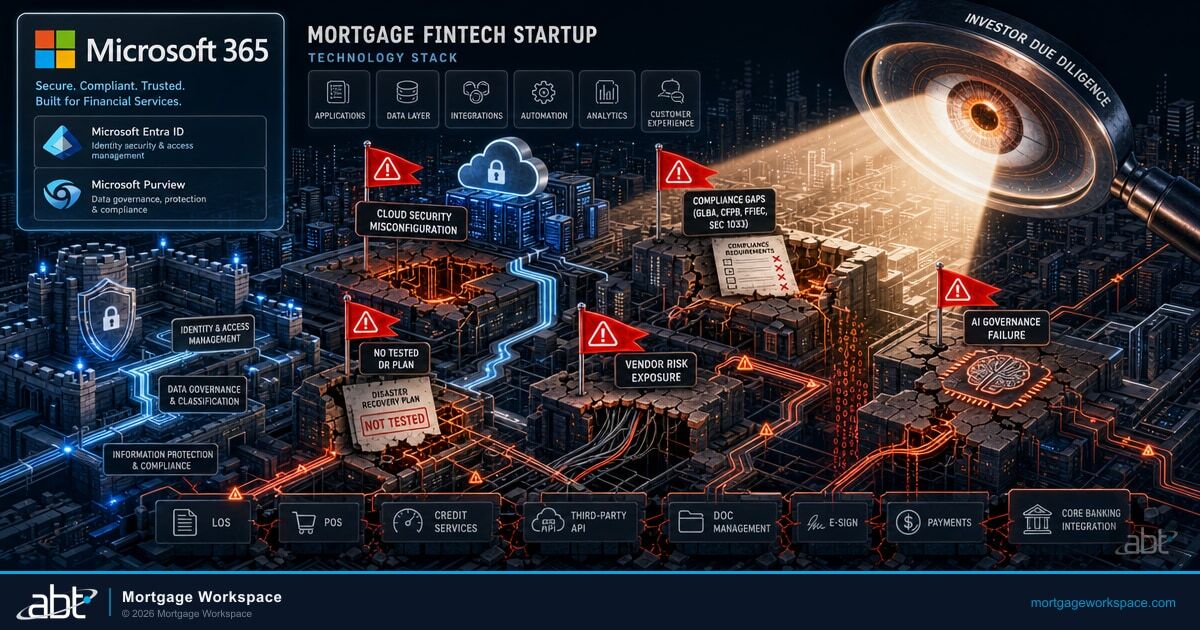
Most startups discover their gaps only after the diligence team arrives. Here are the patterns that consistently derail mortgage fintech funding rounds:
Weak Cloud Security Configuration
Misconfigured Azure or AWS settings can expose databases to unauthorized access. A U.S. Treasury report on financial services cloud adoption found that many security incidents trace back to user misconfiguration. Investors check for proper identity and access policies, encrypted storage at rest and in transit, network segmentation, and recent penetration testing results.
Missing or Outdated Documentation
Good infrastructure without documentation fails diligence. Investors want current architecture diagrams, data flow maps, API documentation, and incident response runbooks. They expect every control to be documented.
No Tested Disaster Recovery Plan
Nearly half of companies lack tested DR plans. For mortgage startups processing borrower applications daily, an untested plan means unknown recovery timelines. Investors treat this as binary: either you have tested failover in the last 90 days, or you have not.
Compliance Gaps in Borrower Data Handling
GLBA requires specific safeguards for nonpublic personal information. CFPB rules govern disclosure timing, fair lending, and data accuracy. Startups that cannot demonstrate compliance documentation, staff training records, and audit trails for every data touchpoint raise immediate red flags.
Vendor Dependencies Without Risk Assessments
Every third-party integration introduces supply chain risk. Have you assessed your loan origination system provider's security? Your e-sign vendor's SOC 2 status? Your cloud provider's incident history? If you cannot answer with documented assessments, the deal slows down or dies.
How an MSP Strengthens Your Diligence Posture
A managed service provider with mortgage industry experience bridges the gap between startup-speed development and investor-grade infrastructure. The qualifier matters. Generic IT MSPs run generic SMB baselines. A mortgage-vertical MSP that already operates the regulated stack for hundreds of lenders brings pattern recognition that translates directly to diligence-ready evidence.
Cybersecurity Assessment and Hardening
An MSP conducts penetration testing, vulnerability scanning, and configuration audits specific to mortgage workflows. This covers loan origination systems, borrower portals, e-sign integrations, and document management. These are not generic scans. They simulate attack vectors that target mortgage data flows.
Microsoft 365 Tenant Management
Most startups run collaboration and document sharing on Microsoft 365. Default configurations leave gaps in email authentication, external sharing, and data loss prevention. ABT manages the Microsoft 365 tenant under delegated admin (the Tier-1 Cloud Solution Provider relationship), applies Conditional Access in Microsoft Entra ID, layers Microsoft Intune device compliance, and enables Microsoft Defender for Office 365 and Defender for Endpoint policies tuned to the mortgage data the startup handles. Those gaps close before the diligence team finds them. For ABT's fuller take, see Securing Client Data.
Managed Detection and Response
Basic antivirus does not satisfy investor expectations. Managed Extended Detection and Response provides continuous threat monitoring, behavioral analysis, and incident response. Showing this capability tells investors you have built a real security operation, not just installed software.
Compliance Documentation and Audit Readiness
An MSP builds the documentation investors expect: security policies mapped to GLBA and FFIEC, incident response procedures, business continuity plans with tested recovery times, and access control matrices. This package becomes your diligence war room.
The ABT Stack of Record: MortgageExchange, Calyx PointCentral, Azure, and M365 Guardian
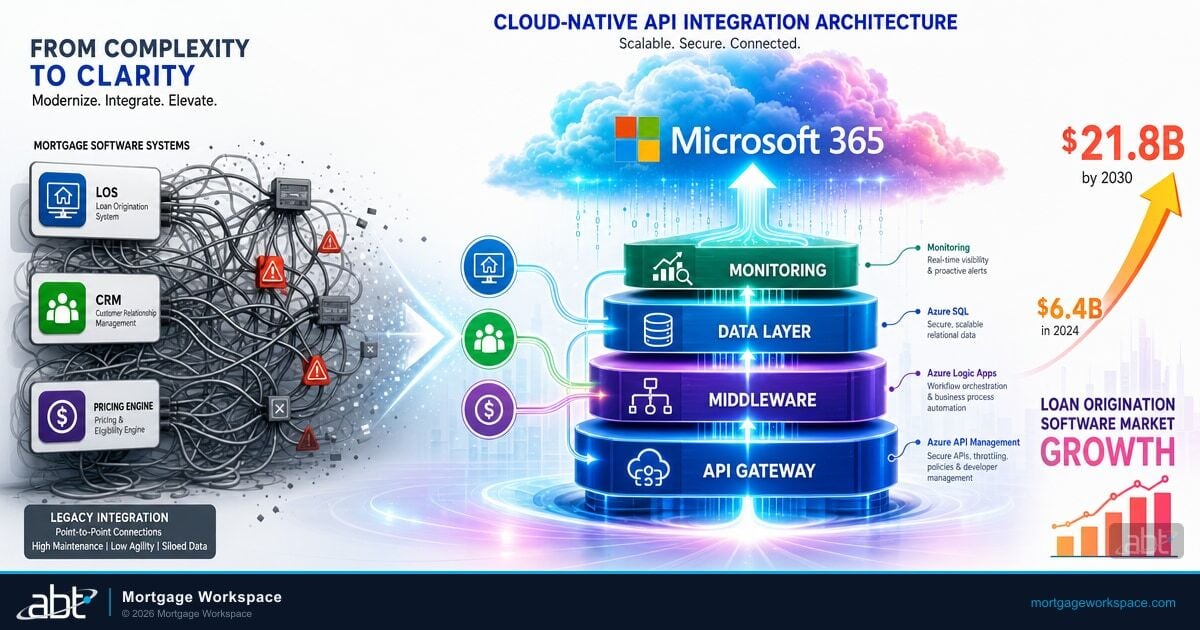
Most MSPs that pitch fintech mortgage startups cobble the stack together: a SaaS LOS from one vendor, a generic cloud hosting provider for the rest, a third-party security tool dropped in on top, and a fourth-party SIEM stitched at the boundary. Each seam is a diligence question. Each integration is another vendor risk assessment. Each handoff is another place the audit trail breaks. Investors notice. ABT brings a different shape: MortgageExchange as the custom integration layer between the loan origination system and the core or settlement systems, Calyx PointCentral hosted on Microsoft Azure as the dedicated loan origination environment, the Microsoft 365 tenant managed end-to-end under delegated admin, and a Microsoft Sentinel deployment ABT operates as the partner of record. One operational owner across the whole footprint. One audit trail. One vendor risk assessment that covers the surface a diligence team actually maps. A startup that arrives at a Series A meeting with this stack of record on the cover page of the diligence package has already moved past two rounds of vendor-risk questions a cobbled-together stack would still be answering.
The M365 Guardian operating model is the governance baseline diligence reviewers expect. Guardian is the ABT operating model layered on top of the Microsoft 365 tenant ABT manages: Conditional Access policies tuned to mortgage workflows, Microsoft Purview retention aligned to GLBA and CFPB recordkeeping expectations, Microsoft Intune device compliance with explicit BitLocker and Defender Antivirus posture, Communication Compliance review templates calibrated to actual financial-services findings, and a 24/7 security operations center watching the Sentinel and Defender signals every minute. For a fintech mortgage startup heading into Series A or Series B diligence, the Guardian operating model collapses the gap between "we run on Microsoft 365" and "we can produce a year of audit evidence on demand." The reviewer asks for the retention configuration; ABT pulls a cross-tenant report. The reviewer asks for the last incident response timeline; the Sentinel incident view produces it. The reviewer asks for the third-party oversight package on the cloud platform; ABT supplies the SOC 2 Type II attestation under NDA. That is the operational difference between investor-grade infrastructure and a startup pitch that promises one.
ABT is a Tier-1 Direct-Bill Microsoft Cloud Solution Provider. Microsoft owns and operates the Microsoft 365 service; ABT manages the customer's tenant under delegated admin through the partner relationship. By contrast, ABT hosts Microsoft Azure environments and hosts Calyx PointCentral on Azure as the partner of record running the subscription. That precision matters for a diligence reviewer reading your vendor oversight package: when you say "ABT manages our Microsoft 365 tenant and hosts our Calyx PointCentral instance on Azure," the reviewer immediately understands who runs what and how the audit trail crosses the boundary. Microsoft Entra ID, Microsoft Purview, Microsoft Intune, Microsoft Defender, and Microsoft Sentinel are configured and maintained inside the M365 Guardian operating model that ABT applies and documents across the full footprint.
Tech Due Diligence Checklist for Mortgage Startups
Score yourself before investors do:
Governance and Compliance
- Documented alignment with GLBA, FFIEC, and CFPB requirements
- Privacy and security policies reviewed within the last 12 months
- Staff training records for security awareness and regulatory topics
- AI model governance documentation if using machine learning in any workflow
Infrastructure
- Cloud configuration follows CIS benchmarks or equivalent
- Network segmentation isolates borrower data from general workloads
- Monitoring and alerting covers all production systems
- Capacity planning supports 3x current peak volume
Data Protection
- Encryption at rest and in transit for all borrower data
- Data classification policy identifying PII and NPI categories
- Retention and deletion policies aligned with regulatory requirements
- Access logging for every system that touches borrower records
Access Management
- Multi-factor authentication on all accounts
- Role-based access control with quarterly access reviews
- Privileged access management for admin accounts
- Offboarding procedures that revoke access within 24 hours
Disaster Recovery
- DR plan tested within the last 90 days
- Defined RPO and RTO for all critical systems
- Automated failover for borrower-facing applications
- Backup integrity verified through regular restore tests
Turn Diligence Into a Competitive Edge
Speed up fundraising. When your diligence package is organized before the first investor meeting, term sheets move faster. Investors reward preparedness because it signals operational maturity across the entire business. A diligence-ready stack means a startup that can answer the security and governance questions in 48 hours, not three weeks of scrambling.
Future-proof compliance. Mortgage regulations shift constantly. Building compliance into infrastructure rather than bolting it on later means you spend less on remediation and more on product development. The MortgageExchange interface layer adapts to CFPB Section 1033 obligations through standard adapter patterns instead of a custom integration rewrite. We cover Building a Compliant IT Framework for Mortgage Companies in a companion piece.
Support scale. Infrastructure designed for diligence is infrastructure designed for growth. The same monitoring, documentation, and access controls that satisfy investors also support higher loan volumes and institutional partnerships. Calyx PointCentral hosted on Azure gives the startup an environment that scales the way investors expect, with the recovery posture they want to see.
Key Takeaway
Most fintech mortgage startups fail diligence because the stack is cobbled together from generic vendors, leaving each seam as an open question for the diligence team. The ABT stack of record collapses those seams: MortgageExchange as the custom interface layer, Calyx PointCentral hosted on Microsoft Azure as the loan origination environment, the Microsoft 365 tenant managed end-to-end under the M365 Guardian operating model, and a Microsoft Sentinel deployment ABT operates as the partner of record. One operational owner, one audit trail, one vendor oversight package. That is the difference between a startup that closes a Series A on schedule and one that loses the term sheet to diligence delay.
Get a Tech Diligence Readiness Review
ABT runs the diligence-ready stack described in this article for fintech mortgage startups, independent mortgage banks, and bank-affiliated lenders. A 30-minute conversation maps your current cloud and Microsoft 365 footprint, surfaces the gaps an investor diligence team is most likely to find, and outlines what an ABT-managed deployment would cover. No commitment, no quote, no obligation.
Frequently Asked Questions
Mortgage fintechs operate under overlapping regulations including GLBA, CFPB rules, FFIEC guidelines, and state-specific requirements across all 50 states. They handle sensitive borrower data such as Social Security numbers, bank statements, and credit reports. Investors evaluate compliance posture, data protection controls, and scalability together, making the diligence bar significantly higher than payments or general lending startups. The MortgageExchange interface layer and the M365 Guardian operating model collapse multiple seams in the diligence map into a single audit trail.
Missing or outdated documentation is the most common deal killer. Even strong infrastructure fails diligence when architecture diagrams, security policies, compliance mappings, and incident response plans are absent or stale. Investors treat documentation gaps as evidence of broader operational immaturity that increases risk across the entire startup. An MSP with mortgage experience builds and maintains the documentation package as a continuous operating output, not a one-time scramble before an investor meeting.
The ABT stack of record collapses what would otherwise be four to six separate vendor relationships into a single operational footprint. MortgageExchange handles the custom interface between the loan origination system and the core or settlement systems. Calyx PointCentral runs as a dedicated environment on Microsoft Azure, hosted by ABT as the partner of record. The Microsoft 365 tenant is managed end-to-end under delegated admin through the Tier-1 Cloud Solution Provider relationship. A Microsoft Sentinel deployment aggregates the signals. For a diligence reviewer, that is one vendor oversight package instead of six, one incident response runbook instead of stitched-together vendor procedures, and one audit trail across the whole regulated surface.
M365 Guardian is the ABT operating model layered on top of the Microsoft 365 tenant ABT manages. It covers Conditional Access policies in Microsoft Entra ID tuned to mortgage workflows, Microsoft Purview retention aligned to GLBA and CFPB recordkeeping expectations, Microsoft Intune device compliance with explicit BitLocker and Defender Antivirus posture, Communication Compliance templates calibrated to financial services findings, and a 24/7 security operations center watching the Sentinel and Defender signals. For a diligence reviewer, Guardian is the governance baseline that answers "how do you prove your Microsoft 365 controls actually run the way you say they run." The Guardian package produces cross-tenant configuration reports, incident timelines, and retention evidence on demand.
With a focused engagement, fintech mortgage startups can become diligence-ready in four to six weeks. The timeline covers cybersecurity assessment, Microsoft 365 tenant hardening under the M365 Guardian operating model, compliance documentation, disaster recovery testing, vendor oversight assembly for every upstream integration, and creation of the complete diligence package that investors review during the funding process. Starting from the ABT stack of record (MortgageExchange + Calyx PointCentral on Azure + managed Microsoft 365) compresses the timeline because the architecture is already designed for the diligence map.
Regulators including the CFPB and SEC require that AI used in lending decisions or compliance workflows meets existing fair lending and Bank Secrecy Act standards. Investors now ask for model documentation, bias testing results, explainability frameworks, and data governance policies. Startups using machine learning in underwriting face additional scrutiny on training data quality and model audit trails. A managed Microsoft 365 tenant with Microsoft Purview data governance and Microsoft Entra ID identity protection produces the evidence trail that ties AI inputs and outputs back to authenticated users and retained records.