In This Article
- Why AI Underwriting Is Spreading Across the Industry
- The Microsoft AI Stack for Mortgage Underwriting
- Stage 1: AI-Powered Document Processing
- Stage 2: Income and Employment Verification
- Stage 3: Credit and Risk Assessment
- Anchoring AI to the Mortgage Stack: Copilot, Mortgage BI, and MortgageExchange
- Meeting Freddie Mac's New AI Governance Requirements
- The 2026 AI Underwriting Adoption Landscape
- The Human-Plus-AI Underwriting Model
- The ABT Advantage for Mortgage Lenders
- Frequently Asked Questions
Freddie Mac Bulletin 2025-16 took effect March 3, 2026. It is not guidance. It is a requirement. Any seller or servicer delivering loans to Freddie Mac must now implement continuous, risk-based AI governance covering every use of AI or machine learning across the entire loan lifecycle: underwriting automation, document intelligence, chatbots, fraud detection, income calculation, and borrower outreach. Annual check-the-box reviews are no longer sufficient. The lenders that pass clean exams have the same thing in common: one operational owner running the Microsoft AI stack across the whole institution, with a single console view, fed back to the compliance team as ready-to-use evidence. Access Business Technologies operates Microsoft 365 tenants for 750+ financial institutions, and mortgage companies are a core part of that footprint.
As of March 3, 2026, Freddie Mac Bulletin 2025-16 requires all sellers and servicers to have formal AI governance frameworks in place. Any mortgage with an application received date on or after March 3, 2026 must comply. Lenders without documented AI policies, risk assessments, and senior management sign-off face compliance exposure on every loan delivered to Freddie Mac.
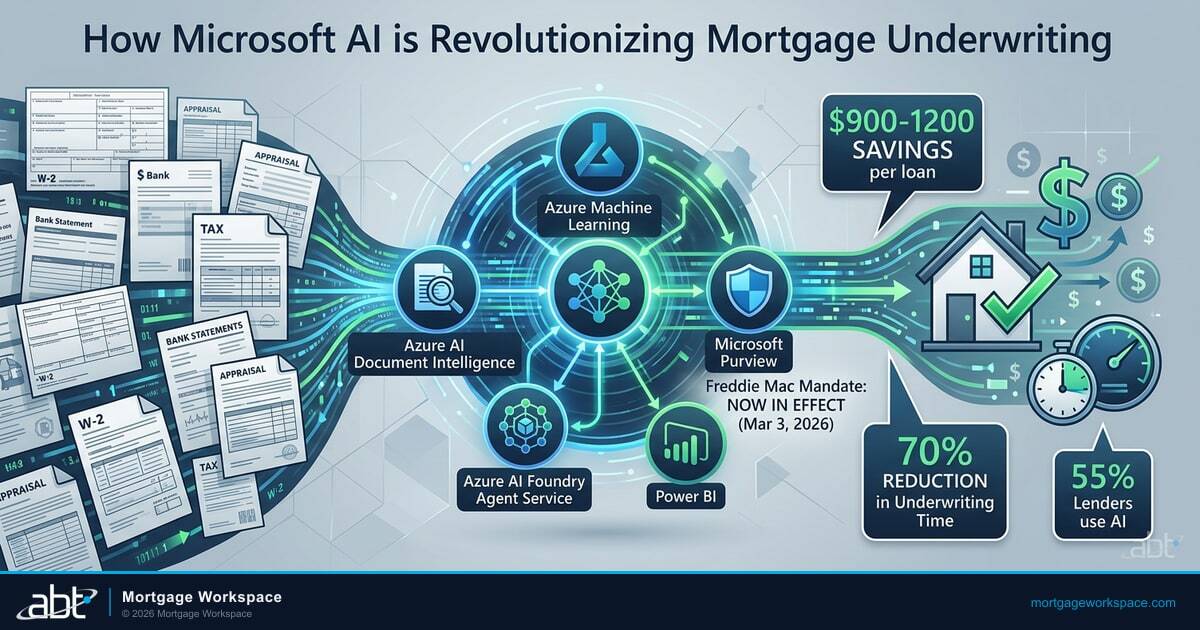
The adoption numbers explain why Freddie Mac acted. Fifty-five percent of mortgage lenders now use AI technologies in their operations. Gateless reports 70% to 75% auto-clearing rates on its Smart Underwrite platform, with projections of 85% by late 2026. GreenState Credit Union increased its general approval rate by 26% and its approval rate for protected classes by 32% using AI underwriting, with no added risk. Microsoft launched Azure AI Foundry Agent Service with multi-agent workflows that handle document verification, eligibility assessment, and loan calculations through GPT-4o powered agents. AI in underwriting is the production environment, not a pilot program.
This guide covers how Microsoft AI tools work at each stage of mortgage underwriting, what Freddie Mac's governance requirements mean for your implementation, and how an ABT-managed deployment of Microsoft 365 Copilot, Mortgage BI, and MortgageExchange pulls the stack together so the technology delivers underwriting speed and audit-ready evidence at the same time.
Why AI Underwriting Is Spreading Across the Industry
Traditional underwriting has a math problem. Underwriters spend roughly 70% of their time on document review and data verification. That leaves 30% for actual risk assessment, the part that requires judgment, experience, and pattern recognition. AI flips that ratio.
Three forces accelerated adoption in the past 12 months:
Speed is now a competitive requirement. Lenders using AI-assisted underwriting approve loans in minutes, not days. When a borrower can get a decision from one lender in 20 minutes and from another in 5 days, the slower lender loses the deal. AI-assisted underwriting tools deliver average savings of $900 to $1,200 per loan in processing costs.
Document volumes keep growing. Fannie Mae's UAD 3.6 and UCD v2.0 updates added new data requirements. State regulations layer additional documentation demands. The average loan file now exceeds 500 pages. No human team can scale with that growth without AI-assisted document processing.
Fair lending scrutiny is increasing. The Government Accountability Office reported in May 2025 that financial agencies are training staff, forming AI working groups, and collaborating internationally to build AI oversight capabilities. The GAO has since called on the Federal Housing Finance Agency to provide guidance to Fannie Mae and Freddie Mac regarding fair lending requirements for property technology deployed in the homebuying process. Companies that deploy AI without governance frameworks face regulatory problems. Freddie Mac's Bulletin 2025-16 made that explicit.
57% of mortgage professionals predict AI-driven underwriting will create the greatest mortgage industry change in 2026.
National Mortgage News Survey, 2025Your Data Governance Gaps Are Showing
AI agents need guardrails. Your Microsoft 365 tenant configuration determines whether Copilot helps your institution or exposes it. Find out where you stand.
The Microsoft AI Stack for Mortgage Underwriting
Microsoft offers a layered AI stack that handles every part of mortgage underwriting. Each tool covers a different part of the process. ABT operates these tools as a Tier-1 Microsoft Cloud Solution Provider, managing tenants under delegated administration so the bank, credit union, or independent mortgage banker gets the productivity outcome without the partner-program mechanics underneath it.
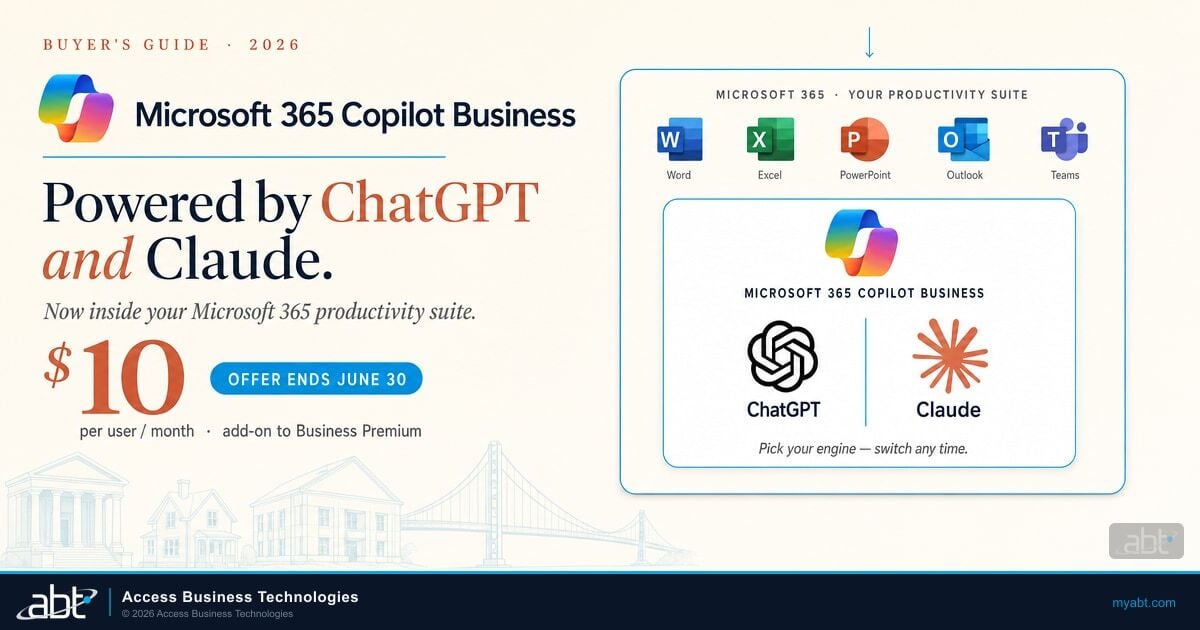
Microsoft 365 Copilot is the workplace AI layer that sits inside Outlook, Word, Excel, Teams, and SharePoint where your underwriters, processors, and loan officers already work. Copilot summarizes long borrower email threads, drafts initial conditions letters, pulls data out of W-2s and bank statements into Excel for analysis, and answers natural-language questions about loan files in SharePoint. For mortgage lenders this is the highest-frequency AI surface, because it improves every existing workflow without moving the underwriter into a new tool. ABT enables Copilot inside the firm's tenant with the Microsoft Purview governance, sensitivity labels, and Conditional Access policies tuned to mortgage NPI before the first underwriter ever opens it.
Azure AI Document Intelligence (formerly Form Recognizer) extracts data from mortgage documents using optical character recognition and natural language processing. It reads pay stubs, W-2s, tax returns, bank statements, and appraisal reports. It handles PDFs, scanned images, and photographed documents. Extraction accuracy exceeds 95% on structured financial documents.
Azure Machine Learning builds the predictive models that assess borrower risk. Train models on your historical loan performance data to predict repayment probability, identify risk factors, and score applications based on hundreds of variables beyond traditional credit metrics.
Azure AI Foundry Agent Service orchestrates multi-agent workflows. Microsoft published a detailed architecture in 2025 showing GPT-4o powered agents handling document verification, eligibility assessment, loan calculations, packet assembly, and digital signing integration. Each agent specializes in one task. The orchestration layer coordinates the sequence.
Microsoft Purview handles AI governance and compliance. It provides audit trails for every AI-assisted decision, tracks model performance, and enforces data access policies. This is the tool that helps you meet Freddie Mac's continuous governance requirements.
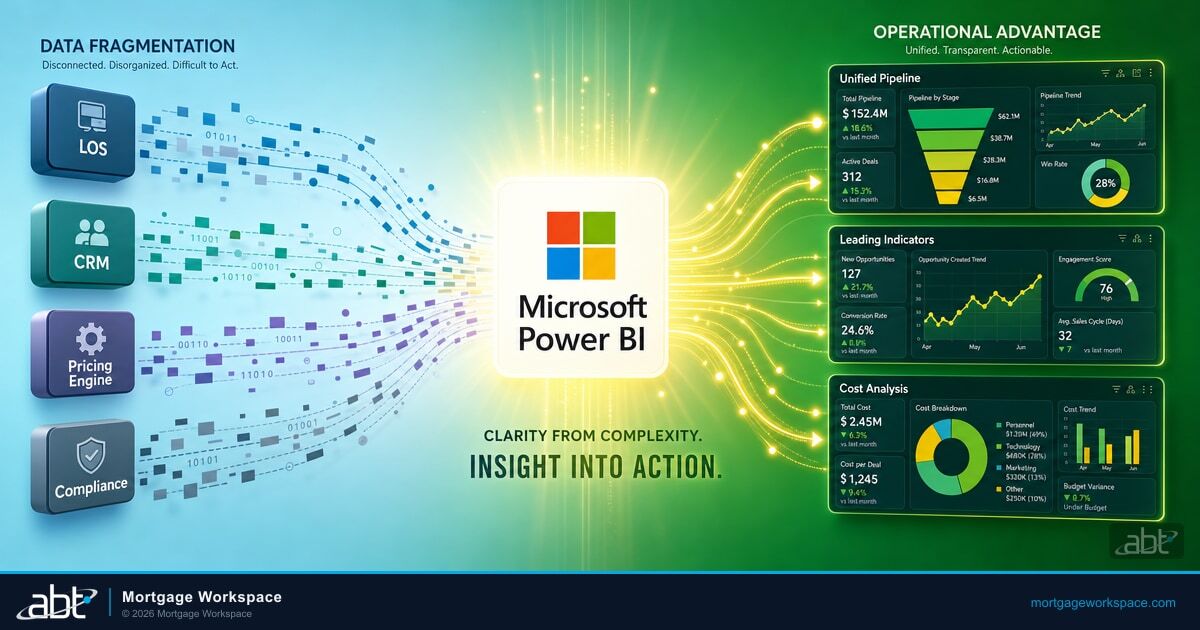
Power BI and Mortgage BI. Power BI creates dashboards that give underwriting managers real-time visibility into AI-assisted pipeline metrics: auto-clearing rates, exception rates, turn times, and model confidence scores. ABT's Mortgage BI product is a mortgage-specific business intelligence layer built on Power BI with prebuilt visuals for loan pipeline, broker performance, channel margin, fallout, and locked-versus-funded rates so the lender starts on day one with the reports their executive team actually asks for, instead of building dashboards from raw data over six months.
Stage 1: AI-Powered Document Processing
Every underwriting decision starts with documents. The faster and more accurately you process them, the faster you reach a decision.
Intake and classification. Azure AI Document Intelligence receives the complete document package and classifies each file by type: income documentation, asset documentation, property records, credit reports, and disclosures. Classification happens in seconds, not minutes. Misfiled documents get flagged and re-routed automatically.
Data extraction. The AI extracts structured data from each document. From a W-2: employer name, wages, federal tax withheld, state tax withheld, Social Security wages. From a bank statement: account holder, account number, ending balance, average balance, large deposits. From an appraisal: property address, estimated value, comparable sales, condition rating.
Cross-referencing. Extracted data flows into validation rules. Does the income on the pay stub match the income on the tax return? Does the deposit pattern on the bank statement support the stated income? Does the property address on the appraisal match the purchase contract? The AI flags discrepancies for human review instead of requiring underwriters to find them manually.
Completeness checking. The system compares received documents against the required checklist for the specific loan type (conventional, FHA, VA, jumbo). Missing documents generate automated requests to the borrower or processor before the file reaches the underwriter's queue.
Stage 2: Income and Employment Verification
Income verification is where traditional underwriting consumes the most time and where AI delivers the largest savings.
Multi-source income analysis. The AI analyzes income across document types simultaneously. Pay stubs provide current earnings. Tax returns provide annual income trends. Bank deposits provide actual cash flow. The system reconciles these sources and flags significant discrepancies. A borrower claiming $8,000 per month on the application but showing $5,500 per month in bank deposits gets flagged, not approved.
Self-employed income calculation. Self-employed borrowers produce the most complex income documentation. Two years of tax returns, profit and loss statements, Schedule C or K-1 forms, and business bank statements. Azure Machine Learning models trained on self-employed loan data calculate qualifying income from these documents in seconds, applying the same depreciation add-back and business expense analysis that experienced underwriters perform manually.
Employment stability assessment. The AI evaluates employment history for gaps, job changes, and industry risk factors. A borrower with 10 years at the same employer in a stable industry scores differently than one with three job changes in two years in a volatile sector.
Alternative data analysis. For borrowers with non-traditional income, Azure ML models analyze rental payment history, utility payment patterns, and banking transaction trends. This expanded data view supports credit-worthy borrowers who may not qualify under rigid traditional analysis, supporting both fair lending goals and business growth.
Stage 3: Credit and Risk Assessment
AI does not replace the underwriter's risk judgment. It gives the underwriter better data and more time to apply that judgment.
Predictive risk modeling. Azure Machine Learning models analyze hundreds of variables across your historical loan portfolio. Beyond credit score and DTI ratio, the models evaluate spending pattern changes, credit utilization trends, payment timing patterns, and geographic risk factors. The output is a risk probability score that supplements traditional AUS findings.
Exception detection. The AI identifies loans that fall outside standard guidelines but may still be approvable with compensating factors. A borrower with a 38% DTI but substantial reserves and excellent payment history gets flagged for exception review rather than automatic decline.
Fraud pattern recognition. Machine learning models trained on known fraud cases identify suspicious patterns: straw buyer indicators, income inflation red flags, property flipping schemes, and identity inconsistencies. These patterns are difficult for human reviewers to spot across individual files but visible to AI systems analyzing data at scale.
Collateral risk assessment. AI models analyze property data, comparable sales trends, and market conditions to assess collateral risk. A property in a declining market with limited comparable sales receives a different risk treatment than one in a stable market with strong recent sales activity.
Freddie Mac's Automated Collateral Evaluation (ACE+ PDR) uses AI to enable loan delivery without a traditional appraisal report. ACE+ PDR loans close an average of 12 days faster for purchases and 10 days faster for refinances. Borrowers save approximately $400 per transaction. In 2025, Freddie Mac expanded ACE+ PDR eligibility to cover higher LTV ratios, broadening access to AI-powered valuations across more loan products.
Anchoring AI to the Mortgage Stack: Copilot, Mortgage BI, and MortgageExchange
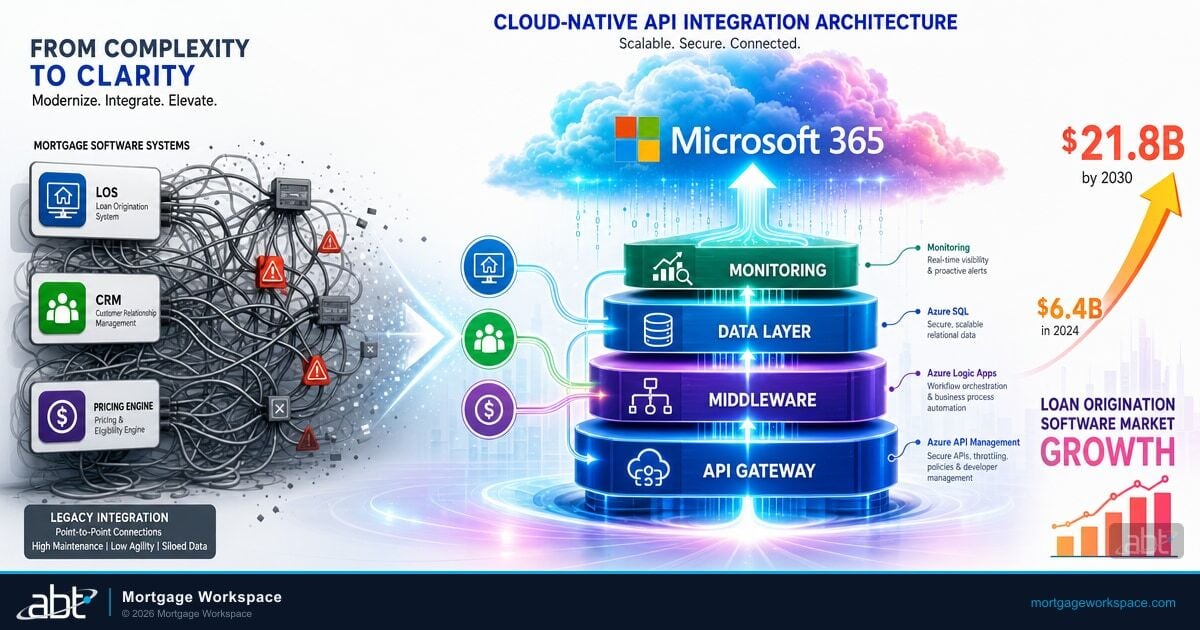
The Microsoft AI tools described above are the engine. The mortgage stack underneath them is where the engine has to land. A document intelligence model that extracts borrower income in two seconds is useful only if that income flows into the loan origination system without a processor re-keying it. A risk probability score from Azure Machine Learning is useful only if it shows up next to the AUS findings on the underwriter's screen. AI value is realized at the integration seam, not in the model.
Microsoft 365 Copilot is the daily AI surface for underwriters and processors. Copilot sits inside the Outlook inbox where conditions get cleared, inside the SharePoint library where loan files live, inside the Excel workbook where the underwriter is reconciling income, and inside the Teams chat where the processor and the underwriter resolve exceptions. ABT enables Copilot for mortgage lenders with the Microsoft Purview sensitivity labels that keep borrower NPI from leaking into prompts, the Conditional Access policies that scope Copilot to managed devices, and the data-loss-prevention rules that block paste-into-consumer-AI behaviors before the first audit cycle. The productivity unlock for a 25-underwriter shop is roughly the equivalent of adding three full-time underwriters without adding the headcount.
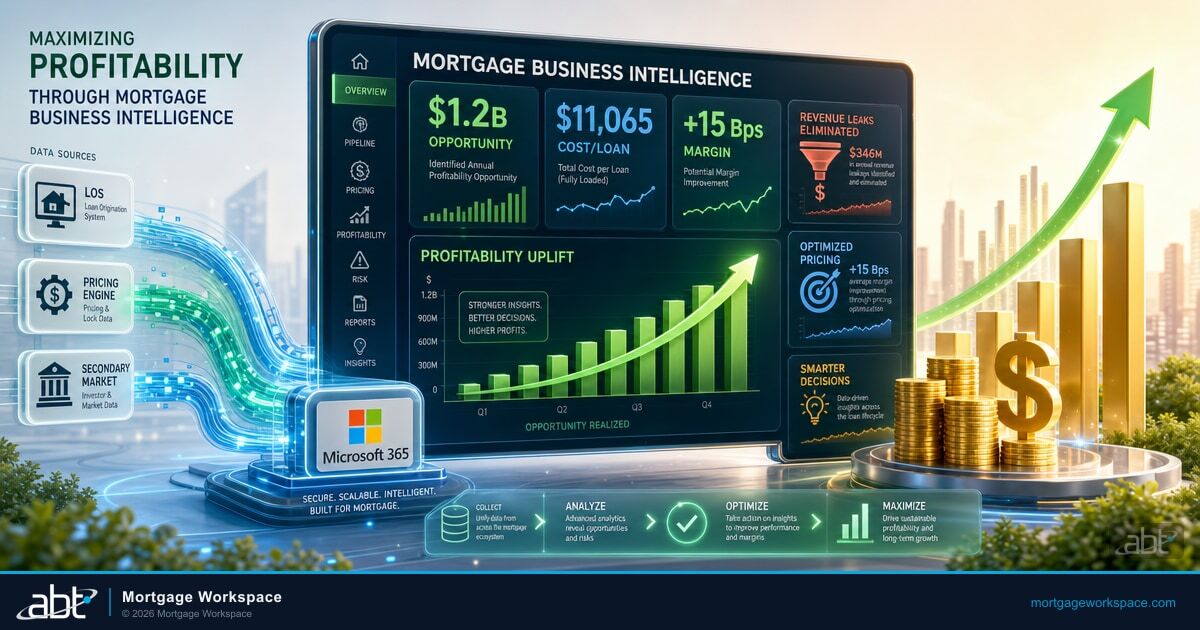
Mortgage BI is the dashboard layer that makes AI-assisted underwriting measurable. Freddie Mac's continuous governance requirement is not satisfied by a one-time policy document. Examiners want to see ongoing monitoring of approval rates, exception rates, model confidence, override frequency, and demographic fairness across the lender's actual loan production. ABT's Mortgage BI is built on Power BI with prebuilt visuals for AI-assisted-pipeline KPIs alongside the standard mortgage executive reporting (lock-to-fund ratios, broker performance, channel margin, fallout). A CIO or Chief Risk Officer signs into a single dashboard and sees both the business view and the governance view side by side, instead of running spreadsheets out of two different systems.
MortgageExchange is the integration layer between Microsoft AI and the loan origination system. The largest unsolved problem in mortgage AI is not the model quality. It is the data movement. Azure AI Document Intelligence extracts borrower income from a pay stub in two seconds, and then a processor spends 20 minutes typing that same income into Encompass, Calyx, Empower, Optimal Blue, or the firm's core banking system because the model output never reached the LOS. ABT's MortgageExchange is the custom interface that connects the Microsoft AI extraction layer to the loan origination system the lender actually runs. The borrower income, the property address, the bank balance, the credit pull, and the AI risk score all flow into the LOS field-by-field, with a documented audit trail that satisfies the SEA Rule 17a-3 and 17a-4 recordkeeping bar. The AI savings become real savings only after the integration is in place, and MortgageExchange is the largest interface product ABT operates for mortgage lenders.
For a focused view of how Microsoft Copilot fits into mortgage operations specifically, see our companion article: Microsoft Copilot Mortgage Operations Guide.
Meeting Freddie Mac's New AI Governance Requirements
Freddie Mac Bulletin 2025-16 changed the compliance landscape for every lender using AI. The bulletin covers AI-enabled vendors and tools too, not just models you build in-house. Here is what your organization needs.
Cross-functional governance body. Freddie Mac requires a governance committee that includes leadership from IT, cybersecurity, risk management, legal, compliance, and business operations. This body oversees AI policy, reviews model performance, and makes decisions about AI deployment across the loan lifecycle.
Senior management accountability. The framework now requires CIO, CTO, or Chief Risk Officer sign-off on the lender's AI policies. This is not a committee recommendation. It is executive accountability for AI governance decisions.
Continuous model monitoring. Annual reviews are no longer sufficient. You need ongoing monitoring of model performance, accuracy, and bias detection. Microsoft Purview provides the audit infrastructure. Azure Machine Learning tracks model drift, prediction accuracy, and fairness metrics in real time. Mortgage BI surfaces the same monitoring data to the executive team in a single dashboard.
Documented risk management. Every AI model needs a risk assessment covering intended use, data inputs, output interpretation, and failure modes. Freddie Mac wants to see that you understand what your AI does, how it makes decisions, and what happens when it gets something wrong.
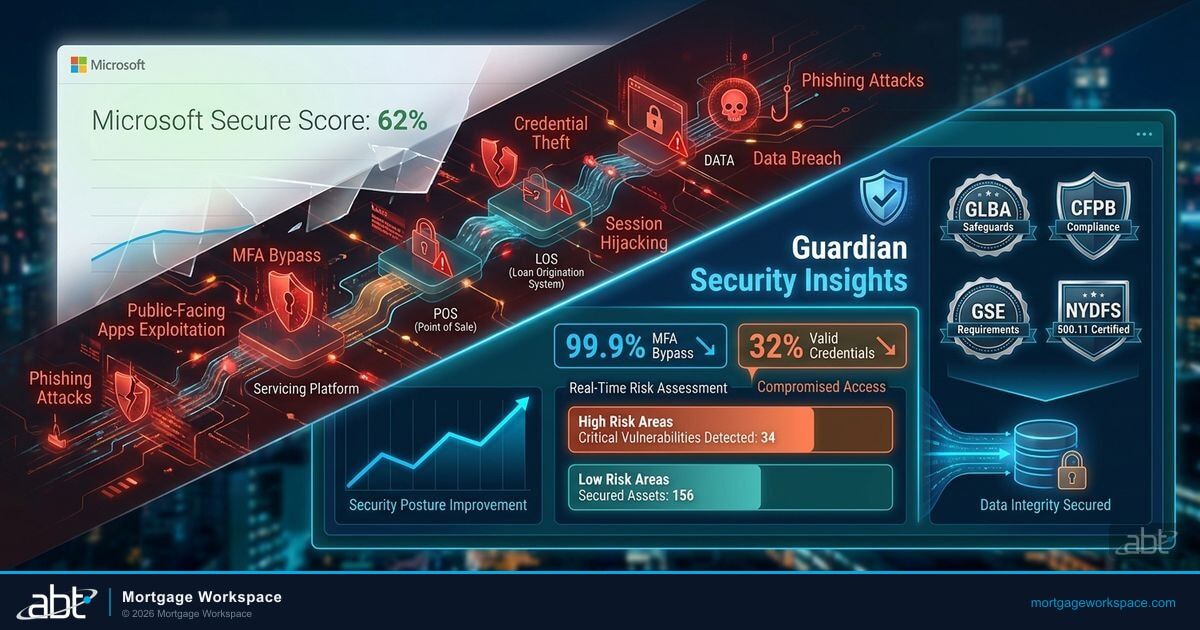
AI-specific security guardrails. The framework defines guardrails to prevent AI-specific threats including model inversion, data poisoning, and prompt injection attacks. Lenders must separate responsibilities to prevent conflicts of interest in AI development and deployment.
Demonstrable human oversight. Human underwriters must review AI outputs, not rubber-stamp them. Your process needs to document how underwriters evaluate AI recommendations, when they override them, and how overrides are tracked.
Fair lending testing. Run regular adverse impact analyses on AI-assisted lending decisions. Compare approval rates, pricing, and terms across demographic groups. Azure Machine Learning's responsible AI toolkit includes fairness assessment features designed for this purpose.
Vendor oversight. If you use third-party AI tools (Gateless, ICE Mortgage Technology, or any vendor with AI in the workflow), you must demonstrate governance over those tools too. Freddie Mac's requirements cover the entire AI supply chain, not just your internal models.
The framework focuses on three core principles: transparency, accountability, and ethical stewardship. You need to know where you are using AI, who is responsible for it, and how its use is controlled and monitored over time.
MQM Research, Freddie Mac AI Governance FAQ, 2025For a complete compliance checklist and implementation timeline, see our companion article: Freddie Mac AI Mandate Compliance Checklist.
The 2026 AI Underwriting Adoption Landscape
The regulatory mandate arrived alongside an acceleration in AI adoption that makes governance more urgent, not less.
Budget commitments are growing. A Celent study commissioned by Zest AI found that 83% of lenders plan to increase their generative AI budgets in 2026. Two-thirds of lenders have already completed or will implement GenAI strategies by 2026, a faster adoption rate than previous lending technology waves.
Origination volumes respond to AI investment. Lenders implementing AI-powered platforms report a 50% increase in mortgage origination volume. Those without AI face an increasingly steep competitive disadvantage as borrowers expect faster decisions and streamlined processes.
Regulatory encouragement, not just enforcement. Over a third (37%) of lenders say the current regulatory environment encouraged them to accelerate AI adoption in underwriting. Freddie Mac's governance framework is not designed to block AI. It is designed to ensure AI is deployed responsibly.
For a broader view of how AI vendor risk affects mortgage companies, see our analysis of FHFA's AI vendor risk guidance.
The Human-Plus-AI Underwriting Model
The most effective AI underwriting implementations follow a clear division of labor.
AI handles: document classification, data extraction, cross-referencing, completeness checking, income calculation, initial risk scoring, fraud pattern detection, and compliance rule checking. These are high-volume, pattern-based tasks where speed and consistency matter more than judgment.
Humans handle: exception decisions, compensating factor evaluation, borrower conversations, complex income analysis for unusual situations, final risk determination, and override documentation. These are judgment-intensive tasks where experience and context matter more than speed.
The result is faster underwriting because quality improves. When the AI handles document review, the underwriter reads a structured summary instead of 500 pages. When the AI flags discrepancies, the underwriter investigates specific issues instead of searching for them. Gateless reports that this model produces 70% to 75% auto-clearing rates today, with the remaining files receiving focused human review.
The ABT Advantage for Mortgage Lenders
Access Business Technologies is a Tier-1 Microsoft Cloud Solution Provider that manages Microsoft 365 tenants for more than 750 financial institutions, with mortgage companies a core part of that footprint. ABT manages the Microsoft 365 tenant where Copilot runs, hosts the Azure environment where the AI extraction models execute, and operates MortgageExchange as the custom interface that connects the AI output to Encompass, Calyx, Empower, or the lender's loan origination system of record. Mortgage BI sits over the whole pipeline and reports the AI-assisted underwriting KPIs the firm's executive team and Freddie Mac examiner both want to see. The lender keeps its Microsoft licensing, owns its loan data, and retains the regulatory relationship. ABT operates the AI control plane so the lender's underwriters, processors, and loan officers experience faster decisions, cleaner files, and audit-ready evidence without becoming a Microsoft systems integration shop on the side.
Key Takeaway
Microsoft AI changes the math on mortgage underwriting. Microsoft 365 Copilot is the daily productivity surface for underwriters and processors. Mortgage BI is the executive dashboard that makes AI-assisted underwriting measurable and Freddie Mac-governable. MortgageExchange is the integration that connects Microsoft AI to the lender's loan origination system. A Tier-1 Microsoft Cloud Solution Provider applies, monitors, and documents the deployment so the lender experiences the speed gain and the compliance gain at the same time.
"Every Copilot deployment we have evaluated has at least three governance gaps that would expose sensitive data to AI summarization. The fix is straightforward, but you have to find the gaps first."
Serving 750+ financial institutions since 1999
Get a Mortgage AI Readiness Review
ABT runs the Microsoft 365 Copilot, Mortgage BI, and MortgageExchange stack for mortgage lenders preparing for Freddie Mac Bulletin 2025-16. A 30-minute conversation maps your current tenant footprint, surfaces the AI governance gaps your next examiner is most likely to find, and outlines what an ABT-managed deployment would cover. No commitment, no quote, no obligation.
Frequently Asked Questions
No. Microsoft AI handles document processing, data extraction, cross-referencing, and initial risk scoring. Human underwriters review AI outputs, make exception decisions, evaluate compensating factors, and render final lending decisions. The AI shifts underwriter time from routine document review to judgment-intensive risk analysis where their experience matters most.
Freddie Mac Bulletin 2025-16, effective March 3, 2026, requires mortgage sellers and servicers to implement continuous risk-based AI governance covering the entire loan lifecycle. Lenders must demonstrate ongoing model monitoring, documented risk management, human oversight, regular fair lending testing, security alignment, and vendor AI oversight. It replaces annual policy reviews with continuous governance.
Microsoft 365 Copilot sits inside Outlook, Word, Excel, Teams, and SharePoint where underwriters, processors, and loan officers already work. It summarizes borrower email threads, drafts initial conditions letters, extracts data from W-2s and bank statements into Excel, and answers natural-language questions about loan files in SharePoint. With Microsoft Purview sensitivity labels and Conditional Access policies in place, Copilot delivers the daily productivity gain without exposing borrower NPI. ABT enables Copilot for mortgage lenders with the governance configured before the first underwriter opens it.
Azure AI Document Intelligence uses optical character recognition and natural language processing to extract structured data from mortgage documents including pay stubs, W-2s, tax returns, bank statements, and appraisals. It classifies documents by type, extracts key fields, cross-references data across sources, and flags discrepancies for human review. Extraction accuracy exceeds 95% on structured financial documents. ABT routes the extracted data through MortgageExchange into the lender's loan origination system so the AI output reaches Encompass, Calyx, or Empower without a processor re-keying it.
Mortgage BI is ABT's mortgage-specific business intelligence layer built on Power BI. It surfaces approval rates, exception rates, model confidence scores, override frequency, and demographic fairness metrics alongside the standard mortgage executive reporting like lock-to-fund ratios, broker performance, channel margin, and fallout. A CIO or Chief Risk Officer signs into a single dashboard and sees both the business view and the Freddie Mac governance view side by side, instead of running spreadsheets across two systems. The continuous monitoring required by Bulletin 2025-16 becomes a recurring report instead of a manual audit.
MortgageExchange is ABT's custom interface that connects the Microsoft AI extraction layer to the loan origination system the lender actually runs. Azure AI Document Intelligence extracts borrower income from a pay stub, but the value only becomes real when that income lands in Encompass, Calyx, Empower, Optimal Blue, or the firm's core banking system without re-keying. MortgageExchange moves the borrower income, property address, bank balance, credit pull, and AI risk score field-by-field into the LOS with a documented audit trail. It is the integration layer that converts AI savings on paper into AI savings on the production floor.
Mortgage companies run regular adverse impact analyses comparing AI-assisted approval rates, pricing, and terms across demographic groups. Azure Machine Learning includes responsible AI fairness assessment tools that identify disparate impact in model outputs. Companies document test results, remediation actions, and ongoing monitoring to satisfy both regulatory expectations and Freddie Mac Bulletin 2025-16 governance requirements. Mortgage BI surfaces the fairness metrics on the same executive dashboard that carries the rest of the AI-assisted pipeline KPIs.
Yes. Freddie Mac Bulletin 2025-16 took effect March 3, 2026. Any mortgage with an application received date on or after that date must comply with the new AI governance requirements. Lenders without formal AI policies, risk assessments, and senior management accountability face compliance exposure on every loan delivered to Freddie Mac.