In This Article
Fannie Mae's 2025 cybersecurity supplement now requires lenders to report cybersecurity incidents within 36 hours. HUD's Mortgagee Letter 2024-10 tightens that to 12 hours for FHA lenders. The NYDFS Part 500 amendments mandate universal MFA certification by April 2026. And the Homebuyers Privacy Protection Act, passed in September 2025, takes effect March 4, 2026, restricting how lenders use trigger lead data.
Regulatory change is hitting mortgage lending from every direction simultaneously. Microsoft 365 gives lenders the tools to keep up. But tools without proper configuration and monitoring create a false sense of compliance. The question is not whether the controls exist inside Microsoft 365. The question is whether they are configured, monitored, and documented in a form your next examiner will accept. That is where a managed Microsoft 365 footprint changes the picture.
Regulatory Challenges Facing Mortgage Lenders in 2026
Mortgage lending operates under overlapping federal, state, and GSE requirements. Each layer adds compliance obligations that compound in complexity.
Rapidly Shifting Compliance Requirements
The CFPB has an active rulemaking agenda covering loan originator compensation, servicing standards under RESPA, Equal Credit Opportunity Act changes, and personal financial data rights. The agency withdrew several guidance documents in May 2025, creating uncertainty about enforcement priorities. State regulators, particularly California with its finalized CCPA amendments requiring automated decision-making disclosures and annual cybersecurity audits, are filling regulatory gaps independently.
Escalating Data Security Demands
The FTC Safeguards Rule requires mortgage lenders to implement nine core security controls including MFA for all system access, encryption at rest and in transit, penetration testing, and written incident response plans. Breach notification requirements took effect in May 2024, mandating FTC notification within 30 days for incidents affecting 500+ consumers.
The financial services sector experienced 739 data compromises in 2025. The U.S. saw a record 3,322 total compromises, a 79% increase over five years. Attackers are more targeted. Average breach cost: $4.4 million.
Audit and Documentation Burden
Every loan file, every borrower communication, every compliance decision needs a retrievable audit trail. Fannie Mae's cybersecurity supplement requires annual officer attestation covering 14 security domains. State licensing fee increases from the Conference of State Bank Supervisors add to operational costs. Manual compliance processes cannot scale.
Third-Party Vendor Risk
Third-party breaches accounted for 30% of all data compromises in 2024. The NYDFS has stated that regulated entities cannot delegate Part 500 compliance obligations to vendors. You own your compliance posture even when you outsource operations. Every vendor relationship requires documented risk assessment, contractual security requirements, and ongoing oversight.
How Microsoft 365 Addresses Compliance Requirements
Microsoft 365 is built for regulated industries. Its compliance, security, and collaboration tools map directly to the frameworks mortgage lenders must satisfy.
Security and Compliance Infrastructure
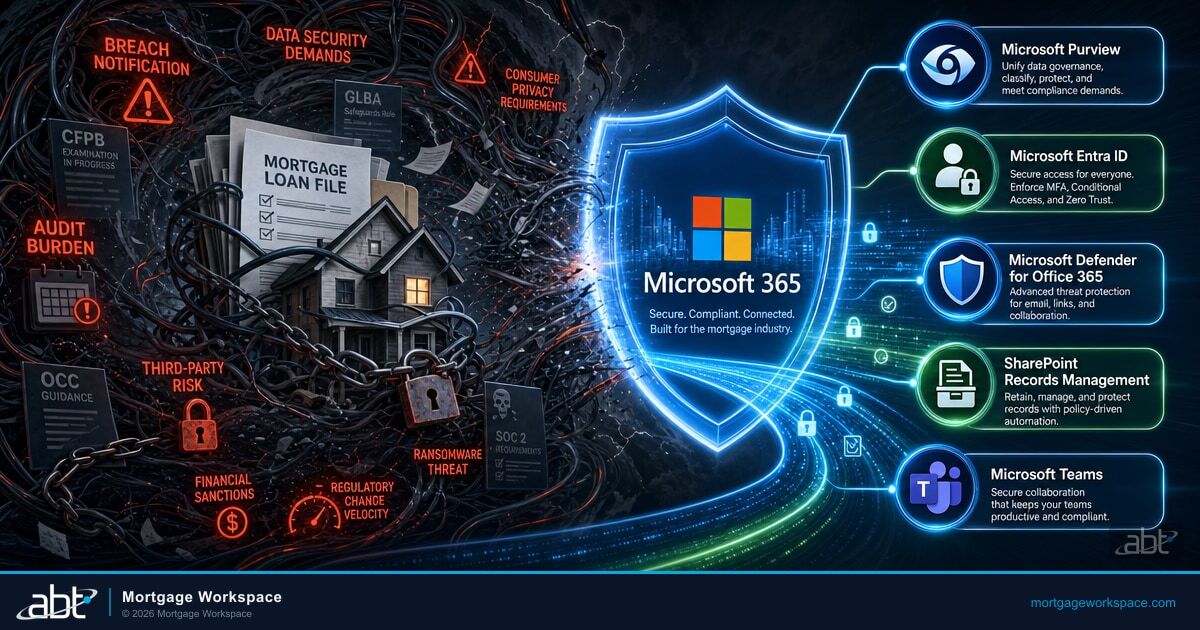
Microsoft 365 meets SOC 2, ISO 27001, and FedRAMP certification requirements. Microsoft has published risk assessment tools specifically for GLBA compliance, mapping Azure and Microsoft 365 capabilities to each regulatory requirement. Microsoft Purview Compliance Manager includes templates for GLBA, FFIEC Information Security Booklet, and the FTC Safeguards Rule.
The regulatory-ready Microsoft 365 baseline for lenders is a specific stack of three controls running together. Microsoft Purview Audit produces the time-stamped trail of every create, modify, and delete action across Exchange Online, SharePoint Online, OneDrive, and Microsoft Teams, which is the recordkeeping floor that GSE attestations and state examiners increasingly ask to see in raw form. Microsoft Purview sensitivity labels travel with loan files and borrower correspondence regardless of where the document moves, satisfying the FTC Safeguards Rule's data protection requirements and the Homebuyers Privacy Protection Act's restrictions on consumer financial data handling. Microsoft Entra ID Conditional Access enforces MFA against the actual sign-in risk signal, blocks legacy authentication, and locks impossible-travel patterns, which together satisfy the NYDFS Part 500 universal MFA mandate and the Safeguards Rule's access control requirements. Configured together, those three controls form the Microsoft 365 regulatory baseline. Configured separately or left at vendor defaults, they leave the same compliance gaps a manual checklist would. See also our breakdown of Microsoft 365 Copilot Buyer's Guide for Mortgage Lenders.
Real-Time Collaboration with Built-In Audit Trails
Microsoft Teams, OneDrive, and SharePoint Online provide real-time collaboration with automatic version tracking. Every document edit, every file share, every access event is logged. When auditors request documentation, the trail already exists. No manual reconstruction needed.
Automated Compliance Monitoring
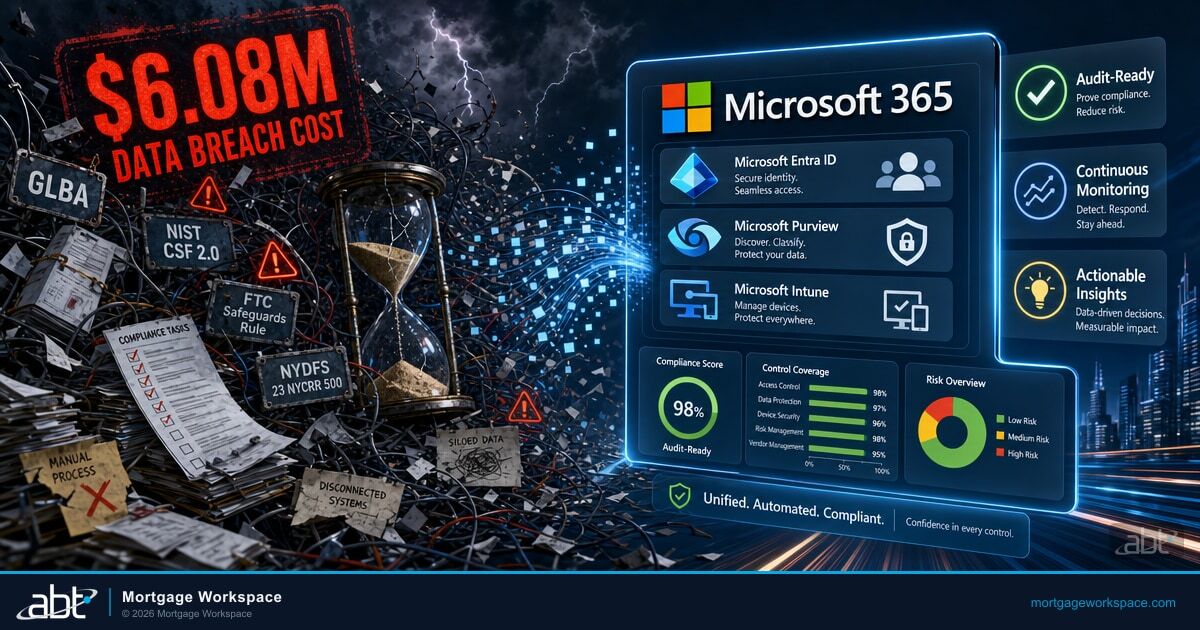
Microsoft Purview Compliance Manager provides a numerical compliance score that updates as you implement recommended actions. It identifies gaps, suggests specific configuration changes, and tracks remediation progress. The December 2025 update introduced AI-powered regulatory templates that convert regulatory PDFs into actionable controls.
Scalable Architecture
Whether you run a 20-person brokerage or a 500-seat lending operation with multiple branches, Microsoft 365 scales without architectural changes. Conditional Access policies, Data Loss Prevention rules, and compliance configurations apply across the entire organization from a single management plane.
Key Microsoft 365 Features for Regulatory Compliance
Microsoft Purview Compliance Manager
Compliance Manager calculates a score based on your current configuration against regulatory frameworks. For mortgage lenders, the GLBA and FFIEC templates map directly to FTC Safeguards Rule requirements. It recommends specific improvement actions, prioritized by impact. It generates reports suitable for annual attestation and board-level compliance reporting.
Microsoft Purview Information Protection
Sensitivity labels classify and protect loan documents, borrower correspondence, and financial records. Labels travel with the document regardless of where it is stored or shared. Data Loss Prevention policies prevent sensitive borrower data from leaving the organization through email, Microsoft Teams, or file sharing without appropriate protections.
Microsoft Entra ID and Conditional Access
Microsoft Entra ID manages identity and access across your Microsoft 365 environment. Conditional Access policies enforce MFA based on risk signals, restrict access from non-compliant devices, and block sign-ins from impossible travel locations. These controls satisfy the FTC Safeguards Rule's access control requirements and the NYDFS universal MFA mandate.
SharePoint Records Management
SharePoint Online provides compliant document storage with retention policies, legal holds, and records management capabilities. Loan files, contracts, and borrower communications archive automatically based on configurable rules. Compliance archiving preserves records for the periods required by GLBA, state regulations, and GSE requirements.
Microsoft Teams with Compliance Controls
Microsoft Teams replaces fragmented communication channels with a single secure platform. Compliance recording captures conversations for regulatory review. Information barriers prevent inappropriate communication between departments. Retention policies apply to chat messages and meeting recordings, ensuring nothing falls outside your compliance framework.
Microsoft Defender for Office 365
Email remains the primary attack vector. Microsoft Defender for Office 365 provides AI-driven phishing detection, Safe Links that scan URLs in real time, Safe Attachments that detonate suspicious files in a sandbox, and anti-impersonation policies that protect executives and key finance personnel from targeted attacks.
The ABT Productized Regulatory Framework for Mortgage Shops
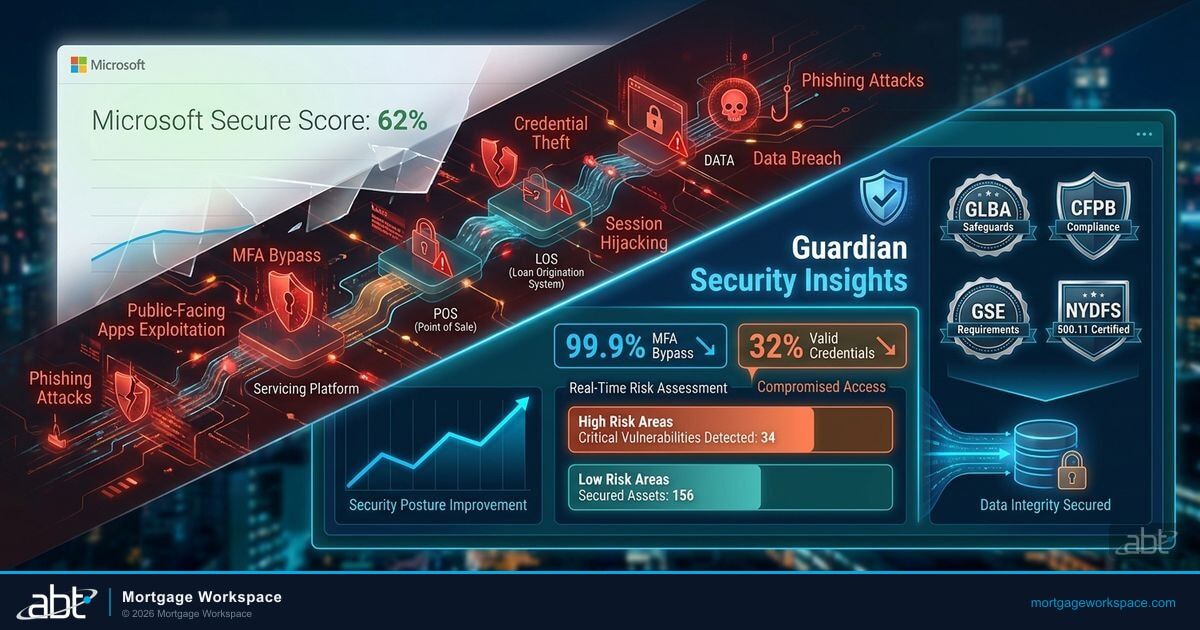
Microsoft 365 supplies the controls. ABT supplies the operating model that runs them for a mortgage shop the way mortgage examiners expect to see them run. That operating model has a name and a product surface: M365 Guardian paired with MortgageWorkSpace. M365 Guardian is the configuration, monitoring, and 24x7 SOC layer Access Business Technologies applies on top of every managed Microsoft 365 tenant. It is the layer that turns Microsoft Entra ID Conditional Access into mortgage-specific access patterns, turns Microsoft Purview Audit retention into SEA Rule 17a-4-aligned recordkeeping evidence, and turns Microsoft Defender for Office 365 into a tuned email security posture for the recurring impersonation patterns mortgage lenders see. MortgageWorkSpace is the mortgage-vertical wrapper around that managed Microsoft 365 footprint, integrating the loan origination system connectivity, document management workflows, and pipeline reporting the rest of the shop runs on. Together, M365 Guardian plus MortgageWorkSpace are ABT's productized answer to the same question every lender's compliance officer is now asking: how do we keep our Microsoft 365 tenant inside the regulatory baseline without consuming half the IT team's week reconciling configurations across portals.
That productized framework is why ABT can show up to a Fannie Mae attestation cycle, a state cybersecurity audit, or a CFPB enforcement inquiry with the technical evidence already in hand for more than 750 financial institutions. ABT manages Microsoft 365 tenants under delegated administrative privileges, which means Microsoft hosts the infrastructure and ABT operates the controls on top of it. The lender keeps the Microsoft 365 licensing, owns the customer relationships, and signs the attestations. ABT runs the operational layer that produces the evidence behind them.
Implementation Tips for Lending Organizations
1. Assess Your Compliance Gaps First
Run Microsoft Purview Compliance Manager against your current environment before making changes. The baseline score identifies which regulatory requirements you already meet and which need attention. Prioritize gaps that affect your highest-risk areas: borrower data protection, email security, and access controls.
2. Start with One Department
Test new policies with your loan servicing team or compliance department before rolling out organization-wide. This approach catches workflow disruptions before they affect production. Conditional Access policies, DLP rules, and sensitivity labels can be scoped to specific groups for piloting.
3. Automate Compliance Workflows
Power Automate can handle routine compliance tasks that consume staff time. Automated workflows send reminders for data review deadlines, route documents for compliance approval, trigger alerts when retention periods expire, and generate compliance reports on schedule. Every automated workflow reduces manual error risk.
4. Train Staff on Tools, Not Just Policies
Compliance training that only covers regulations is incomplete. Staff need hands-on training with Microsoft Purview Compliance Manager, sensitivity labels, DLP policy notifications, and Microsoft Teams compliance features. Microsoft's Attack Simulation Training provides phishing awareness in the same environment staff use daily.
5. Partner with a Mortgage-Specific Tier-1 Microsoft CSP
Microsoft 365 has hundreds of configuration settings. The difference between a secure environment and a checkbox deployment is in the details: which Conditional Access policies are active, how DLP rules are tuned, whether email authentication is properly enforced, and how quickly anomalies trigger investigation. We cover Microsoft 365 for Mortgage Industry in a companion piece.
MortgageWorkSpace, operated by Access Business Technologies, is a Tier-1 Microsoft Cloud Solution Provider serving 750+ financial institutions. M365 Guardian, ABT's productized control layer, handles tenant hardening, continuous compliance monitoring, and policy enforcement across the Microsoft 365 environment so the lender's IT and compliance staff can focus on the higher-judgment work their next examiner actually wants them doing. Our guide to CFPB Compliance and Your Microsoft 365 Environment goes deeper on this.
Get a Mortgage Lender Microsoft 365 Regulatory Readiness Review
ABT runs the M365 Guardian + MortgageWorkSpace operating model described in this article for mortgage shops across the country, from independent mortgage banks to multi-branch lending operations. A 30-minute conversation maps your current Microsoft 365 tenant footprint, surfaces the gaps your next Fannie Mae attestation, FTC Safeguards Rule audit, or state cybersecurity examination is most likely to find, and outlines what an ABT-managed deployment would cover. No commitment, no quote, no obligation.
Frequently Asked Questions
Fannie Mae's 2025 cybersecurity supplement requires lenders to report any cybersecurity incident within 36 hours of identification. This includes ransomware attacks, denial of service events, business email compromise, and any event that affects services or loan operations. Lenders must also establish a formal information security program aligned with NIST standards, appoint a senior executive to oversee the program, and provide annual officer attestation covering 14 security domains.
Microsoft Purview Compliance Manager includes regulatory assessment templates for GLBA and the FFIEC Information Security Booklet. It calculates a compliance score based on your current Microsoft 365 configuration, identifies gaps in data protection and access controls, and recommends specific improvement actions prioritized by impact. The tool generates reports that document your compliance posture for auditors and regulators, reducing the manual effort required for annual attestations.
The NYDFS Part 500 amendments require universal multi-factor authentication for all individuals accessing any information system, covering cloud applications like Microsoft 365, on-premise systems, third-party tools, and vendor access. The first annual certification is due April 15, 2026. Contracts with third-party service providers must require MFA to the same standard as internal users. Non-compliance can result in fines up to $100,000 per violation and criminal penalties up to five years in prison.
The Homebuyers Privacy Protection Act, passed in September 2025 and effective March 4, 2026, restricts how mortgage lenders can access and use consumer credit information for marketing purposes, specifically targeting trigger lead practices. Lenders must update their data handling and marketing processes to comply with the new restrictions on credit inquiry-based marketing. This affects how lead generation campaigns operate and requires changes to both data storage policies and outbound marketing workflows.
Sensitivity labels in Microsoft Purview Information Protection classify documents based on their content and intended audience. A loan application marked Confidential Borrower Data receives automatic encryption, access restrictions, and visual markings that travel with the file. Labels apply whether the document is stored in SharePoint Online, shared through Microsoft Teams, or attached to an email. For mortgage companies, this ensures borrower financial data stays protected across every collaboration scenario without relying on individual employee judgment.