In This Article
- What Loan Stacking Is and Why Detection Keeps Failing
- The Quiet Period Problem Between Application and Closing
- Six Detection Strategies Your Lending Software Needs
- How Undisclosed Debt Monitoring Closes the Gap
- AI-Powered Fraud Detection in Mortgage Lending Software
- MortgageExchange: The Spine That Makes Detection Actionable
- Calyx PointCentral on ABT-Hosted Azure for Mortgage Shops and Brokers
- Building Anti-Stacking Rules Into Your Origination Workflow
- Frequently Asked Questions
Mortgage fraud risk rose 8.2 percent year-over-year in Q3 2025, with 1 in 118 applications showing fraud indicators according to Cotality's quarterly report. Undisclosed real estate debt fraud led the surge at 12 percent growth. Identity fraud indicators climbed for the second consecutive year. And the CFPB's enforcement posture shifted in 2025, with the Bureau dismissing most pending actions and signaling reduced oversight at the federal level.
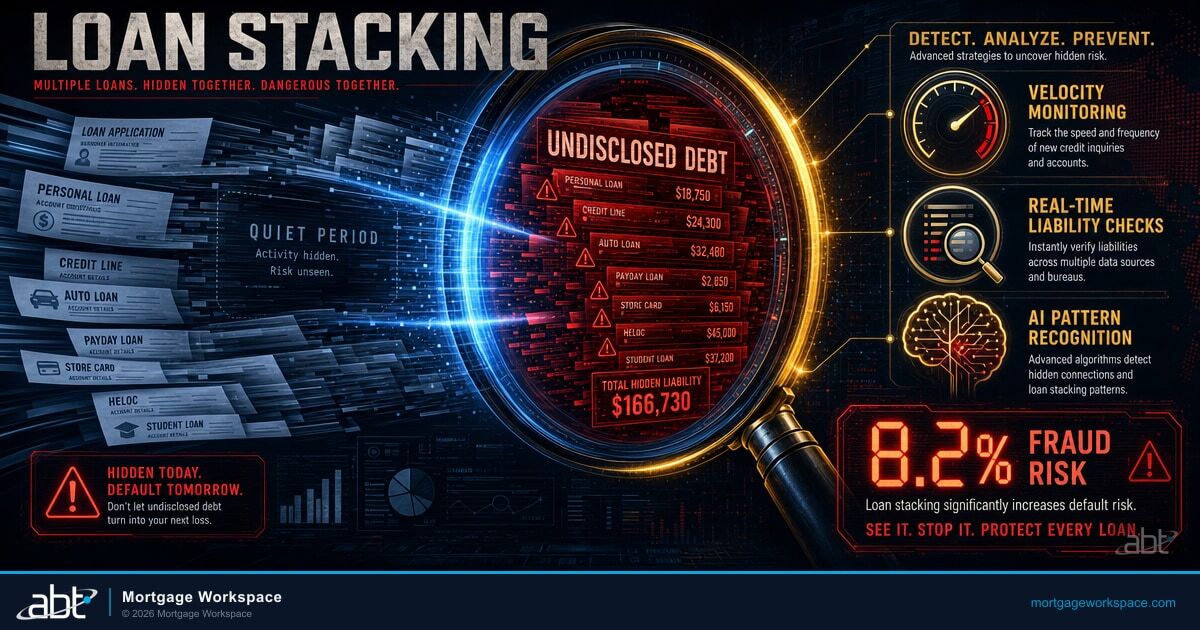
That combination of rising fraud and reduced federal enforcement creates a specific operational problem for mortgage lenders: loan stacking detection now falls almost entirely on your internal systems. When a borrower takes out three loans from three lenders in the same week, each lender sees only its own file. The borrower qualifies individually for each one. By the time credit bureaus update, the damage is already in the portfolio.
Lending software that handles loan stacking needs to do more than run a credit check at application. It needs velocity monitoring, continuous debt surveillance, cross-platform data sharing, and AI pattern recognition working together throughout the origination lifecycle. It also needs an integration spine that pushes verified borrower data through the LOS and into the core in real time, so the alerts actually land in front of the people who can act on them. This guide walks through how the loan stack has evolved, what your detection technology needs to catch what manual review misses, and how an ABT-managed Microsoft 365 footprint with ABT MortgageExchange and Calyx PointCentral pulls the whole picture together.
What Loan Stacking Is and Why Detection Keeps Failing
Loan stacking happens when a borrower takes out multiple loans in rapid succession, often from different lenders, without disclosing existing obligations. Each lender sees only its own file. The borrower qualifies individually for each loan because no single institution has the full picture. By the time credit bureau data refreshes, the borrower is overextended and defaults start cascading.
Three structural shifts have made stacking harder to catch.
Faster digital disbursals. Approval-to-funding timelines collapsed from weeks to hours. That speed creates windows where a borrower can apply across multiple platforms before any single lender's approval appears in bureau data.
Fragmented data across lenders. Even with credit bureau integration, real-time liability visibility is imperfect. Reporting cycles and update delays create the gaps that sophisticated borrowers and fraud rings exploit.
Non-QM loan growth. Cotality called out non-QM loans as a growing fraud vector, noting that fraud detection programs may lag in this segment. Non-QM products involve non-traditional income documentation, making it harder to verify a borrower's complete financial picture.
The Quiet Period Problem Between Application and Closing
The quiet period between initial credit pull and loan closing is where most stacking damage occurs. Nearly 14 percent of all mortgage borrowers apply for at least one new trade line during this window. Even a 3 percent increase in debt-to-income ratio during this period can derail a loan or trigger costly repurchase demands.
Traditional underwriting treats the credit report as a snapshot. It shows what the borrower owed at the time of the pull. A borrower who opens new credit lines between application and closing changes the risk profile without triggering any flag in the original underwriting file.
This is why Fannie Mae's Desktop Underwriter Version 12.0 introduced enforcement relief for representations and warranties tied to undisclosed non-mortgage debt. The GSE recognized that catching undisclosed debt before closing is a technology problem, not an underwriting discipline problem. Lenders who adopt continuous monitoring tools get relief. Those who rely on point-in-time snapshots absorb the repurchase risk.
Six Detection Strategies Your Lending Software Needs
No single check catches every stacking attempt. Your lending software needs all six strategies working together, and the integration spine has to carry the alerts from each strategy into the LOS where loan officers and processors actually work.
Track how fast a borrower is seeking credit. Multiple bureau pulls within 7 to 14 days, rapid applications across platforms, and loan sizes clustering just below underwriting thresholds are strong stacking signals. Velocity data tells a story that static exposure numbers cannot.
Refresh bureau data at disbursal, not just at approval. Monitor for newly opened trade lines between approval and funding. A loan approved on Monday may face new liabilities by Thursday. The gap between approval-time and disbursal-time data is where stacking hides.
Borrowers stacking loans show specific cashflow signatures: multiple small inbound disbursals within days, immediate withdrawals after credits land, repayment obligations across overlapping cycles, and sudden spikes in short-term debt. Analytics on bank statement data reveal emerging stress before defaults hit.
Consortium-based fraud detection tools like Point Predictive's MortgagePass score risk based on patterns learned across participating lenders. When your software connects to these networks, you see data no individual lender can generate alone. High-risk files get flagged at intake rather than at post-closing quality control.
Some borrowers study lending rules and structure applications just below approval limits. Risk teams should test for concentrations of approvals near threshold values, clusters of similar loan sizes, and correlations between borderline approvals and early delinquency.
Individual applications may pass every check. Portfolio patterns often reveal what individual reviews miss. Early delinquency rates among specific geographies, loan sizes, or origination campaigns signal stacking clusters. Loan stacking tends to cluster. Portfolio monitoring catches the pattern.
How Undisclosed Debt Monitoring Closes the Gap
Undisclosed Debt Monitoring provides continuous surveillance of borrower credit files between application and closing. Instead of a single credit snapshot, monitoring sends daily alerts when new inquiries or trade lines appear, when significant balance changes occur, or when a borrower's debt-to-income ratio shifts materially.
Equifax's Undisclosed Debt Monitoring product, integrated into platforms like First American's FraudGUARD, provides proactive notifications that let lenders address issues before closing rather than discovering them in post-closing quality control. The risk score updates dynamically throughout the origination process.
Desktop Underwriter Version 12.0 created a direct incentive to adopt these tools. Loans that receive an Approve and Eligible recommendation now qualify for enforcement relief on undisclosed non-mortgage debt. If a borrower takes on a car loan or credit card debt between application and closing, the lender gets representation and warranty protection. Mortgage-related undisclosed debt like HELOCs and second liens is excluded.
This is Fannie Mae signaling that continuous monitoring should be standard practice. The lenders who invest in real-time surveillance get regulatory protection. Those who rely on point-in-time checks absorb the repurchase risk. The same continuous-monitoring discipline applies on the security side of the stack, where our companion article on email security for mortgage lenders walks through how to keep wire-fraud and BEC attacks out of the closing room.
AI-Powered Fraud Detection in Mortgage Lending Software
The Fannie Mae and Palantir partnership announced in May 2025 represents the biggest escalation in mortgage fraud detection in years. The AI-powered Crime Detection Unit scans millions of datasets to detect patterns, anomalies, and fraud rings that rule-based systems miss.
What separates AI-powered detection from traditional rules engines:
Pattern recognition across datasets. AI identifies fraud rings operating across multiple lenders, geographies, and time periods. A single fraudulent application might pass every rule-based check. A pattern of 20 similar applications from related entities triggers an AI alert.
Behavioral analysis. Traditional systems flag static indicators like mismatched addresses or out-of-range income claims. AI analyzes behavior: application timing, document modification patterns, communication anomalies, and correlation with known fraud signatures.
Adaptive learning. Rule-based systems need manual updates when new fraud schemes emerge. AI models learn from new data continuously, adapting to evolving tactics without waiting for a human to write a new rule.
The practical question is not whether to adopt AI fraud detection. It is how to integrate it into existing origination workflows. The Mortgage Bankers Association reports AI reduced fraud cases by 20 percent in 2025. Companies like Ocrolus, which processes more than 95 percent of Better Mortgage's documents, combine AI extraction with human validation to boost accuracy while catching indicators that manual review misses. Our companion article on deploying Microsoft Copilot for mortgage operations covers how AI assist fits into the loan officer and processor workflow without leaving the Microsoft 365 tenant the institution already runs.
MortgageExchange: The Spine That Makes Detection Actionable
Detection technology only matters if the alerts reach the right person at the right step in the workflow. A velocity alert that sits in a fraud platform's queue while a loan officer marks a file ready-to-fund in the LOS does not stop a stacked loan. The integration spine between the POS, the LOS, the fraud detection layer, and the core is where most detection investments either pay off or fail.
ABT MortgageExchange is the mortgage-aware integration platform most ABT customers use for that spine. MortgageExchange carries verified borrower data and detection-layer alerts from the POS through the LOS into the core in real time, with no manual re-entry between systems. Fraud, velocity, and undisclosed-debt signals get surfaced in the LOS workspace where the originator, processor, or underwriter is already working, not in a separate vendor portal that nobody opens.
| System Layer | What MortgageExchange Carries for Stacking Detection | Common Platforms Connected |
|---|---|---|
| Point-of-Sale | Borrower application data, verified income and asset feeds, velocity-check results, consortium screen results, document upload metadata. | Encompass Consumer Connect, MeridianLink Mortgage Access, Calyx Path borrower portal, third-party POS platforms with API connectivity. |
| Loan Origination System | Pre-qualification decisions, conditions, undisclosed-debt alerts, AUS findings, fraud platform scores, refreshed credit pulls between approval and funding. | ICE Encompass, MeridianLink Mortgage, Mortgage Cadence, Dark Matter Technologies Empower, Calyx PointCentral. |
| Core Banking System | Boarded loan record, payment posting, escrow analysis events, general ledger entries, statement triggers, member or customer relationship updates. | Fiserv DNA, Fiserv Premier, Jack Henry SilverLake, Jack Henry Symitar Episys, Jack Henry Synapsys, FIS Horizon, Corelation KeyStone. |
| Audit and Reporting | Event log of every cross-system handoff and fraud-flag disposition, tamper-evident retention, evidence packages tied to FFIEC, OCC, NCUA, and CFPB examiner expectations. | Microsoft Fabric data lake, Microsoft Power BI dashboards, Microsoft Purview retention and audit policies. |
The mortgage-aware piece matters. Generic middleware platforms route messages between systems, but every mortgage-specific data mapping and every fraud-event schema has to be built and maintained inside the platform. MortgageExchange ships with pre-built connectors and event handling for the LOS, core, and servicing systems most ABT customers actually run, with the velocity event, the undisclosed-debt event, the boarding event, the escrow analysis event, the payment posting event, and the payoff event all mapping to mortgage-aware schemas rather than being reconstructed by the institution. Audit evidence collection runs by default. Our companion article on mortgage software integration with cloud technology walks through the architecture in more depth.
Calyx PointCentral on ABT-Hosted Azure for Mortgage Shops and Brokers
For mortgage shops, independent mortgage banks, and broker networks running on the Calyx Software stack, the LOS itself sits inside ABT's hosted environment. ABT hosts Calyx PointCentral on a dedicated Microsoft Azure subscription, with managed backups, business continuity geo-redundancy, and a documented business continuity posture that fits FFIEC and CFPB examiner expectations. The institution keeps its Calyx workflow and configuration. ABT operates the Azure subscription as partner of record, applies the security baseline, and produces the evidence the firm's compliance team needs without slowing down originators.
The hosting pattern matters for stacking detection in a specific way. When the LOS runs on ABT-hosted Azure rather than on a generic shared host, the audit log, the data retention policy, and the access controls are all under a single Tier-1 Cloud Solution Provider partnership that already manages the firm's Microsoft 365 tenant. Velocity alerts, undisclosed-debt monitoring events, AI fraud scores, and consortium screen results flow through MortgageExchange into the same Calyx workspace the originator already uses. The fraud signal is visible where the work happens. The audit log is tamper-evident inside Microsoft Purview. Examiners can be handed evidence from one operating model rather than from four disconnected vendor portals.
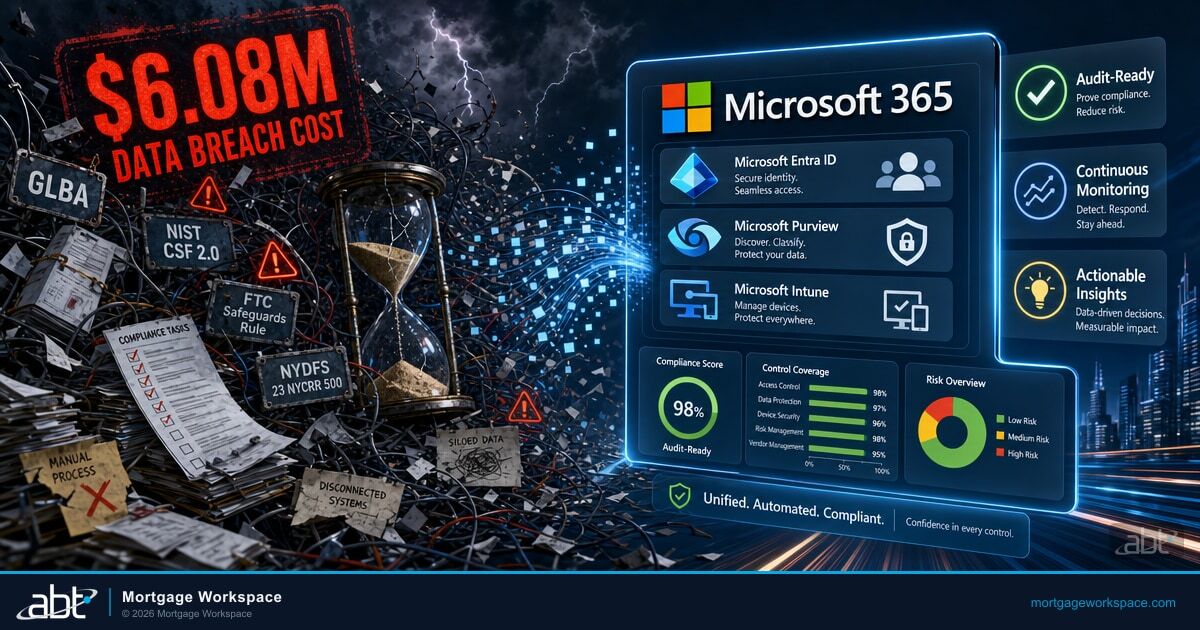
Access Business Technologies manages Microsoft 365 tenants and hosts Microsoft Azure environments for more than 750 financial institutions, including community banks, credit unions, and mortgage companies. For mortgage clients, ABT runs the integration spine through ABT MortgageExchange, hosts Calyx PointCentral on dedicated Azure subscriptions, and layers M365 Guardian as the operating model that keeps the stack audit-ready. Detection technology lands in the LOS workspace. Audit evidence lands in Microsoft Purview. Examiners see one partner of record across the loan stack.
Building Anti-Stacking Rules Into Your Origination Workflow
Detection technology works only when it is embedded in the origination workflow, not bolted on as a quality-control afterthought.
At application intake: Run velocity checks and consortium-based screening. Flag applicants with multiple recent credit inquiries. Score risk at the front door. MortgageExchange carries the intake-time fraud and velocity scores from the POS into the LOS condition list so the originator sees them on first review.
At underwriting: Pull refreshed credit data, not just the initial report. Cross-reference declared liabilities against bureau data and bank statement analytics. Challenge borderline debt-to-income ratios with additional documentation. MortgageExchange surfaces refreshed pulls and undisclosed-debt alerts in the underwriter's condition queue.
Between approval and closing: Activate continuous monitoring. Set alert thresholds for new trade lines, balance changes, and inquiries. Build a clear triage workflow for alerts that must be resolved before funding. MortgageExchange holds the alert disposition log so the audit trail is intact when an examiner asks how a flagged file was resolved.
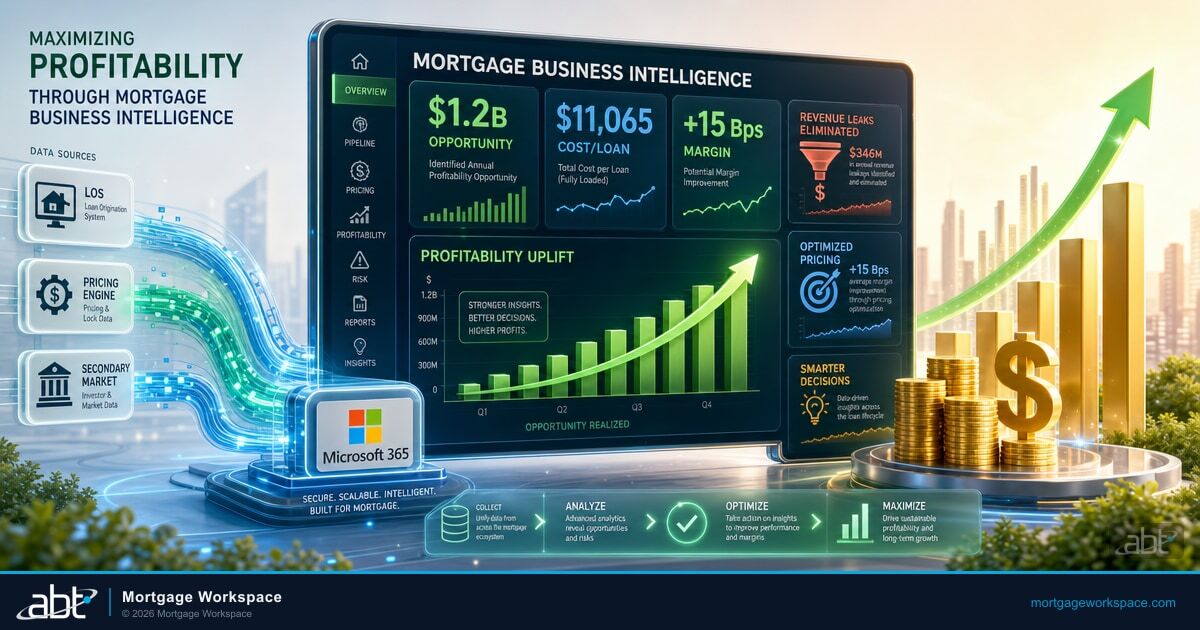
Post-closing: Monitor early payment default rates by segment. Feed findings back into front-end scoring models. Look for stacking patterns in portfolio data that individual file reviews miss. Our companion article on maximizing profitability through mortgage business intelligence covers how a Mortgage BI layer on Microsoft Fabric and Power BI surfaces those portfolio patterns for the risk team.
Key Takeaway
Loan stacking detection is not a single tool. It is velocity monitoring plus undisclosed debt surveillance plus consortium data plus AI pattern recognition plus a workflow integration spine that carries every alert into the LOS workspace where the originator, processor, and underwriter actually work. ABT MortgageExchange is that spine for ABT customers. Calyx PointCentral runs on ABT-hosted Azure for the mortgage shops and brokers that use the Calyx stack. M365 Guardian is the operating model that keeps the audit log examiner-ready. The detection signal, the workflow, and the evidence all run on one partner relationship.
Get a Lending Stack Stacking-Detection Review
ABT runs the integration spine and the hosted Calyx environment described in this article for mortgage companies, banks, and credit unions facing the same loan stacking pressure your team sees every week. A 30-minute conversation maps your current POS, LOS, fraud platform, and core stack, surfaces where stacking alerts are falling on the floor, and outlines what an ABT-managed deployment would cover. No commitment, no quote, no obligation.
Frequently Asked Questions
Loan stacking occurs when a borrower obtains multiple loans from different lenders in rapid succession without disclosing existing obligations. It is increasing because digital disbursals shortened approval timelines, credit bureau reporting cycles create visibility gaps between lenders, and growing non-QM loan volumes involve less standardized fraud detection. Cotality's 2025 data found undisclosed real estate debt fraud rose 12 percent year-over-year.
Undisclosed Debt Monitoring provides continuous surveillance of borrower credit files between application and closing. It sends daily alerts when new trade lines, credit inquiries, or balance changes appear during this quiet period. Nearly 14 percent of borrowers apply for new credit during this window. Undisclosed Debt Monitoring catches these changes before closing, letting lenders address debt-to-income shifts that point-in-time credit reports miss.
AI-powered fraud detection identifies stacking patterns that rule-based systems miss. It analyzes behavior across multiple lenders, geographies, and time periods to detect fraud rings and coordinated applications. Fannie Mae partnered with Palantir in May 2025 to launch an AI Crime Detection Unit scanning millions of datasets. AI systems adapt to new fraud tactics continuously without requiring manual rule updates.
The quiet period is the gap between initial credit pull and loan closing, typically spanning several weeks. During this window, borrowers can take on new debt not reflected in the original underwriting decision. Traditional credit reports capture a single snapshot, so new obligations go undetected. Even a 3 percent debt-to-income increase during this period can change the risk profile of a loan approved based on stale data.
Desktop Underwriter Version 12.0 introduced enforcement relief for representations and warranties tied to undisclosed non-mortgage debt. Lenders whose loans receive an Approve and Eligible recommendation and meet specific Desktop Underwriter conditions get protection against repurchase demands caused by borrower debt taken on before closing. This incentivizes continuous monitoring adoption. Mortgage-related debt like HELOCs and second liens is excluded from this protection.
ABT MortgageExchange is the mortgage-aware integration spine that carries velocity events, undisclosed-debt alerts, consortium screen results, and AI fraud scores from the POS and the fraud platform layer into the LOS condition queue where loan officers, processors, and underwriters work. Instead of asking originators to log into a separate vendor portal to see fraud signals, MortgageExchange surfaces the alerts on the borrower file in the LOS itself. ABT operates the spine for Encompass, MeridianLink, Mortgage Cadence, Empower, and Calyx PointCentral on the LOS side, and for Fiserv DNA, Fiserv Premier, Jack Henry SilverLake, Symitar Episys, and Corelation KeyStone on the core side.
ABT hosts Calyx PointCentral on a dedicated Microsoft Azure subscription as partner of record. The mortgage shop or broker keeps its Calyx workflow and configuration. ABT operates the Azure subscription, applies the security baseline, runs the managed backups and geo-redundancy, and produces the FFIEC and CFPB audit evidence inside Microsoft Purview. Velocity alerts, undisclosed-debt events, and AI fraud scores flow through ABT MortgageExchange into the same Calyx workspace the originator already uses, so the detection signal lands where the work happens.