In This Article
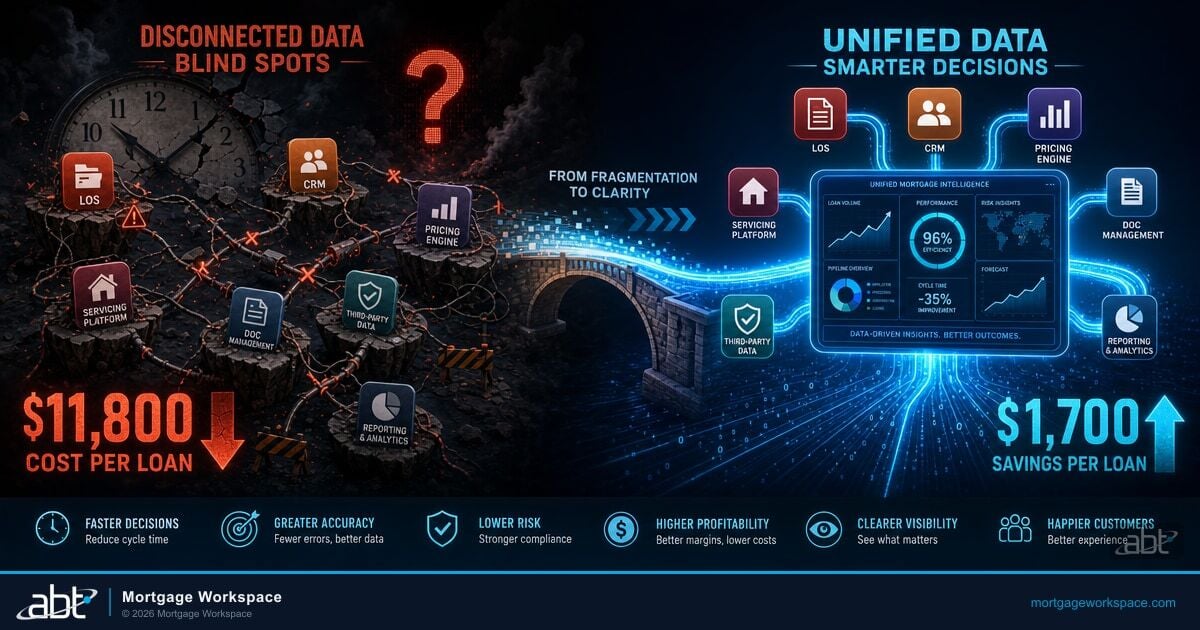
Technology spend at large mortgage lenders runs 10-18% of operating expenses. Yet most of that investment sits in disconnected systems that create bottlenecks instead of eliminating them. Your LOS doesn't talk to your CRM. Your document platform doesn't sync with your compliance engine. Your team fills the gaps with manual work.
The result: the average cost to originate a mortgage loan hit $11,800 in Q2 2025. A significant portion of that cost comes from the friction between systems that should be connected but aren't.
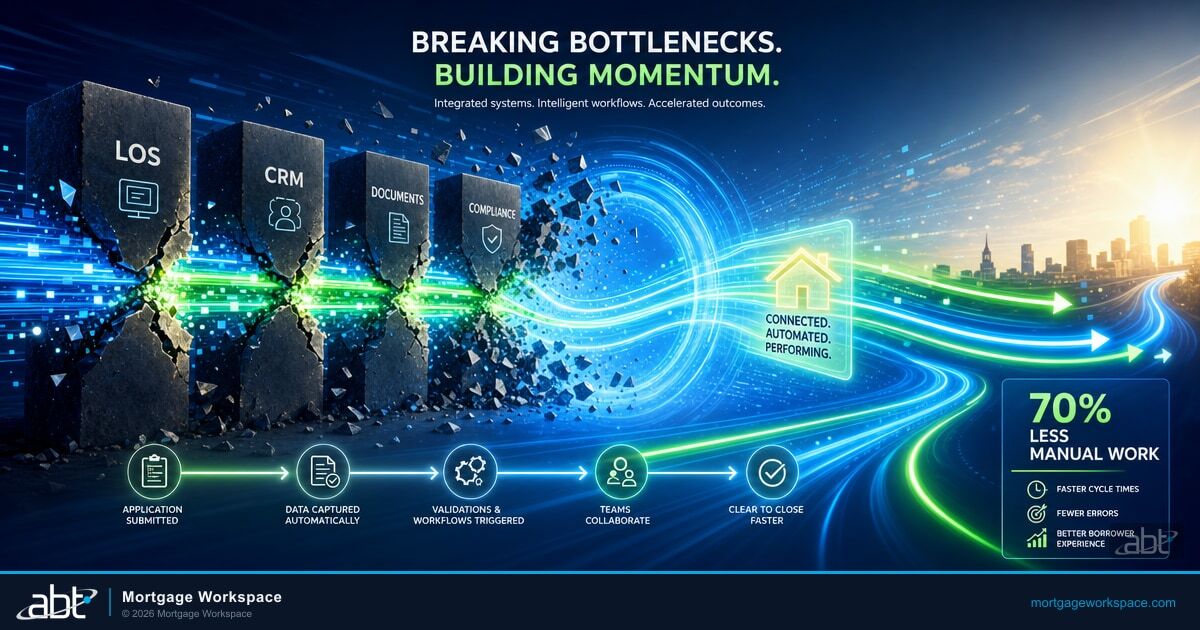
Mortgage software integration fixes these bottlenecks by connecting your platforms into a single workflow. Here's where the biggest bottlenecks hide and how integration eliminates them.
Where Mortgage Operational Bottlenecks Hide
The Handoff Problem
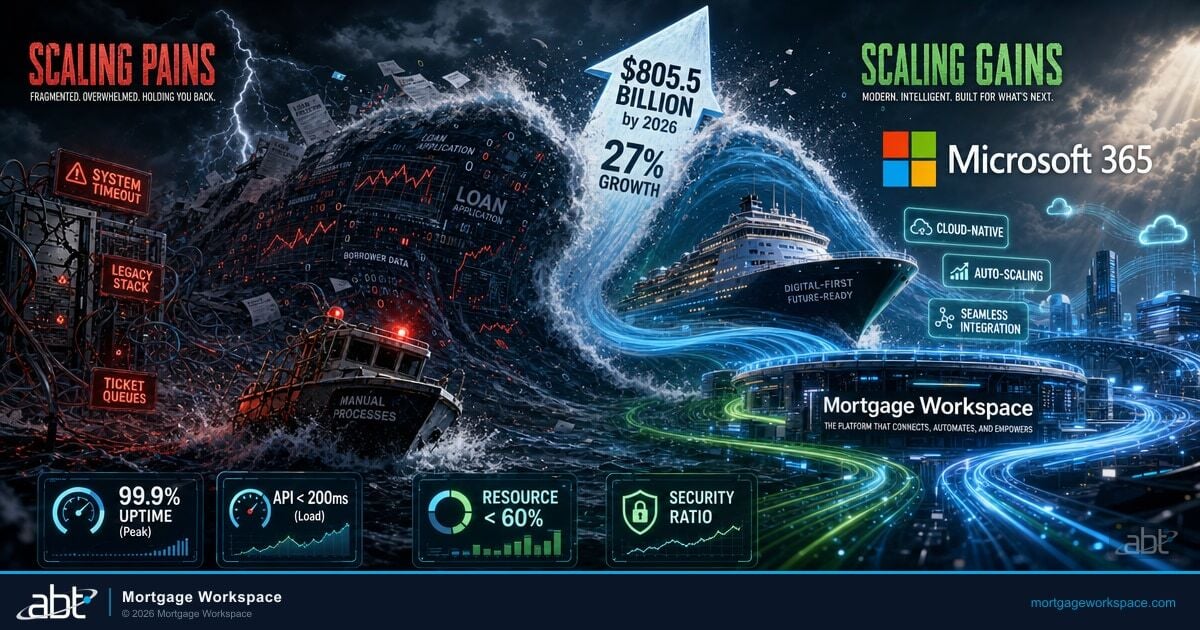
Every time data moves from one system to another through a person, you've created a bottleneck. Loan officer enters application data in the LOS. Processor re-enters borrower details in the doc management system. Closer re-keys fee information into the disclosure engine. This connects closely to Scaling Pains or Scaling Gains? IT Metrics That Predict Mortgage Growth.
Each handoff adds time, introduces error risk, and creates a queue where work stacks up waiting for someone to manually push it forward.
The Compliance Delay
CFPB, GLBA, FTC Safeguards Rule, and state regulators all require specific data at specific times. When your compliance checks run in a separate system from your LOS, someone has to export data, run the check, and import the results. That manual round-trip adds hours to every loan file.
73% of mortgage lenders have now adopted AI and ML tools to enhance compliance reviews, according to a 2025 Fannie Mae report. The lenders who haven't are falling behind on both speed and accuracy.
The Communication Gap
Borrowers call their loan officer for status updates. The loan officer checks one system, then another, then asks the processor. The processor checks their queue. By the time the borrower gets an answer, 20 minutes have passed and three people were interrupted.
Disconnected communication tools cost your team capacity every single day.
Five Ways Software Integration Removes Bottlenecks
1. Automated Data Flow Between Systems
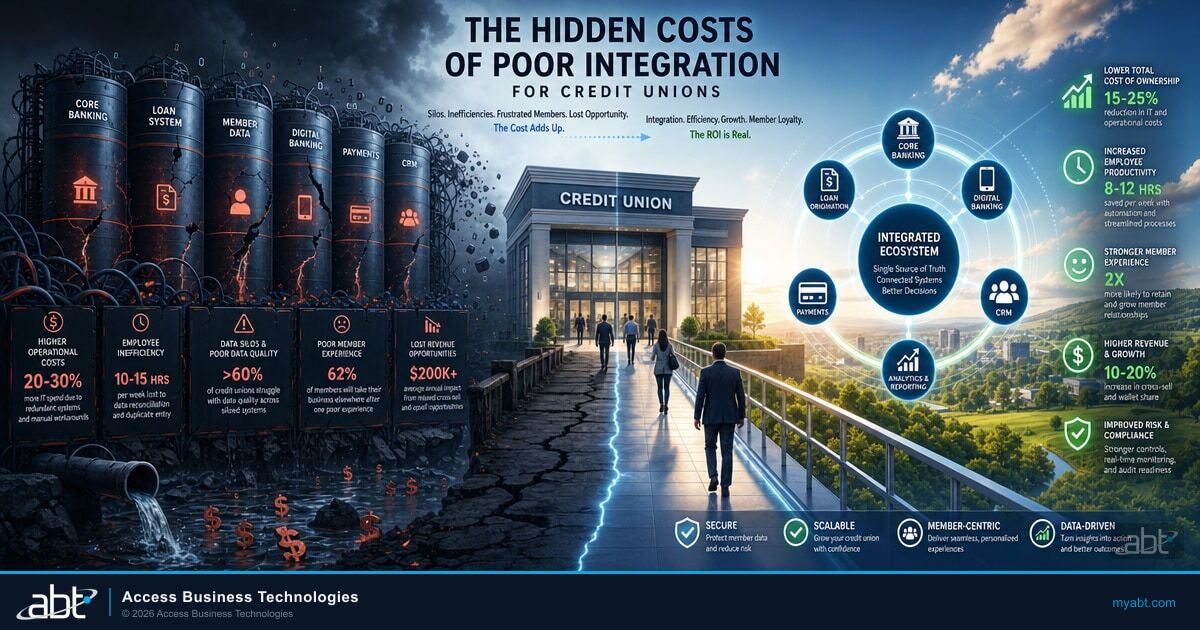
Integration connects your LOS, CRM, document platform, and compliance engine so data flows automatically. When a borrower submits an application through your portal, the information populates your LOS, triggers a credit pull, and notifies your processor. No re-keying. No waiting. We cover The Hidden Costs of Poor Integration for Credit Unions in a companion piece.
MortgageExchange handles this automated data flow for credit unions and mortgage lenders, connecting Encompass, Calyx, and other LOS platforms to core banking systems and CRMs through a single integration layer. One connection replaces dozens of manual handoff points.
Lenders using integrated platforms report a 70% reduction in manual tasks between borrower and creditor systems.
2. Real-Time Document Management
Integrated document platforms accept borrower uploads and route them to the right place in the loan file automatically. A W-2 goes to income verification. A bank statement routes to asset documentation. An appraisal report lands in the collateral section.
AI-powered document automation handles this classification in seconds. Manual sorting takes processors 15-30 minutes per file.
3. Faster Underwriting Decisions
When your AUS connects directly to your LOS, underwriting decisions happen in minutes instead of hours. Fannie Mae's Desktop Underwriter and Freddie Mac's Loan Product Advisor both offer API-based connections that pull loan data directly from your system.
Lenders maximizing these connections see pull-through rates increase by 1.8%, adding measurable revenue to their annual production.
4. Automated Compliance Monitoring
Integration lets compliance engines monitor your loan data continuously instead of checking it at specific milestones. TRID timelines, fee tolerance calculations, and disclosure accuracy all validate in real time.
When a regulation changes, the compliance engine updates once. Every loan in your pipeline benefits immediately. No manual file-by-file review required.
5. Borrower Self-Service
Connected systems let borrowers track their own loan status, upload documents, and sign disclosures without calling their loan officer. 60% of borrowers already engage in mortgage activities through mobile devices. Integration makes that self-service possible.
Fewer status calls mean more time for your team to focus on complex files that need human attention.
How to Choose a Mortgage Integration Platform
Not all mortgage technology platforms integrate the same way. Here's what separates real integration from marketing claims:
- Native API connections: The platform should connect to your LOS through published APIs, not file-based exports
- Bi-directional data flow: Data should move in both directions. Read-only connections create new bottlenecks
- Error handling and logging: When a sync fails, the platform should log the error and alert your team instead of silently dropping data
- Compliance certification: The integration platform should hold SOC 2 Type II certification or equivalent security validation
- Mortgage-specific experience: General integration platforms don't understand MISMO data standards, ULAD formatting, or GSE submission requirements
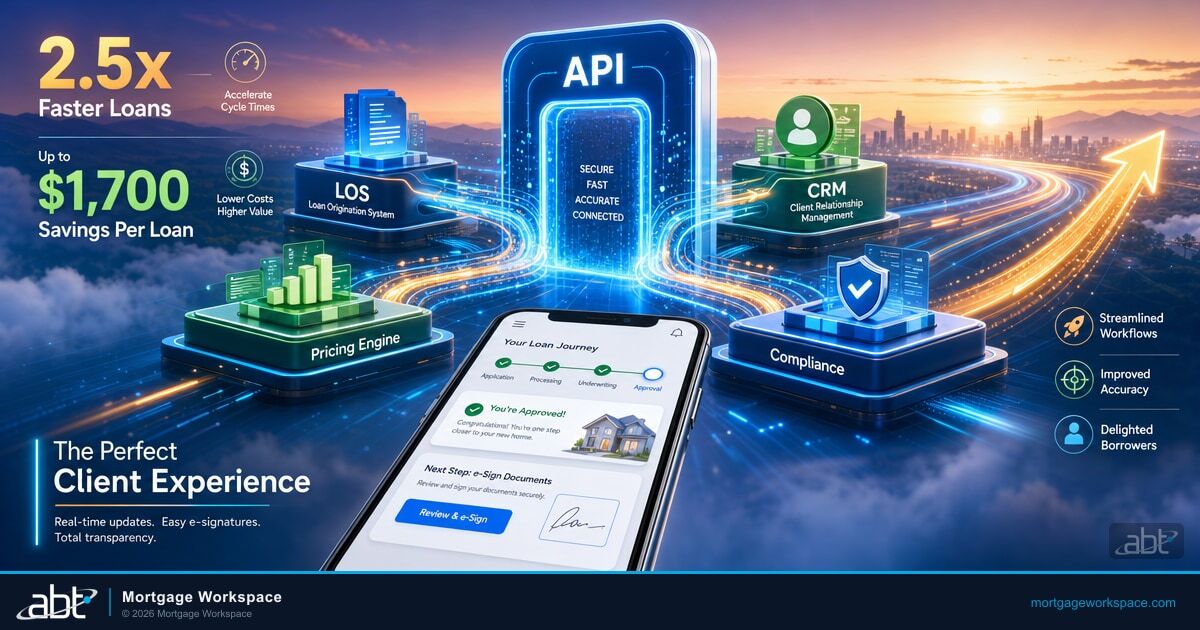
Providers serving 750+ financial institutions build with these requirements from the start. MortgageExchange was designed to meet every one of these criteria, with native API connections to every major LOS, CRM, and servicing platform in the market. For ABT's fuller take, see How API-Driven Mortgage Software Helps You Build the Perfect Client Expe.
Integration Implementation Checklist
Use this checklist when planning a mortgage software integration project:
- Audit current manual handoffs: Document every point where a person moves data between systems
- Rank bottlenecks by volume: Start with the connection that handles the most daily transactions
- Verify API availability: Confirm your LOS and other platforms offer the API endpoints you need
- Test in a sandbox: Run integration testing with real data structures before going live
- Train your team: Processors and loan officers need to understand the new workflow, not just the technology
- Monitor continuously: Set up alerts for sync failures, data mismatches, and queue buildups
Where Are the Bottlenecks Slowing Your Pipeline?
Operational bottlenecks usually trace back to software that does not integrate, forcing manual workarounds at every step. MortgageWorkspace breaks down those barriers so your team spends time on loans, not on copying data.
Frequently Asked Questions
The most common mortgage processing bottlenecks are manual data re-entry between disconnected systems, document routing and classification delays, compliance check round-trips between separate platforms, and fragmented borrower communication across email, phone, and portal channels. These bottlenecks add days to loan timelines and increase origination costs.
Mortgage lenders using integrated platforms report 2.5x faster loan closures compared to industry averages. Specific improvements include reducing document verification from 48 hours to 4 hours, cutting manual task volume by 70%, and accelerating underwriting decisions from hours to minutes through direct AUS-to-LOS connections.
Mortgage integration platforms should hold SOC 2 Type II certification, support encryption in transit and at rest, and comply with GLBA data protection requirements. Additional standards include FTC Safeguards Rule technical controls, multi-factor authentication for system access, and audit logging for all data transfers between connected platforms.
Most modern integration platforms connect to legacy LOS platforms through middleware layers and API adapters. ICE Mortgage Technology replaced Encompass SDK integrations with REST APIs in 2025, and other major LOS providers offer similar migration paths. Middleware tools bridge the gap for platforms that lack native API support.
Talk to a Mortgage IT Specialist
Every manual handoff in your mortgage operation is a bottleneck waiting to slow down your next loan. Talk to a mortgage IT specialist about how MortgageExchange and integrated mortgage technology can connect your systems for faster processing and lower origination costs.