In This Article
NCUA released its 2026 Supervisory Priorities on January 16, 2026 and named information security, information technology, and operational resilience among the top examination focus areas. Cornerstone Advisors found that more than two-thirds of mid-size financial institutions rank core-to-digital integration as a top three obstacle to their digital strategy. Filene Research has been reporting for years that fewer than one in three credit unions operate with a formal enterprise data strategy. Data silos are not a back-office annoyance anymore. They are an examination risk and a competitive disadvantage at the same time.
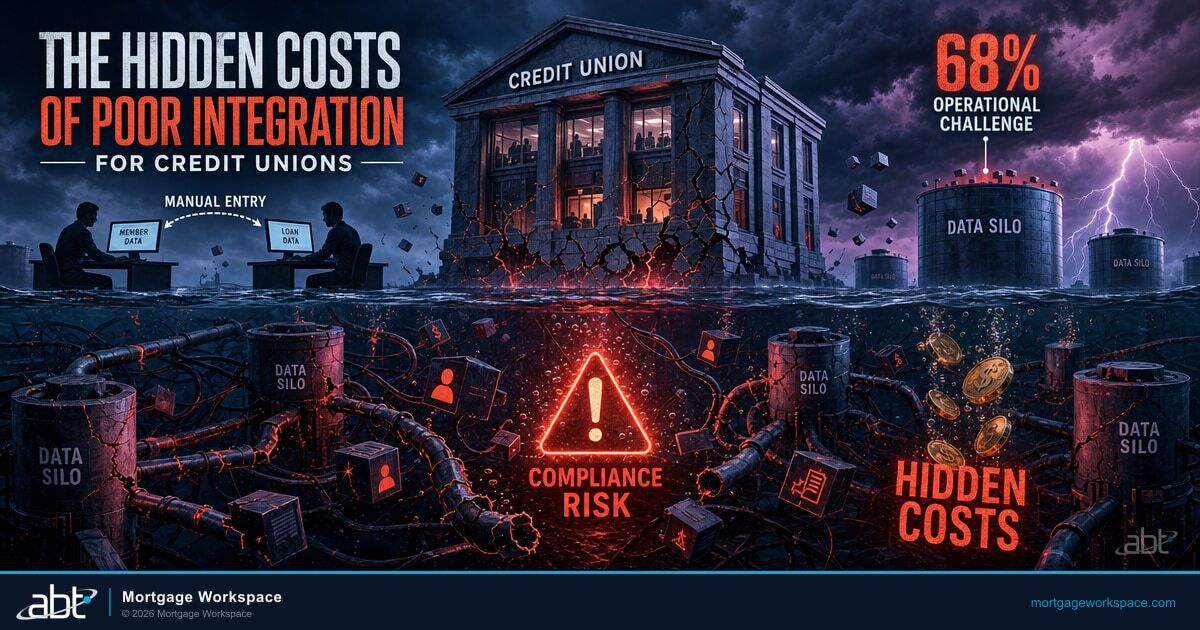
When your loan origination system, core banking platform, and compliance tools do not share data automatically, the gaps get filled by people. People copy numbers between screens. People re-enter borrower information. People catch errors, sometimes, during post-close reviews. Every manual handoff costs money, creates risk, and slows down member service. Credit unions, banks, and mortgage companies that grew through acquisition or that bolted on best-of-breed point solutions tend to carry the heaviest integration debt because each platform was selected to solve a department's problem, not the whole institution's.
This article maps the hidden costs of poor integration, ties them to current NCUA examination priorities, and shows what a connected technology stack looks like in practice. The goal is a concrete framework you can use to decide whether your next IT investment should be a new system or the integration plumbing that holds the systems you already have together. Access Business Technologies operates Microsoft 365 tenants for more than 750 financial institutions and runs the LOS-to-core integration layer for many of them through MortgageExchange, the firm's purpose-built interface product hosted in Microsoft Azure.
Compliance Risk From Disconnected Systems
NCUA examiners evaluate how credit unions manage data integrity across systems. When loan data moves between platforms through manual processes, audit trails break. Broken audit trails draw examiner attention, and a broken audit trail discovered during examination week is a much harder problem than the same audit trail rebuilt during a quiet quarter.
Manual data transfers create gaps where errors slip through undetected. A borrower's income figure typed incorrectly during re-entry might not surface until a quality control review weeks later. By then, the loan may have closed, creating a compliance exception that requires remediation, a refund of any miscalculated fees, and a formal write-up in the next exam cycle.
The FFIEC IT Examination Handbook requires credit unions to demonstrate that data transfers between systems are accurate, timely, and auditable. The FFIEC Operational Resilience Booklet published August 2024 extended that expectation to recovery scenarios, requiring institutions to prove that critical data flows can be restored intact after a disruption. Manual processes rarely meet all of those criteria.
NCUA 2026 Supervisory Priorities: integration is on the list
NCUA Letter to Credit Unions 26-CU-01, published January 16, 2026, lists information security, information technology and digital banking, operational resilience, and third-party and CUSO risk management among the year's examination focus areas. Each of those touches integration. Information security depends on consistent identity and access controls across systems. Operational resilience requires verified data recovery across integrated platforms. Third-party risk management requires a documented data-flow map between the credit union and every vendor that touches member data. Disconnected systems make every one of those harder to evidence on examination week.
Common compliance gaps from poor integration:
- Missing or incomplete audit trails between the LOS and core systems, especially for conditions added or cleared mid-process
- Inconsistent borrower data across platforms that triggers HMDA reporting errors, including LAR field mismatches between the loan record and the action-taken record
- Delayed regulatory filings because staff must manually reconcile data before submission, and the reconciliation step is single-threaded through one analyst
- Inability to produce complete transaction records during examinations because pieces live in the LOS, pieces live in the core, and the bridge between them is a spreadsheet that lives on someone's desktop
- Third-party risk gaps when a vendor system holds borrower data and the credit union cannot tell examiners which fields, with what retention, under what access controls
Data Accuracy Problems That Compound Over Time
Duplicate data entry is not just inefficient. It is a compounding error source that distorts your reporting, your member analytics, and your regulator-facing data submissions at the same time.
Every time a staff member re-enters information from one system into another, there is a chance of introducing a mistake. Over hundreds of loans per month, those small errors accumulate into patterns that distort reporting, trigger false exceptions, and waste staff time on corrections. Credit unions that track data quality metrics typically find that manual entry processes produce error rates between 1% and 5% per field. On a loan file with 200 or more data fields, that translates to multiple errors per loan. Some are caught during processing. Others survive to closing and become compliance exceptions instead of data entry errors.
Integrated systems eliminate this category of error entirely. When data flows automatically from the LOS to the core banking platform, the borrower's name, Social Security number, income, and property address are entered once and propagated everywhere. The savings show up in three places: fewer errors at origination, faster cycle times because no one is waiting on manual reconciliation, and cleaner data feeding every downstream report.
Examiners do not ding you because your data is in multiple systems. They ding you because you cannot prove the data is consistent across those systems. Integration is not a tooling problem. It is an evidence problem.
This is the framing that matters for credit union boards and CEOs. The integration question is not whether to spend the money. It is whether to spend the money on connectivity now or on remediation, error correction, and examiner findings later. Chevron Federal Credit Union's data silo work is a useful walkthrough of how one institution sequenced that decision.

Member Service Suffers When Systems Are Slow
Members notice when your systems do not keep up. A borrower calls to check loan status. Your member services team opens the core platform, sees outdated information, and has to call the lending department to get a current answer. That phone call takes five minutes. Multiply that across every status inquiry across a year and you have a service bottleneck that frustrates both staff and members.
Real-time data synchronization between systems means every department sees the same current information. The member services team can answer status questions instantly. The lending team does not get pulled away from processing to field internal inquiries. The contact center reports cleaner first-contact resolution rates, which credit union boards typically track as a member satisfaction proxy.
In a competitive lending market where credit union first-mortgage originations have been growing in the mid-single-digit to low-double-digit range year over year per NCUA Quarterly Data Summary trends, member experience is a differentiator. Borrowers who encounter delays or inconsistencies during the loan process are less likely to return for their next transaction. They are also more likely to share that experience with their network, which matters because credit union membership growth is driven heavily by word-of-mouth referrals rather than paid acquisition.
Filene baseline: enterprise data maturity in credit unions
Filene Research has reported consistently that fewer than one in three credit unions operate with a formal enterprise data and analytics strategy, and even fewer have a unified data warehouse or lake feeding their reporting. Most credit unions collect substantial member data; the gap is in turning that data into a connected operating asset. Integration projects that close LOS-to-core data gaps are typically the first concrete step toward closing the enterprise data maturity gap as well.
The Real Financial Cost of Integration Gaps
Poor integration costs more than most credit unions estimate because the expenses hide in places that standard reporting does not capture. The direct costs show up in IT and operations budgets. The indirect costs show up as cycle-time creep, member attrition, and exam findings that take quarters to remediate.
| Cost category | Where it shows up | Why it is easy to miss |
|---|---|---|
| Manual data entry and reconciliation labor | Operations FTE hours; loan processing payroll | Hidden inside payroll line items rather than IT spend; rarely tagged as integration cost |
| Error correction and rework on loans with data discrepancies | Quality control labor; remediation labor; reissued disclosures | Counted as a QC cost, not an integration cost; same error pattern repeats each cycle |
| Compliance remediation when audit exceptions result from data gaps | Compliance department time; outside counsel for material findings; member refunds | Shows up months after the original integration gap caused the issue, breaking the cause-and-effect link |
| Longer loan cycle times that increase cost per loan | MBA cost-per-loan benchmarks; operations efficiency reports | Per-loan cost creep is gradual; rarely pinned on integration specifically |
| Member attrition from poor service experiences | Member retention rates; share-of-wallet trends | Members leave for many reasons; the integration link is invisible from the outside |
| Missed cross-sell opportunities because member data is fragmented | Cross-sell ratio; products per member | Counts as a marketing or business-development gap; underlying data fragmentation rarely diagnosed |
| IT staff time spent maintaining custom workarounds | IT department hours; deferred strategic projects | Custom integration scripts become part of the steady-state environment; nobody adds them up |
Credit union IT spending typically runs in the range of 7 to 12 percent of operating expense for mid-size and large institutions per Cornerstone Advisors benchmarks. The institutions that allocate a meaningful slice of that spend to integration plumbing tend to outperform peers on cost-to-originate and on member retention. The institutions that defer integration in favor of new front-end systems tend to accumulate technical debt that surfaces eventually as a forced re-platforming event with much higher cost and much higher disruption.
Curious whether your existing IT spend has a hidden integration tax inside it? Talk to an ABT credit union IT specialist about a focused integration audit that maps your current data flows, identifies the silos that are costing you the most, and prices the integration work against the labor and remediation cost it would eliminate.
What Seamless Integration Looks Like
A fully integrated credit union technology stack moves data automatically at every stage of the lending process. The work is not glamorous. It is API connections, message brokers, retention policies, and field-mapping documentation. But it is what separates institutions that scale cleanly from institutions that hit walls every time they add a new product or new branch.
Application stage: Borrower data entered in the online application flows directly into the LOS without re-entry. Credit pulls, income verification, and property data populate automatically through API connections to credit bureaus, verification services, and appraisal vendors. Loan officers see a complete file from the first touch.
Processing stage: Documents uploaded by the borrower are indexed and attached to the loan file. Compliance checks run automatically against NCUA, FFIEC, and CFPB requirements. Conditions are generated and communicated to the borrower through the portal without staff intervention.
Closing stage: Loan data transfers from the LOS to the core banking platform automatically upon closing. The new loan appears in the member's account without manual boarding. Closing documents land in the document management system tagged with retention and sensitivity labels.
Post-close stage: Quality control reviews pull data from both systems for comparison. Reporting to NCUA, GSEs, and state regulators draws from a single source of truth. HMDA submissions assemble automatically from validated source data instead of being rebuilt manually each quarter.
This is the pattern MortgageExchange implements for ABT's credit union, bank, and mortgage company customers. MortgageExchange is the LOS-to-core interface product Access Business Technologies built specifically to carry borrower, loan, and member data between origination platforms and the core banking systems that hold the booked loan. The interface runs on Microsoft Azure, which means the heavy integration traffic, the retry logic, the message-broker durability, and the per-tenant isolation all sit on customer-controlled cloud infrastructure that ABT operates as the partner of record. MortgageExchange handles cores including Fiserv DNA, Symitar Episys, and Jack Henry SilverLake, and it bridges those cores to LOS platforms including Encompass, MeridianLink, and Calyx PointCentral. The same field-mapping, audit-logging, and retention discipline applies to every connection, which is what gives the credit union's CCO a single integration story to tell an examiner rather than seven different per-vendor explanations.
Credit unions working with integration-focused IT partners achieve this level of connectivity today. The key is having a technology partner that understands both the LOS ecosystem and the core banking platform deeply enough to bridge them without losing data fidelity or examiner trail. ABT has worked with credit unions like Chevron Federal Credit Union, Patelco Credit Union, and Bay Federal Credit Union to close data gaps and reduce manual processing across the lending workflow.
Three ABT product layers sit underneath an integrated credit union stack. MortgageExchange is the interface product that moves borrower and loan data between the LOS and the core banking system, with field-mapping and audit-trail discipline tuned to NCUA and FFIEC examination expectations. Microsoft Azure hosts the heavy integration traffic, including the message brokers, the retry queues, the tenant-isolated databases, and the storage that carries the audit log forward. M365 Guardian is ABT's operating model over the surrounding Microsoft 365 controls, including Microsoft Entra ID Conditional Access, Microsoft Purview retention and Audit, Microsoft Defender for Office 365 and Endpoint, Microsoft Intune device posture, and Microsoft Sentinel SIEM correlation. ABT manages the Microsoft 365 tenant under delegated admin and hosts the Azure environment where MortgageExchange runs, so the credit union retains ownership of its data and its regulatory relationships while ABT carries the technical operations.
How Microsoft 365 Governs the Connected Stack
Integration plumbing moves data between systems. Microsoft 365 governs the people, identities, devices, and documents that surround that data. Both layers have to be solid for an audit-ready credit union operation that holds up under NCUA examination.
Specific Microsoft 365 components that support an integrated credit union stack:
- Microsoft Entra ID Conditional Access enforces multi-factor authentication on every loan officer, processor, underwriter, and member services representative who touches integrated systems. Conditional Access policies block sign-ins from risky locations and unmanaged devices, which closes a common audit finding for credit union operations.
- Microsoft Purview Audit and Information Protection retain audit-quality logs on every action against member data and apply sensitivity labels to loan and account documents so they cannot be sent outside the organization without explicit override. Purview retention policies satisfy the documentation requirements that attach to NCUA records retention and to integrated reporting.
- Microsoft Defender for Office 365 protects the email channel that lenders, members, title agents, and warehouse partners use to confirm loan data and reconcile exception handling. Anti-phishing and Safe Links protect against business email compromise on the funding-day email thread, which is a recurring attack vector for institutions doing wire transfers.
- Microsoft Intune manages the laptops and mobile devices that loan officers and branch staff use, ensuring that even endpoints meeting Conditional Access requirements have current encryption, screen-lock policies, and remote wipe configured.
- Microsoft Sentinel correlates security events across the Microsoft 365 surface and the integrated systems, giving the IT team a single place to investigate suspicious activity that crosses platform boundaries. This is the layer where third-party risk monitoring earns its keep at examination time.
M365 Guardian is the operating model ABT applies on top of these Microsoft tools for regulated financial institutions. Guardian is not a separate product license. It is the disciplined configuration, monitoring, and response work that turns a generic Microsoft 365 tenant into an examination-ready operating environment. For a credit union with MortgageExchange running between the LOS and the core, M365 Guardian wraps the surrounding people-and-document layer with Conditional Access tuned to branch geography, Purview retention aligned to NCUA records expectations, Defender policies tuned to the wire-fraud and business email compromise patterns that target credit unions, and a Sentinel deployment that correlates signals from the Microsoft 365 surface with signals from the MortgageExchange integration layer running in Microsoft Azure. The result is a single connected operating picture rather than seven disconnected vendor consoles.
The point is not that Microsoft 365 replaces integration work. The point is that integration without Microsoft 365 governance produces connected systems that are not audit-ready because the surrounding controls are weak. Credit unions, banks, and mortgage companies running both layers correctly produce evidence packages that hold up to NCUA, FDIC, OCC, and state regulator examinations without scrambling on examination week. Microsoft 365 email configuration for financial institutions covers the configuration baseline that pairs with the integration work.
Decision Lens
If your IT team cannot produce a current data-flow map showing how borrower information moves from application through closing and into the core, the integration risk is higher than it looks. If your Microsoft 365 tenant cannot tell you who accessed which integrated system in the last 90 days, the audit risk is higher than it looks. Both gaps tend to show up together because both come from underinvestment in the same operational layer. Power Automate for automated compliance is one common way to start bridging the two.
The reason ABT pairs MortgageExchange with Microsoft Azure and M365 Guardian as a single offering is that examiners and auditors evaluate them together. MortgageExchange carries the borrower and loan data between the LOS and the core, and the audit log it produces is only as defensible as the cloud infrastructure it runs on. Microsoft Azure gives the integration layer tenant-isolated databases, geo-redundant storage for the audit trail, message-broker durability across availability zones, and an explicit shared-responsibility model that ABT can hand to an examiner without hedging. The Azure environment is provisioned per customer rather than as a shared multi-tenant pool, which means a Patelco or Bay Federal incident review never crosses tenant boundaries and the audit-log retention follows the credit union's own NCUA records policy rather than a vendor default.
M365 Guardian then wraps the people-and-document layer around that integration spine. The credit union's loan officers, processors, and member services representatives sign in through Microsoft Entra ID Conditional Access policies tuned to branch geography. Documents produced by MortgageExchange land in SharePoint and OneDrive with Microsoft Purview sensitivity labels applied automatically, and retention follows NCUA records expectations rather than the default 90-day deletion most generic Microsoft 365 tenants ship with. Microsoft Defender for Office 365 covers the funding-day email thread where business email compromise typically lands, Microsoft Intune verifies device posture on every endpoint that touches the integrated systems, and Microsoft Sentinel correlates signals from the M365 surface with signals from the Azure-hosted MortgageExchange integration. The result is one connected operating picture across origination, core boarding, and the Microsoft 365 governance layer, managed by ABT under delegated admin and hosted by ABT in the customer's own Azure subscription, so the credit union retains ownership of its data, its members, and its regulatory relationships.
Map your real integration footprint before the next examination cycle
Most credit unions think they have integration coverage because their vendors said so on the contract. The audit reality lives in the data flows that connect the LOS to the core, the digital banking platform, the document-of-record, and every downstream report. ABT manages the Microsoft 365 tenant, hosts the Microsoft Azure environment where MortgageExchange runs, and operates the M365 Guardian layer for more than 750 financial institutions. A 30-minute conversation maps your current footprint, surfaces the integration gaps your next NCUA examiner is most likely to find, and outlines what an ABT-managed deployment would cover.
Frequently Asked Questions
Data silos create incomplete audit trails that NCUA examiners flag during IT examinations. When loan data exists in disconnected systems without automated reconciliation, the credit union cannot demonstrate data integrity across the lending lifecycle. Examiners look for consistent borrower information, complete transaction records, and documented data flows between all systems that handle member financial data. NCUA Letter to Credit Unions 26-CU-01 published January 16, 2026 lists information technology, operational resilience, and third-party risk management among its 2026 supervisory priorities, all of which depend on connected systems and verified data flows.
Manual data entry processes in credit union loan processing produce error rates between 1% and 5% per field. On a typical loan file with 200 or more data fields, that translates to multiple errors per loan. Each error requires staff time to identify, research, and correct. Errors that survive to closing create compliance exceptions that require remediation, may trigger refunded fees to members, and often produce a write-up in the next examination cycle. The total cost spans direct labor, rework, compliance remediation, and the cycle-time creep that drives cost per loan higher across the portfolio.
A fully integrated LOS-to-core system moves borrower data automatically from application through closing and loan boarding. Data entered once during the application flows through underwriting, compliance checks, and closing without manual re-entry. Documents upload directly to the loan file. The closed loan boards to the core platform automatically, and both systems share a single source of truth for reporting and quality control. ABT implements this pattern through MortgageExchange, an interface product hosted in Microsoft Azure that handles the LOS-to-core data flow for credit unions, banks, and mortgage companies. The integration layer is built on API connections, message brokers, tenant-isolated Azure databases, and Microsoft Purview retention policies that govern the documents the integration produces.
Credit unions with fewer than 500 employees typically lack the specialized IT staff needed to manage LOS integrations, core banking API connections, Microsoft 365 governance, and compliance monitoring simultaneously. A managed service provider with credit union experience handles the technical complexity while the credit union's team focuses on lending and member service. The deciding factor is whether your IT team has deep experience with both your LOS vendor and your core banking platform, plus the Microsoft Power Platform and Microsoft Entra ID layers that surround them. Most institutions find a hybrid model works best: a managed partner runs the integration and governance plumbing while internal IT focuses on member-facing technology and strategic initiatives.
NCUA Letter to Credit Unions 26-CU-01 published January 16, 2026 names information security, information technology and digital banking, operational resilience, and third-party and CUSO risk management among the year's supervisory priorities. The IT and operational resilience expectations are concrete: examiners want to see documented data flows between integrated systems, evidence that critical data can be recovered intact after a disruption, and a third-party risk register that maps every vendor touching member data. The FFIEC Operational Resilience Booklet published August 2024 reinforces those expectations and applies to NCUA-supervised credit unions through interagency examination guidance.
The three layers cover different parts of the same integration problem. MortgageExchange is the interface product that carries borrower and loan data between the LOS and the core banking platform with field-mapping, audit logging, and retention tuned to NCUA and FFIEC examination expectations. Microsoft Azure is the cloud infrastructure where MortgageExchange runs, providing the message brokers, retry queues, tenant-isolated databases, and storage that carry the integration traffic and the audit trail. M365 Guardian is ABT's operating model over the surrounding Microsoft 365 controls, including Microsoft Entra ID, Microsoft Purview, Microsoft Defender, Microsoft Intune, and Microsoft Sentinel. ABT manages the Microsoft 365 tenant under delegated admin and hosts the Azure environment where MortgageExchange runs, so the credit union owns its data, its members, and its regulatory relationships while ABT carries the technical operations across all three layers.
A useful credit union integration audit produces five concrete artifacts: a current data-flow map showing how borrower and member data moves between systems; an inventory of every manual data-handoff step with the labor cost attached; a control map showing where Microsoft Entra ID, Microsoft Purview, and Microsoft Defender are protecting the integrated data and where they are not; a list of compliance gaps tied to NCUA and FFIEC examination expectations; and a prioritized remediation plan that pairs each gap with the integration or governance work that closes it. The audit should take days, not months, and should produce decisions the IT committee can act on immediately.