In This Article
- What an Automated Underwriting System Does
- How AUS Technology Works: Three Stages
- The Data Pipeline Problem: Where MortgageExchange Fits In
- Desktop Underwriter and LPA Updates for 2025-2026
- Speed and Consistency Manual Underwriting Cannot Match
- Monitoring AUS Outcomes with Mortgage BI and M365 Copilot
- The Compliance Advantage of Automated Underwriting
- Where AI-Powered Underwriting Is Heading
- Getting Your AUS Implementation Right
- Frequently Asked Questions
On February 25, 2026, Dark Matter Technologies became the first LOS provider to support AI agents inside its Empower platform using Model Context Protocol. Business teams can now build and deploy AI agents that interact with the loan origination system through a secure, auditable gateway. That announcement follows Fannie Mae's partnership with Palantir to detect mortgage fraud using AI and the continued rollout of DU Version 12.0's expanded cashflow assessment. Automated underwriting systems are absorbing capabilities that were separate products eighteen months ago.
The mortgage companies, mortgage divisions inside community banks, and credit union mortgage shops that are getting the most from this shift have one thing in common. They have already solved the data pipeline problem behind the AUS. They have a managed interface layer that pulls borrower data, employment verification, account history, and product configurations out of their loan origination system and their core banking platform and feeds it to Desktop Underwriter and Loan Product Advisor in the form those engines expect. Access Business Technologies operates that interface layer for hundreds of mortgage lenders under the product name MortgageExchange, and runs the Microsoft 365 and Microsoft Azure environment around it under an operating model called M365 Guardian.
This article explains what an automated underwriting system does, what changed in 2025 and 2026, where the data pipeline fits in, how to monitor outcomes through Mortgage BI and Microsoft 365 Copilot, and what a clean implementation looks like for a mortgage lender that wants the speed and consistency advantages of automated underwriting without losing the compliance posture examiners expect.
What an Automated Underwriting System Does
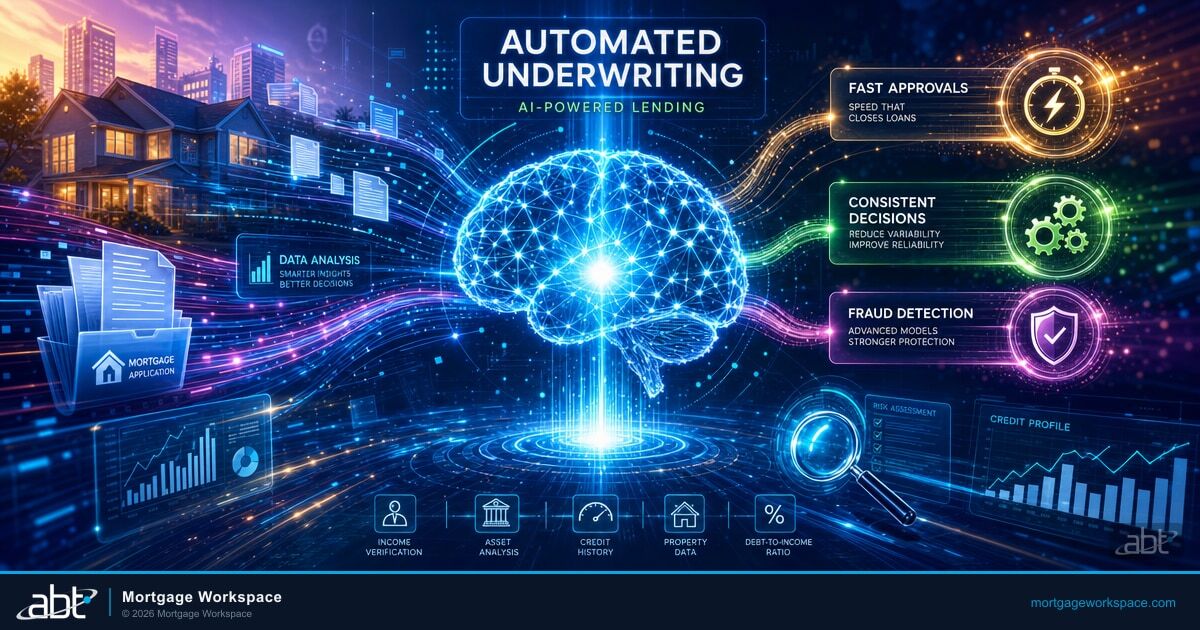
An automated underwriting system evaluates loan applications using algorithms and data analytics instead of manual human review. It pulls together a borrower's credit history, income, employment, debt obligations, and property data, then runs it all against lending guidelines to produce an approve, refer, or deny recommendation. The two dominant platforms are Fannie Mae's Desktop Underwriter (DU) and Freddie Mac's Loan Product Advisor (LPA). Together they process millions of applications annually with accuracy rates around 95% for standard mortgage products.
Companies like Gateless now report 70-75% auto-clearing rates on credit, income, and asset conditions, with a target of 85% by late 2026. AUS does not replace underwriters. It handles routine evaluations so experienced underwriters focus on complex cases, exception handling, and borrower relationships. Mortgage lenders that implement AUS well see their underwriters shift from data entry to decision-making.
Why This Matters to Mortgage Lenders Right Now
Mortgage fraud risk rose 8.2% year-over-year in Q3 2025 according to Cotality. AI-driven underwriting systems are one of the few tools that can match that rising risk with equally fast detection. At the same time, examiners under ECOA, RESPA, HMDA, and amended Regulation S-P expect to see consistent, documented technical controls across every step of the lending workflow. A clean AUS implementation produces both, the speed advantage and the compliance evidence, on the same machine-readable trail.
How AUS Technology Works: Three Stages
AUS operates in three stages: data collection, enrichment, and decisioning. Understanding each stage helps a mortgage lender evaluate platforms and diagnose bottlenecks in its own workflow.
Stage 1: Data Collection. Borrower information enters the system through APIs, OCR technology for scanned documents, or RPA wrappers that extract data from existing forms. The quality of this intake determines everything downstream. Lenders using digital verification at the front end see fewer conditions and faster processing.
Stage 2: Data Enrichment. The system pulls third-party data from credit bureaus, employment verification databases, banking institutions, and property databases. DU Version 12.0 expanded this enrichment layer to include cashflow assessment for all borrowers and broader use of rent payment history data. Fannie Mae reports that loans with at least one digital validation component are 33% less likely to produce defects.
Stage 3: Decisioning. Algorithms evaluate risk across multiple dimensions simultaneously: credit history patterns, income stability, debt composition, and property characteristics. Each factor receives weighting based on statistical models trained on millions of loan outcomes. The system produces a recommendation with clear explanations, specific conditions, and documentation requirements. Modern platforms go beyond approve or deny. They recommend specific loan products, flag compliance issues, and generate the audit trail that regulators require.
The Data Pipeline Problem: Where MortgageExchange Fits In
An AUS recommendation is only as good as the data flowing into it. The mortgage lenders that get the most from DU, LPA, and the newer AI-augmented platforms have one thing in common. They have a managed interface layer that pulls borrower data, employment verification, account history, and product configurations out of their loan origination system and their core banking platform, normalizes it, and feeds it to the AUS engine in the form the engine expects.
ABT operates that interface layer for hundreds of mortgage lenders under the product name MortgageExchange. It is the custom integration that connects an institution's loan origination system, such as Encompass, Calyx Point, or Empower, to the core banking platform, such as Fiserv DNA, Symitar Episys, or Jack Henry's Synapsys, and on to Desktop Underwriter, Loan Product Advisor, and adjacent AI underwriting platforms. Without that interface, a processor is rekeying borrower data from one system into another and inconsistencies between the LOS and the core become AUS findings that the loan officer has to clear by hand. With it, the borrower's application arrives at the AUS pre-populated, validated against the core, and tagged with the right product and program codes. For an introduction to how this integration layer is built, see our overview of modern loan origination systems and our deeper article on tracking your mortgage pipeline across integrated systems.
The data lake that MortgageExchange populates is also where Mortgage BI dashboards read from and where Microsoft 365 Copilot agents can be grounded for compliance-aware analysis of the underwriting outcomes. Treating AUS as a standalone deployment misses the larger picture. The pipeline is the product.
Desktop Underwriter and LPA Updates for 2025-2026
The GSE platforms have undergone their most significant updates in years. If you are operating on assumptions from 2023 or earlier, your underwriting criteria may be out of sync with what DU and LPA support today.
Desktop Underwriter Version 12.0 (January 2025)
- FICO floor removed. DU no longer requires a minimum 620 credit score. The system evaluates borrowers on their full financial profile using trended credit data, cashflow patterns, and rent payment history.
- Expanded cashflow assessment. Previously limited to borrowers without credit scores, cashflow analysis now applies to all applicants. Bank statement data validates income patterns for self-employed borrowers, gig workers, and others with non-traditional income.
- Revised first-time buyer evaluation. Fannie Mae research showed first-time buyers performed better than expected compared to repeat buyers with similar risk profiles. DU 12.0 adjusts risk weighting accordingly.
- Student loan recalibration. Borrowers with student loan debt performed better than those without at similar total debt levels. DU now factors this into its risk model.
- Rent payment expansion. On-time rent payment reporting now benefits 2.5 times more borrowers than the original 2021 implementation.
DU Version 12.1 (March 2026)
Fannie Mae announced that DU V.12.1 will include accessory dwelling unit (ADU) income eligibility, HomeStyle Refresh capabilities, and expanded manufactured housing options. These updates push AUS toward evaluating borrowers and properties that were difficult to underwrite through automated systems.
Freddie Mac Loan Product Advisor
LPA released specification version 6.1 in December 2025 with revised rental income calculations for investment properties and 2-4 unit primary residences, updated Income Calculator capabilities, and alignment with 2026 FHA and VA loan limits. The MISMO iLAD 2.5.0 dataset incorporates both DU and LPA specification changes, standardizing data exchange across the industry. For mortgage lenders running both DU and LPA, the MortgageExchange interface normalizes the differences so the LOS, the core, and the AUS share a single canonical version of borrower data.
Speed and Consistency Manual Underwriting Cannot Match
Speed is the obvious advantage. Consistency is the more important one. When a manual underwriter reviews ten files in a day, decision quality varies based on experience, fatigue, and individual judgment. When AUS reviews those same ten files, every application gets evaluated against identical criteria. That consistency reduces fair lending risk, produces more predictable portfolio performance, and gives the compliance team reliable audit documentation.
The speed advantage is still significant. Processing applications in minutes rather than days changes the competitive equation. In bidding-war markets, the lender who delivers the fastest conditional approval wins the deal. Rocket Mortgage processes 1.5 million documents monthly with AI-powered systems that auto-identify 70% of them, saving over 5,000 underwriter hours per month. For mid-market mortgage lenders, AUS creates capacity without adding headcount. The existing underwriting team can handle more volume by focusing on the 20-30% of applications that genuinely require human judgment.
Every application gets the same evaluation criteria. That removes the inconsistency that triggers ECOA scrutiny and gives examiners data-driven answers for every underwriting decision.
Monitoring AUS Outcomes with Mortgage BI and M365 Copilot
Automating the underwriting decision is one job. Knowing whether the decisions are working is a separate job. Mortgage lenders that treat the AUS engine as a black box end up with a portfolio they cannot explain to examiners and a fair lending posture they cannot defend. The lenders that pass clean exams have a monitoring layer that watches AUS outcomes by product, by branch, by loan officer, and by ECOA-protected class continuously, not at quarter end.
That monitoring layer is where two more ABT products come in. Mortgage BI is the business intelligence platform that reads from the same MortgageExchange data lake and produces the dashboards a chief lending officer, a compliance officer, or an owner can act on. Approval rates by branch. Refer-rate trends after the DU 12.0 cashflow-assessment changes. Time-to-decision by loan officer. Disparate-impact ratios by ECOA-protected category. Pull-through rates from AUS approval to closing. Manual-override patterns by underwriter. The dashboards refresh as the AUS produces decisions, so the picture is current rather than 60 days stale.
The next layer is Microsoft 365 Copilot. With Copilot Business or Microsoft 365 Copilot in E5, an underwriter, loan officer, or compliance analyst can ask Copilot in plain English what changed week-over-week in the refer-and-deny mix, why a particular branch saw a drop in pull-through, or which loan officer has the highest manual-condition rate this quarter. Copilot reads the BI surface and returns a grounded answer with citations back to the source dashboards. That turns the BI layer from a tool only a power user knows how to drive into a tool the whole lending team uses. ABT manages the Microsoft 365 tenant that Copilot runs in, configures the data boundaries, and keeps Copilot grounded to the institution's own lending data rather than the public internet.
The Compliance Advantage of Automated Underwriting
Mortgage lending operates under TILA, RESPA, ECOA, HMDA, BSA/AML, and state-level regulations. Manual underwriting creates compliance risk every time a decision lacks clear documentation or deviates from published criteria. AUS platforms generate machine-readable decision explanations for every application. Each decision includes the specific factors that influenced the outcome, the data sources consulted, and the lending criteria applied. This creates the audit trail that examiners expect.
Fair lending compliance is where AUS provides its strongest regulatory advantage. Every application gets the same evaluation, removing the inconsistency that triggers ECOA scrutiny. When regulators ask why applicant A was denied while applicant B was approved, AUS provides a data-driven answer tied to the risk model rather than individual discretion. Cotality's 2025 data shows undisclosed real estate debt fraud up 12% year-over-year, with identity fraud indicators increasing for two consecutive years. AI-driven underwriting systems reduced fraud cases by 20% in 2025 by catching anomalies in income documentation, property data, and application patterns that manual reviewers miss.
The underwriting decision itself, the BI dashboard that monitors decision outcomes, and the Microsoft 365 environment that hosts the workforce identity, the document libraries, and the Copilot grounding all need to be operating at the same standard. ABT runs that security and configuration layer for mortgage lenders under an operating model branded M365 Guardian, layering Microsoft Entra ID Conditional Access, Microsoft Defender, Microsoft Purview retention and DLP, and Microsoft Intune device compliance over the lending footprint. The mortgage lender continues to own the loan, the borrower relationship, and the regulatory responsibility. ABT operates the technology underneath in a configuration that examiners recognize.
Where AI-Powered Underwriting Is Heading
The next generation of AUS goes beyond rule-based automation into predictive intelligence. Several capabilities are already in deployment.
Predictive default modeling. AI underwriting systems analyze 10,000+ data points per application compared to the 50-100 that traditional models consider. This depth enables default risk prediction with 92% accuracy versus 87% for human underwriters. The models incorporate macroeconomic indicators, property value trends, and behavioral signals alongside traditional credit metrics.
AI agents inside the LOS. Dark Matter Technologies launched support for AI agents inside the Empower LOS using Model Context Protocol in February 2026. Business teams build and manage agents that interact with the loan system through a secure gateway. This approach keeps AI activity auditable and compliant while reducing manual data retrieval and document processing tasks.
Non-QM automation. A&D Mortgage launched the first automated decision system for non-QM loan products. Self-employed borrowers, investors, and foreign nationals now get real-time pre-approval with preliminary conditions. This brings AUS efficiency to a market segment that relied almost entirely on manual underwriting.
Autonomous underwriting. Gateless reports that its best-performing lender clients process 18-20% of loans through to initial decisions without any human touch. By late 2026, the company expects 85% auto-clearing across credit, income, and asset evaluation. Full autonomous underwriting for standard conforming loans is moving from pilot to production.
Getting Your AUS Implementation Right
Technology alone does not deliver results. The mortgage lenders who get the most from AUS share three characteristics.
Clean data at intake. AUS is only as good as the data it receives. Lenders who digitize document collection and use API-based verification at application see faster processing, fewer conditions, and lower defect rates. Fannie Mae data shows loans with digital validation are significantly less likely to produce post-closing defects. This is exactly what MortgageExchange addresses on the LOS-to-core-to-AUS path: clean, normalized, validated data arriving at the engine in the form the engine expects.
Underwriter workflow redesign. Dropping AUS into an existing manual workflow creates bottlenecks. Successful implementations reassign underwriters to exception handling, complex case review, and borrower relationships. The goal is underwriters doing higher-value work, not fewer underwriters. A Mortgage BI dashboard that surfaces the exceptions worth working on, and a Copilot the underwriter can ask plain-English questions of, makes the workflow redesign stick.
Continuous model governance. AUS models require oversight. Lenders need to track decision accuracy, monitor for unintended bias, and keep systems aligned with current GSE guidelines. This matters more as DU and LPA release updates that change how risk factors are weighted. The M365 Guardian operating model produces the configuration evidence, the Microsoft Purview audit log, and the Microsoft Sentinel incident timeline that examiners ask for when they audit the model governance.
Key Takeaway
AUS turns mortgage underwriting from an experience-dependent manual review into a consistent, data-driven decisioning function tied to the regulations that examiners actually grade. The lenders that get the most from it have a managed interface layer such as MortgageExchange feeding clean data into Desktop Underwriter and Loan Product Advisor, a Mortgage BI monitoring layer that watches outcomes by product and protected class, and an M365 Guardian operating model that holds the workforce identity, the document libraries, the device fleet, and the audit trail to the standard examiners expect.
Talk to ABT About Your AUS Pipeline
ABT operates MortgageExchange, Mortgage BI, and the M365 Guardian operating model for more than 750 banks, credit unions, and mortgage companies. A 30-minute conversation maps your current LOS-to-core-to-AUS pipeline, surfaces the interface and monitoring gaps that slow down both speed and audit readiness, and outlines what an ABT-operated environment would cover. No commitment, no quote, no obligation.
Frequently Asked Questions
AUS stands for Automated Underwriting System. It evaluates mortgage loan applications using algorithms and data analytics to assess borrower creditworthiness, income stability, debt levels, and property characteristics. The two primary platforms are Fannie Mae's Desktop Underwriter (DU) and Freddie Mac's Loan Product Advisor (LPA), which process applications against GSE lending guidelines and produce approve, refer, or deny recommendations within minutes. The quality of the recommendation depends heavily on the data pipeline feeding the engine, which is where interface layers such as ABT's MortgageExchange become decisive.
MortgageExchange is ABT's custom interface layer that connects a mortgage lender's loan origination system, such as Encompass, Calyx Point, or Empower, to its core banking platform, such as Fiserv DNA, Symitar Episys, or Jack Henry's Synapsys, and on to Desktop Underwriter and Loan Product Advisor. The interface pulls borrower data, employment verification, account history, and product configurations out of the source systems, normalizes the data, and feeds the AUS engine in the form the engine expects. Without that interface, processors rekey borrower data between systems and the AUS receives lower-quality inputs that produce more conditions and slower clearings. With it, underwriting decisions are faster and the audit trail is cleaner. MortgageExchange also populates the data lake that Mortgage BI dashboards and Microsoft 365 Copilot read from.
Desktop Underwriter Version 12.0 no longer requires a minimum 620 credit score for loan eligibility. The system now uses proprietary risk assessment models that evaluate hundreds of credit and non-credit factors including payment history, cashflow patterns, rent payments, and debt composition. This change expands access for borrowers with thin or non-traditional credit profiles while maintaining consistent risk evaluation. Mortgage lenders running DU 12.0 typically see refer-rate shifts that are worth monitoring through a Mortgage BI dashboard so the credit policy team can act on the pattern rather than discovering it during an exam.
Desktop Underwriter (DU) is Fannie Mae's automated underwriting system. Loan Product Advisor (LPA) is Freddie Mac's platform. Both evaluate applications against their respective GSE guidelines to determine eligibility. They use different proprietary risk models and may produce different recommendations for the same application. Lenders typically submit to both systems and compare results to find the best execution path for each borrower. An interface layer such as MortgageExchange normalizes the data so a single canonical borrower file feeds both engines and the differences in their recommendations become a deliberate business decision rather than a data-cleanliness artifact.
AUS handles routine evaluations but does not replace underwriters. Top-performing systems currently auto-clear 70-75% of standard conditions, with targets of 85% by late 2026. Complex income scenarios, exception cases, and non-standard properties still require human judgment. Successful lenders use AUS to redirect underwriter expertise toward high-value work including complex case analysis and quality control oversight, often supported by Mortgage BI dashboards and Microsoft 365 Copilot grounded to the lender's own data.
AUS applies identical evaluation criteria to every application, removing human judgment variability that creates ECOA compliance risk. Each decision generates a documented audit trail showing which factors influenced the outcome and which data sources were consulted. This consistency reduces disparate treatment claims and gives examiners clear, data-driven explanations for every lending decision. Continuous monitoring through Mortgage BI surfaces disparate-impact ratios by protected class so the lender can act on patterns before an examiner does, and the M365 Guardian operating model produces the configuration evidence and audit log examiners expect to see alongside the AUS output.
Microsoft 365 Copilot, in its Copilot Business or Microsoft 365 Copilot in E5 form, sits on top of the Mortgage BI data and the lender's own SharePoint, OneDrive, Teams, and Outlook content. Underwriters, loan officers, and compliance staff can ask Copilot in plain English what changed in the refer-and-deny mix week-over-week, why a particular branch saw a drop in pull-through, or which loan officer has the highest manual-condition rate this quarter. Copilot returns a grounded answer with citations back to the source dashboards and documents. The value depends on the data boundary: ABT manages the Microsoft 365 tenant so Copilot is grounded to the lender's own data and to the workforce identity controls, Conditional Access policies, and Purview data protections that examiners expect to see.