In this guide:
- TRID Compliance IT Checklist: What Your Systems Must Support
- Loan Estimate and Closing Disclosure Delivery Tracking
- Timing Rules: The 3-Day and 7-Day Requirements
- Fee Tolerance Monitoring and Change Tracking
- Audit Trail Requirements for TRID Examinations
- Common TRID IT Failures and How to Fix Them
- How Microsoft 365 Supports TRID Compliance
- Frequently Asked Questions
- Next Steps
- Technical Reference
TRID turned ten years old in October 2025. A decade should be enough time for mortgage lenders to have their disclosure systems locked down. It isn't. An April 2025 analysis from Compliance Alliance found that the same eight TRID errors identified in 2022 are still showing up in examinations today. Fee tolerance miscalculations, missing delivery timestamps, and broken audit trails persist across the industry.
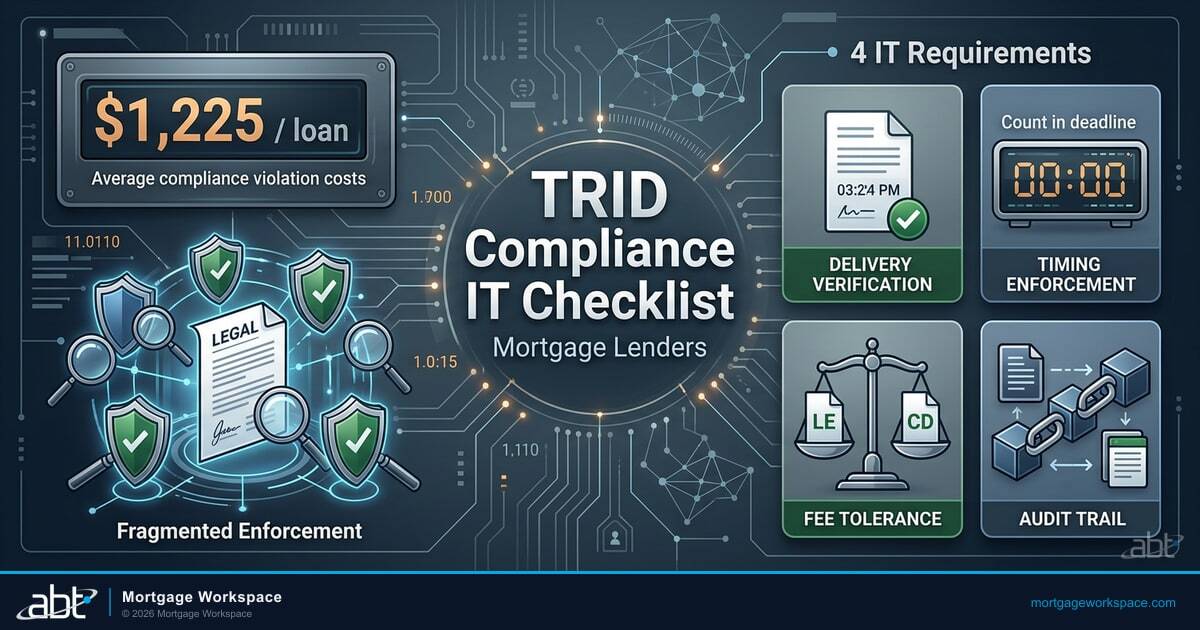
The financial cost is concrete. ICE Mortgage Technology's fee cure study pegged the average cost of TRID tolerance violations at $1,225 per loan, with 35% of all loans requiring some form of fee cure. For a lender closing 1,000 loans a year, that is $1.2 million in avoidable cost before a single examiner walks through the door.
Meanwhile, the enforcement picture has shifted. The CFPB has pulled back sharply since early 2025, dismissing active lawsuits, cutting examination staff by half, and facing a funding crisis that could freeze operations entirely in 2026. But that pullback is not a reprieve. State attorneys general in New York, California, and Michigan have publicly committed to filling the gap with their own mortgage compliance enforcement under state consumer protection statutes. The compliance obligation has not shrunk. It has fragmented across more regulators with less predictable priorities.
That fragmented enforcement makes your IT systems more important, not less. When one federal examiner set the standard, you could calibrate your compliance controls to a single playbook. Now your disclosure tracking, timing enforcement, and audit trails need to hold up under scrutiny from state regulators who may apply different interpretive frameworks to the same underlying TRID requirements. The checklist below covers what your technology stack must support to stay compliant regardless of which regulator comes knocking.
TRID compliance conversations usually stop at the compliance department. The Loan Estimate gets sent. The Closing Disclosure hits the 3-day window. Fees stay within tolerance. But the systems responsible for making all of that happen on time, every time, with a provable audit trail? That's an IT problem.
Most mortgage lenders treat TRID as a process issue. It's also an infrastructure issue. If your loan origination system (LOS) can't timestamp document delivery, your email system doesn't capture proof of borrower receipt, or your document management platform doesn't preserve version history, you have a TRID exposure that no amount of compliance training will fix.
This TRID compliance IT checklist breaks down what your technology stack needs to support TILA-RESPA Integrated Disclosure requirements, where systems commonly fail during CFPB examinations, and what to configure now before an examiner asks for records you can't produce.
While this article focuses on TRID requirements for mortgage lenders, the underlying IT audit principles — disclosure tracking, immutable audit trails, and data loss prevention — apply to any financial institution managing regulatory disclosure obligations. Banks and credit unions face parallel documentation and timing requirements under their own examination frameworks.
TRID Compliance IT Checklist: What Your Systems Must Support
The TILA-RESPA Integrated Disclosure rule consolidated mortgage disclosure requirements into two forms: the Loan Estimate (LE) and the Closing Disclosure (CD). From an IT perspective, TRID created four technology requirements that most lenders didn't have before the rule took effect.
Document Delivery Verification
TRID doesn't just require that you send disclosures. It requires that you prove you sent them and, for electronic delivery, that the borrower received them. Your systems must capture the exact timestamp of delivery, the delivery method (mail, email, eSign portal), and confirmation of receipt where applicable.
Timing Calculation and Enforcement
TRID has specific waiting periods tied to disclosure delivery. Your IT systems need to calculate these windows correctly, account for mailing rules (the 3-business-day receipt presumption for mail delivery), and prevent closings from proceeding before the waiting period expires.
Fee Tolerance Tracking
Certain fees disclosed on the Loan Estimate have zero-tolerance, 10% cumulative tolerance, or unlimited tolerance thresholds. When fees change between the LE and the CD, your systems must categorize the change, check it against the correct tolerance bucket, and trigger a revised LE if the tolerance is exceeded.
Audit Trail Preservation
Every disclosure event, fee change, timing calculation, and delivery confirmation must be logged and retrievable. Consumer Financial Protection Bureau (CFPB) examiners will ask for specific loan files and expect to see a complete history of every TRID-related action from application through closing. This connects closely to CFPB Compliance and Your Microsoft 365 Environment.
Loan Estimate and Closing Disclosure IT Requirements
The Loan Estimate and Closing Disclosure IT requirements break down into three areas: generation, delivery, and receipt confirmation.
Loan Estimate Delivery
The LE must be delivered within three business days of receiving a loan application. "Delivered" means different things depending on the method:
- Electronic delivery (eSign portal): Your LOS or eSign platform must log the exact timestamp the borrower opens or downloads the LE. A "sent" timestamp isn't enough. You need "received" or "first accessed" timestamps to prove the borrower actually got it.
- Email delivery: If you email the LE as a PDF attachment, your system needs to capture a delivery receipt or read receipt. Standard email protocols (SMTP) don't guarantee this. You need either an email tracking solution or a secure document portal that logs access.
- Mail delivery: For physical mail, TRID presumes the borrower receives the disclosure three business days after mailing. Your system must log the mail date and automatically calculate the presumed receipt date. This calculation needs to exclude weekends and federal holidays.
Closing Disclosure Delivery
The CD must be received by the borrower at least three business days before consummation. This is a receipt requirement, not a sent requirement. Your systems must:
- Log the delivery method and timestamp for every CD
- Calculate the earliest permissible closing date based on the delivery method
- Block or flag loan files where closing is scheduled before the waiting period expires
- Track revised CDs separately from the initial CD, with their own delivery timestamps and waiting period calculations
What Your LOS Needs to Capture
Encompass, Byte, LoanSoft, and other LOS platforms handle TRID disclosure tracking differently. Regardless of which platform you use, verify that your configuration captures:
- Disclosure type (initial LE, revised LE, initial CD, revised CD, corrected CD)
- Reason for revision (if applicable) tied to the specific tolerance category
- Delivery method per disclosure
- Sent timestamp and received/presumed-received timestamp
- Calculated waiting period expiration date
- User ID of the person who triggered the disclosure
Why This Matters Right Now
Examination teams - whether CFPB, state regulators, or GSE auditors - review the IT systems behind TRID compliance, not just the disclosures themselves. If your LOS can't produce timestamped delivery records, your email system doesn't capture receipt confirmation, or your document platform doesn't preserve version history, no amount of compliance training covers that gap.
TRID Compliance Starts with Your Technology Stack
Disclosure timing, fee tolerance calculations, and audit trails all depend on systems that are properly configured and secured.
Timing Rules: The 3-Day and 7-Day Requirements
TRID disclosure timing is where IT systems either protect you or expose you. On any TRID compliance IT checklist, timing enforcement ranks near the top. Spreadsheets and calendar reminders do not scale, and they do not produce the audit trail examiners expect.
The 3-Business-Day Rule (Loan Estimate)
You must deliver the initial Loan Estimate within three business days of receiving a loan application. Your LOS must:
- Record the application received date and time (not just the date the loan officer starts data entry)
- Calculate the 3-business-day deadline, excluding Sundays and federal holidays
- Generate alerts when a loan file approaches the deadline without a delivered LE
- Prevent the file from advancing past a designated milestone if the LE hasn't been sent
The gap between "application received" and "application entered in the LOS" is where many lenders get TRID findings. If a loan officer takes a phone application on Friday afternoon and doesn't enter it until Monday morning, the 3-day clock started Friday, not Monday. Your system must capture the actual receipt date.
TRID disclosure timing is where IT systems either protect you or expose you. Spreadsheets and calendar reminders do not scale, and they do not produce the audit trail examiners expect.
The 3-Business-Day Rule (Closing Disclosure)
The borrower must receive the CD at least three business days before closing. For electronic delivery, this means the access timestamp. For mail, it means the mailing date plus three additional business days (the presumed receipt rule). Your system must:
- Automatically calculate the earliest closing date based on CD delivery method
- Flag loans where the scheduled closing date falls within the waiting period
- Handle revised CDs that restart the 3-day waiting period (changes to the annual percentage rate (APR), loan product, or prepayment penalty trigger a new 3-day wait)
The 7-Business-Day Waiting Period
Consummation cannot occur until seven business days after the initial LE is delivered. This means your system must track two parallel timelines on every loan: the 7-day wait from the initial LE and the 3-day wait from the CD. Closing can only proceed when both windows have passed.

Fee Tolerance Monitoring and Change Tracking
Fee tolerance is where mortgage compliance technology either saves you money or costs you money. Automated TRID tolerance tracking catches the manual errors that produce CFPB findings. Enforcement actions citing TRID violations come back to the same root cause over and over: systems that did not track fee changes correctly.
The Three Tolerance Categories
Every fee on the Loan Estimate falls into one of three buckets:
- Zero tolerance (0%): Fees that cannot increase from LE to CD. This includes transfer taxes, fees paid to the lender (origination charges), and fees for required services where the lender selected the provider.
- 10% cumulative tolerance: Recording fees, required services where the borrower chose from the lender's written list of providers. The total increase across all fees in this bucket cannot exceed 10% of the total originally disclosed.
- Unlimited tolerance: Fees for services where the borrower shopped and selected their own provider, prepaid interest, property insurance premiums.
What Your Systems Must Track
Your LOS must categorize every fee into the correct tolerance bucket at the time it's first disclosed on the LE. When a fee changes between the LE and CD, the system must:
- Calculate whether the change exceeds the applicable tolerance threshold
- For 10% cumulative tolerance fees, track the running total across all fees in that category, not just the individual fee
- Determine whether a valid changed circumstance allows a revised LE (which resets the tolerance baseline)
- Log the reason for the fee change and the changed circumstance justification
- Generate a revised LE if required and restart the applicable waiting periods
Without automated TRID fee validation, you are relying on individual loan processors to manually check fee changes against the original LE. That works until it doesn't. And when it fails, the finding applies to every loan with the same error pattern, not just the one an examiner happened to pull.
Audit Trail Requirements for TRID Examinations
When CFPB examiners review your TRID compliance, they'll pull a sample of loan files and reconstruct the disclosure timeline for each one. This is the section of any TRID compliance IT checklist that matters most during an examination. Your IT systems must produce a complete, timestamped record of every TRID-related event. See also our breakdown of Freddie Mac AI Mandate Compliance Checklist.
What Examiners Look For
- Disclosure generation: Who created the disclosure, when, and which version of the form was used
- Delivery evidence: How was the disclosure sent, when was it sent, and when was it received (or presumed received)
- Fee change history: Every fee modification between initial LE and final CD, with the reason for each change and the tolerance calculation at each step
- Timing compliance: Proof that waiting periods were satisfied before closing proceeded
- Changed circumstance documentation: If a revised LE was issued, what triggered it and whether the changed circumstance qualified under TRID rules
System-Level Audit Requirements
Beyond what's in the loan file, your infrastructure must support the audit trail:
- Immutable timestamps: Users should not be able to modify disclosure dates after the fact. Your LOS audit log should capture the original timestamp and flag any attempted modifications.
- Email system retention: All disclosure-related emails must be retained and searchable. If your email system auto-deletes messages after 90 days, you'll lose delivery evidence on loans that close after that window.
- Document version control: Every version of every LE and CD must be preserved. If a disclosure was revised three times, examiners will want to see all three versions with their respective delivery records.
- System clock accuracy: Your servers must use NTP (Network Time Protocol) to maintain accurate timestamps. A server with a drifted clock produces timestamps that won't match other systems in the audit trail.
Retain TRID-related records according to Reg Z §1026.25 retention requirements (3 years for most disclosures, 5 years for ability-to-repay and loan originator records). Many lenders apply a conservative five-year minimum across all TRID records.
Common TRID IT Failures and How to Fix Them
These are the TRID technology failures that show up during examinations and QC reviews. Most of them are configuration problems, not software limitations. Every one of them belongs on a TRID compliance IT checklist. A qualified managed IT provider that understands TILA-RESPA compliance and RESPA TILA compliance requirements will catch these during setup.
- Email systems that don't capture borrower receipt. Standard email doesn't confirm delivery. If you're emailing disclosures as attachments through regular Outlook, you have no proof the borrower received anything. Use a secure delivery portal or eSign platform that logs borrower access timestamps.
- LOS configurations that don't block premature closings. If your LOS allows closing milestones to advance before the waiting period expires, you're relying on individual closers to check dates manually. Best practice: configure hard stops in your LOS workflow that require waiting period expiration before the closing milestone can be reached.
- Manual fee tracking in spreadsheets. Processors tracking fee changes in Excel instead of the LOS creates two problems: the spreadsheet isn't part of the audit trail, and tolerance calculations are only as accurate as the person doing the math. Move all fee tracking into the LOS where it's logged automatically.
- No holiday calendar in timing calculations. TRID business day calculations exclude Sundays and specific federal holidays. If your LOS uses a static holiday calendar, someone needs to update it annually. A missed holiday in the calendar means every timing calculation after that date is wrong.
- Disclosure PDFs without metadata. Some document management systems strip metadata from PDFs during storage. If the creation timestamp, author, and version information are stripped, you lose part of your audit trail. Verify that your document management platform preserves PDF metadata.
- No integration between LOS and email. When your LOS generates a disclosure but delivery happens through a separate email system with no integration, there's a gap in the audit trail. The LOS knows a disclosure was generated but can't confirm it was delivered. Integrate your delivery platform with your LOS so delivery timestamps flow back into the loan file automatically.

How Microsoft 365 Supports TRID Compliance
Most mortgage lenders already run Microsoft 365 for email, documents, and collaboration. When configured correctly, M365 addresses several TRID technology requirements without adding another vendor to your stack. For more details, see our guide on Encompass cloud hosting configuration.
Email Retention and Discovery
Microsoft 365 retention policies can preserve all disclosure-related emails for your required retention period. Configure litigation hold or retention policies on mailboxes that send or receive disclosures. When an examiner asks for the email that delivered a specific Loan Estimate, you can pull it from eDiscovery in minutes instead of searching backup tapes.
Data Loss Prevention for Borrower Data
DLP policies in Microsoft 365 can prevent borrower personally identifiable information (PII) from leaking outside your organization during the disclosure process. Configure rules that detect Social Security numbers, loan numbers, and account numbers in email attachments and block transmission to personal email addresses. This protects against accidental data exposure during disclosure delivery.
Document Management With Audit Trails
SharePoint document libraries can store disclosure templates, completed disclosures, and supporting documentation with full version history and access logging. Every time someone accesses, modifies, or downloads a disclosure document, SharePoint logs the event. Pair this with sensitivity labels that automatically classify documents containing borrower data, and you have an audit-ready document management layer.
Conditional Access for Disclosure Systems
Conditional Access policies in Entra ID control who can access your disclosure-related systems and from where. Require MFA for access to your LOS, restrict access to compliant devices, and block access from unmanaged personal devices. This prevents unauthorized access to disclosure data, which is both a security requirement and a TRID compliance control.
The Bottom Line
TRID compliance is as much an IT problem as a compliance problem. If your systems can't timestamp delivery, enforce timing windows, track fee tolerances, and preserve immutable audit trails, you have a TRID exposure that no amount of training will fix. Configure your technology stack now — before a CFPB examiner asks for records you can't produce.
Ensure Your Systems Meet TRID Requirements
ABT helps mortgage lenders build IT infrastructure that satisfies disclosure timing, fee tolerance, and audit trail requirements - before regulators find the gaps.
Frequently Asked Questions
TRID compliance requires a loan origination system with automated disclosure tracking, an electronic delivery platform that logs borrower receipt timestamps, fee tolerance calculation tools, timing rule enforcement with holiday calendar integration, and immutable audit logging. These systems must work together to produce a complete disclosure timeline for each loan file.
IT systems must calculate the 3-business-day Loan Estimate delivery deadline, the 3-business-day Closing Disclosure waiting period, and the 7-business-day initial waiting period. Calculations must exclude Sundays and federal holidays, account for mail delivery presumptions, and generate automated alerts when deadlines approach or waiting periods have not expired.
CFPB examiners review disclosure delivery evidence, timing compliance records, fee tolerance calculations, changed circumstance documentation, and audit trail completeness. They expect timestamped records showing when each disclosure was generated, how it was delivered, when the borrower received it, and whether all waiting periods were satisfied before closing.
Microsoft 365 supports TRID compliance through email retention policies that preserve disclosure delivery records, data loss prevention rules that protect borrower information during electronic delivery, SharePoint document management with version history and access logging, and Conditional Access policies that restrict who can access disclosure systems and borrower data.
The most common failures include email systems that cannot prove borrower receipt of disclosures, loan origination systems configured without hard stops for waiting period enforcement, manual fee tracking outside the audit trail, outdated holiday calendars producing incorrect business day calculations, and missing integration between disclosure generation and delivery platforms.
Mortgage lenders should configure Conditional Access policies that require multi-factor authentication for access to loan origination systems and disclosure platforms, restrict access to managed and compliant devices, and block legacy authentication protocols. Data Loss Prevention (DLP) rules should detect and block sharing of borrower Social Security numbers, account numbers, and loan data outside the organization through email and Teams. Email retention policies should preserve all disclosure-related communications for at least five years. DMARC email authentication prevents domain spoofing on disclosure emails, and sensitivity labels classify loan documents for proper handling throughout the origination process.
Technical Reference
The following tables define the regulatory frameworks and technical terms referenced throughout this article.
Regulatory Frameworks
| Term | Full Name | What It Means |
|---|---|---|
| TRID | TILA-RESPA Integrated Disclosure | The federal rule that consolidated mortgage disclosure requirements into the Loan Estimate and Closing Disclosure forms, with specific timing, delivery, and fee tolerance requirements. |
| CFPB | Consumer Financial Protection Bureau | The federal agency that writes and enforces TRID rules, conducts examinations, and takes enforcement actions against mortgage lenders for disclosure violations. |
| TILA | Truth in Lending Act | Federal law requiring lenders to disclose credit terms and costs in a standardized format so borrowers can compare loan offers. |
| RESPA | Real Estate Settlement Procedures Act | Federal law governing settlement services, requiring good-faith estimates of settlement costs and prohibiting kickbacks between settlement service providers. |
| FTC Safeguards Rule | Federal Trade Commission Standards for Safeguarding Customer Information | The updated FTC regulation requiring non-bank financial institutions (including mortgage companies) to implement comprehensive information security programs to protect consumer data. |
Glossary
| Term | Definition |
|---|---|
| APR | Annual Percentage Rate — the total cost of borrowing expressed as a yearly rate, including interest and certain fees. |
| Conditional Access | Microsoft Entra ID policies that enforce login requirements — such as multi-factor authentication, device compliance, and location restrictions — before granting access to Microsoft 365 resources. |
| DLP (Data Loss Prevention) | Microsoft Purview rules that detect and block sharing of sensitive data — such as Social Security numbers, account numbers, and loan data — outside the organization. |
| DMARC | Domain-based Message Authentication, Reporting, and Conformance — an email authentication standard that prevents attackers from spoofing your organization's email domain. |
| LOS | Loan Origination System — the primary software platform (such as Encompass, Byte, or LoanSoft) used to process mortgage applications, generate disclosures, and manage the loan pipeline. |
| MFA | Multi-Factor Authentication — requiring two or more verification methods (password plus a phone prompt, hardware key, or biometric) to sign in. |
| NTP | Network Time Protocol — the standard for synchronizing server clocks across a network, ensuring accurate timestamps in audit trails. |
| PII | Personally Identifiable Information — data that can identify an individual, including Social Security numbers, dates of birth, account numbers, and financial records. |
| Sensitivity Labels | Microsoft Purview classifications applied to documents and emails that enforce encryption, restrict sharing, and apply watermarks based on content sensitivity. |
| SMTP | Simple Mail Transfer Protocol — the standard protocol for sending email. Standard SMTP does not guarantee delivery confirmation, which is why secure delivery portals are needed for TRID disclosure delivery. |