In This Article
- How Your Microsoft 365 Configuration Impacts CFPB Compliance
- CFPB Data Retention Requirements Mapped to Microsoft 365
- Microsoft Purview DLP Policies for Consumer Financial Data
- eDiscovery and Legal Hold for CFPB Examinations
- Email Archiving and Communication Compliance
- Microsoft Entra ID and Purview Audit Trail Configuration
- Common CFPB Compliance Gaps in Mortgage Lender M365 Tenants
- The ABT Tier-1 CSP Advantage and M365 Guardian for Mortgage Lenders
- Frequently Asked Questions
The CFPB made mortgages its highest enforcement priority in April 2025. That single sentence should change how every mortgage lender thinks about their Microsoft 365 configuration. The Bureau's supervision memo listed "inadequate controls to protect consumer information resulting in actual loss to consumers" as an explicit enforcement target. Your Microsoft 365 tenant is where consumer financial data lives, moves, and gets shared. If it is misconfigured, the CFPB now has a documented reason to come looking.
Meanwhile, Fannie Mae's Information Security and Business Resiliency Supplement took effect in August 2025, requiring sellers and servicers to report cybersecurity incidents within 36 hours, align their security programs with NIST standards, and attest annually across 14 security domains. That is not a suggestion. It is a contractual obligation that directly affects your ability to sell loans.
Most mortgage lenders already run Microsoft 365. The question is whether the tenant is configured to meet the specific data handling, retention, and access control requirements that CFPB examiners and Fannie Mae auditors actually check. This article maps those requirements to concrete Microsoft Purview, Microsoft Entra ID, and Microsoft Defender configurations, then explains how Access Business Technologies operates the whole stack for mortgage lenders under the M365 Guardian operating model.
Why ABT Operates This Stack for Mortgage Lenders
- Mortgage-specific retention and DLP policies in Microsoft Purview tuned to actual CFPB findings, GSE seller-servicer audits, and state statute-of-limitations exposure rather than generic SMB templates. Consumer NPI, Closing Disclosures, and Loan Estimates each carry their own retention and data-loss-prevention profile.
- Microsoft Entra ID Conditional Access policies in Grant mode for every loan officer, processor, underwriter, and compliance reviewer, with location-aware filters for branch offices and a hard block on legacy authentication that examiners list as a recurring finding.
- Microsoft Sentinel and Microsoft Defender deployments tuned to mortgage attack patterns rather than vendor-default SMB rules, feeding the 36-hour incident notification clock built into Fannie Mae's 2025 supplement and the 30-day customer notification clock under amended SEC Regulation S-P where it applies.
How Your Microsoft 365 Configuration Impacts CFPB Compliance
CFPB compliance is not an abstract regulatory concept. It translates directly into how your Microsoft 365 tenant handles four categories of data:
- Consumer personally identifiable information (PII): Social Security numbers, financial account numbers, loan application data, credit reports, and income documentation flowing through Exchange Online, SharePoint, OneDrive, and Microsoft Teams.
- Disclosure records: Loan Estimates, Closing Disclosures, adverse action notices, and fee change documentation that must be retained for specific periods with provable audit trails.
- Communication records: Borrower-facing emails, internal loan processing discussions, compliance review threads, and any electronic communication related to a consumer's mortgage file.
- Access and activity logs: Records of who accessed consumer data, when, from what device, and what they did with it.
If your Microsoft 365 tenant has default retention settings, no Microsoft Purview DLP policies scoped to financial data types, and basic audit logging without extended retention, you have gaps in all four categories. Default Microsoft 365 configurations were not designed for CFPB-regulated mortgage operations. They were designed for general business use.
Why This Matters Right Now
The CFPB's April 2025 supervision memo explicitly prioritized "inadequate controls to protect consumer information resulting in actual loss to consumers." At the same time, Fannie Mae's cybersecurity supplement requires annual officer attestation across 14 security domains, with incident reporting within 36 hours. Your Microsoft 365 configuration is now auditable from two directions: federal regulators and your secondary market counterparty.
CFPB Data Retention Requirements Mapped to Microsoft 365
Mortgage record retention is governed by multiple overlapping requirements: CFPB regulations (Regulation Z, X, and B), GSE seller/servicer guides (Fannie Mae, Freddie Mac), government loan program rules (FHA, VA), and BSA/AML obligations. Your Microsoft Purview retention policies must align with the longest applicable period for each data type, which in practice means 7 years is the minimum safe harbor for most mortgage records.
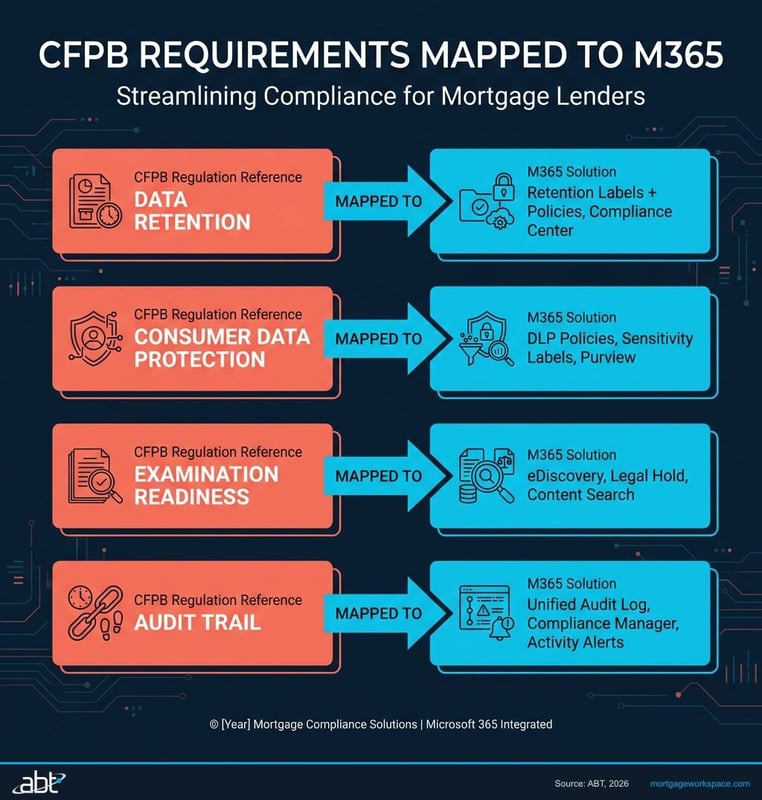
Retention Requirements by Record Type
| Record Type | Minimum Retention | Source |
|---|---|---|
| Freddie Mac Mortgage Files | 7 years after interest satisfied | Freddie Mac Seller/Servicer Guide |
| FHA Servicing Records | 7 years after claim payment or insurance termination | HUD Handbook 4000.1 |
| Foreclosure Records | 7 years from foreclosure sale date | Freddie Mac Seller/Servicer Guide |
| Promissory Notes and Mortgages | 7 years after consummation | Industry standard / state SOL coverage |
| Closing Disclosures | 5 years after consummation | Reg Z, 12 CFR 1026.25(c)(1)(ii) |
| HUD-1 / Settlement Records | 5 years after settlement | Reg X, 12 CFR 1024.10(e) |
| BSA/AML Records (SARs, CTRs) | 5 years from filing date | 31 CFR 1010.430 / FFIEC BSA Manual |
| HMDA Loan/Application Data | 5 years after reporting year | Reg C, 12 CFR 1003.6 |
| Fannie Mae Servicing Files | 4 years after loan liquidation | Fannie Mae Selling Guide A2-4.1-02 |
| LO Compensation Records | 3 years after payment | Reg Z, 12 CFR 1026.25(c)(2) |
| Ability-to-Repay Records | 3 years after consummation | Reg Z, 12 CFR 1026.25(c)(3) |
| Credit Application Records | 25 months | Reg B, 12 CFR 1002.12(b) |
| General TILA Compliance | 2 years after disclosure | Reg Z, 12 CFR 1026.25(a) |
| Servicing Records (CFPB minimum) | 1 year after discharge/transfer | Reg X, 12 CFR 1024.38(c) |
Why 7 years is the practical minimum: The CFPB regulatory minimums above are the floor, not the ceiling. Freddie Mac requires 7 years from the date its interest is satisfied. FHA requires 7 years after claim payment. State statutes of limitations on contract and fraud claims commonly extend to 6 or 7 years. Most compliance officers set a blanket 7-year retention policy across all mortgage records because it covers every federal, GSE, and state requirement without needing to track individual expiration dates per record type. Your Microsoft Purview retention policies should reflect this practical reality, not just the regulatory minimums.
Microsoft Purview Configuration: Retention Policies
In the Microsoft Purview compliance portal, navigate to Solutions > Data Lifecycle Management > Retention Policies. Create policies that cover each data type above:
- Exchange Online retention: Set a minimum 7-year Microsoft Purview retention policy on mailboxes that send or receive mortgage disclosures, borrower communications, and compliance-related correspondence. This covers Freddie Mac, FHA, and state statute of limitations requirements in a single policy. Use adaptive scopes to target specific distribution groups (such as "Loan Processing," "Compliance," "Closers") rather than applying a blanket policy to all mailboxes.
- SharePoint and OneDrive retention: Apply 7-year Microsoft Purview retention labels to document libraries containing Closing Disclosures, loan files, and settlement records. Use auto-apply retention labels based on sensitive information types to catch documents that get saved outside the designated libraries.
- Microsoft Teams retention: If your loan processors use Microsoft Teams channels or chats for borrower-related discussions, those conversations are subject to the same retention requirements. Configure Teams retention to match your Exchange retention period.
The critical mistake is leaving Microsoft 365 at its default retention settings. Default Exchange Online retention is 14 days for deleted items and no long-term retention policy. That means a processor who deletes an email containing a Loan Estimate delivery confirmation loses it in two weeks. An examiner asking for that record three years later will not accept "it was deleted" as an answer.
Microsoft Purview DLP Policies for Consumer Financial Data
Microsoft Purview Data Loss Prevention policies stop consumer financial data from leaving your organization through unauthorized channels. For CFPB compliance, you need Purview DLP rules that specifically address mortgage-related data types.
Microsoft Purview Configuration: DLP Policy Setup
Navigate to Microsoft Purview > Data Loss Prevention > Policies > Create Policy. Start with the "U.S. Financial Data" template and customize it for mortgage operations:
- Sensitive information types to detect: Social Security numbers, U.S. bank account numbers, credit card numbers, U.S. Individual Taxpayer Identification Numbers (ITINs), and driver's license numbers. Add custom sensitive information types for loan numbers and NMLS IDs if your organization uses standardized formats.
- Locations to monitor: Exchange Online, SharePoint Online, OneDrive for Business, Microsoft Teams chat and channel messages, and Endpoint (for organizations using Microsoft 365 E5 or the compliance add-on).
- Policy actions: Block external sharing of documents containing three or more sensitive information types. Show policy tips to users when they attempt to share files containing borrower PII outside the organization. Require business justification for sharing that overrides the policy. Generate incident reports for the compliance team.
Mortgage-Specific DLP Rules
Beyond the standard financial data template, configure rules for these mortgage-specific scenarios:
- Loan application data in email: Block emails containing combinations of SSN plus property address plus loan amount from being sent to external recipients without encryption. Borrowers sending this data to your team is fine. Your team forwarding it to a personal Gmail account is not.
- Disclosure documents as attachments: Flag outbound emails with PDF attachments matching naming conventions for Loan Estimates or Closing Disclosures (such as "LE_" or "CD_" prefixes) unless the recipient domain is on your approved list (eSign platforms, title companies, settlement agents).
- Teams external sharing: If your organization allows guest access in Microsoft Teams, block sharing of files from channels tagged with sensitivity labels like "Borrower Data" or "Consumer PII" with external guests.
eDiscovery and Legal Hold for CFPB Examinations
When a CFPB examiner requests specific loan files, borrower communications, or compliance records, you need to produce them. Microsoft Purview eDiscovery is built for this. The problem is that most mortgage lenders have never configured it.
Microsoft Purview Configuration: eDiscovery Setup
In the Microsoft Purview compliance portal, navigate to Solutions > eDiscovery. Microsoft 365 offers two tiers:
- eDiscovery (Standard): Available with E3 licensing. Allows content searches across Exchange mailboxes, SharePoint sites, and OneDrive accounts. Supports legal holds on specific mailboxes and sites. This is sufficient for most CFPB examination responses.
- eDiscovery (Premium): Available with E5 licensing or the E5 Compliance add-on. Adds custodian management, legal hold notifications, advanced analytics (near-duplicate detection, email threading), and review sets. Worth the investment if your organization handles frequent examination requests or litigation holds.
Pre-Examination Preparation
Do not wait for a CFPB examination notice to set up eDiscovery. Configure it now:
- Assign eDiscovery Manager roles in Microsoft Entra ID: Designate at least two people (typically your compliance officer and IT administrator) as eDiscovery Managers in Microsoft Purview. This role is required to create cases, run searches, and export content.
- Create a standing search template: Build a saved search that covers all mortgage-related content locations (loan processing mailboxes, compliance SharePoint sites, borrower data OneDrive folders). When an examiner requests records for a specific borrower, you clone the template and add the borrower name and loan number as search terms.
- Test your search results: Run a test search quarterly. If the search returns zero results for a borrower you know has records, your content locations are misconfigured or your retention policies deleted the records prematurely.
Legal Hold During Active Examinations
When you receive a CFPB examination notification, if your legal counsel advises preservation beyond your standing retention policies, immediately place legal holds on all relevant content locations. In eDiscovery (Standard), this means placing mailboxes and sites on hold within a case. In eDiscovery (Premium), you can use the custodian management workflow to issue hold notifications and track custodian acknowledgments.
Legal holds override retention policies. If your 7-year Microsoft Purview retention policy would otherwise delete a document that is subject to a legal hold, the hold wins. The document is preserved until the hold is released. This is by design, and it is the safety net that prevents accidental destruction of evidence.
"Bureau-supervised entities will receive advance notice of scheduled examinations providing them with the opportunity to plan. Requests related to exams will focus on Bureau priorities and hew to the defined scope of the exam and not venture into areas outside the scope."
CFPB Humility in Supervisions Pledge, November 2025
Email Archiving and Communication Compliance
Mortgage lending generates a high volume of email. Borrower communications, rate lock confirmations, disclosure delivery records, internal underwriting discussions, and compliance reviews all flow through Exchange Online. Every one of these messages is potentially discoverable in a CFPB examination.
Microsoft 365 Configuration: Archive and Journaling
- In-Place Archive: Enable archive mailboxes for all users who handle mortgage data. Navigate to Exchange admin center > Mailboxes > select user > Manage mailbox archive > Enable. Archive mailboxes provide unlimited storage (with E3/E5 licensing) and ensure emails that are moved out of the primary mailbox are still retained and searchable.
- Auto-expanding archive: For high-volume mailboxes (closers, loan officers, compliance), enable auto-expanding archiving. This prevents the archive mailbox from hitting its 100 GB limit and automatically provisions additional storage.
- Journaling (if required): Some compliance frameworks require a tamper-proof copy of every email. Microsoft 365 supports journal rules that send a copy of every message matching specific criteria to a journal mailbox or third-party archiving service. This is a belt-and-suspenders approach on top of Microsoft Purview retention policies.
Microsoft Purview Communication Compliance Policies
Microsoft Purview Communication Compliance monitors email and Microsoft Teams messages for policy violations. For mortgage lenders, useful detections include:
- Unauthorized disclosure of rates or terms: Flag messages where loan officers share rate information through personal email accounts or unapproved channels.
- Consumer complaint indicators: Detect messages containing phrases like "CFPB complaint," "regulatory complaint," or "attorney general" to route them to compliance for review and documentation.
- Steering language: Monitor for language patterns that could indicate fair lending violations in borrower-facing communications.
Microsoft Entra ID and Purview Audit Trail Configuration
CFPB examiners expect to see who accessed consumer data, when, and what actions they took. Microsoft Purview Audit captures that activity across Exchange Online, SharePoint, OneDrive, Microsoft Teams, and Microsoft Entra ID, but only if you configure it correctly and retain the logs long enough.

Microsoft Purview Configuration: Audit Log Settings
- Verify Microsoft Purview Audit is enabled: Navigate to Microsoft Purview > Audit. For E3 tenants, audit logs are retained for 180 days by default (extended from 90 days in October 2023). For E5 tenants, the default extends to one year. Neither default meets the 7-year retention standard for mortgage records.
- Extend Microsoft Purview Audit retention: With E5 or the E5 Compliance add-on, create audit log retention policies that retain specific activity types for up to 10 years. At minimum, configure 7-year retention for Microsoft Entra ID sign-in events, file access and sharing events in SharePoint and OneDrive, mailbox access events, and admin activity logs.
- Enable mailbox auditing for all users: Mailbox auditing is enabled by default in Microsoft 365, but verify it has not been disabled for specific mailboxes. Navigate to Exchange admin center > Mailboxes > select user > Manage mailbox auditing. Ensure "Owner," "Delegate," and "Admin" actions are all logged.
What Examiners Actually Ask For
During a CFPB examination focused on data handling, examiners typically request:
- Records of who accessed a specific borrower's loan file and when, sourced from Microsoft Purview Audit
- Evidence that former employees' access was revoked upon termination, sourced from Microsoft Entra ID sign-in logs
- Logs showing failed login attempts or access from unusual locations, sourced from Microsoft Entra ID Identity Protection
- Proof that sensitive data was not shared externally without authorization, sourced from Microsoft Purview DLP incident reports
- Documentation of admin changes to security policies, retention settings, or DLP configurations, sourced from Microsoft Purview Audit
If your audit log retention is at the 180-day default and the examiner asks about activity from 18 months ago, you have nothing to show. That gap becomes a finding.
Common CFPB Compliance Gaps in Mortgage Lender M365 Tenants
After configuring Microsoft 365 environments for hundreds of mortgage companies, these are the CFPB compliance gaps that appear most frequently. Each one is a configuration problem, not a licensing limitation.
- No Microsoft Purview retention policies beyond M365 defaults. The single most common gap. Mortgage data gets deleted on standard retention schedules that have nothing to do with CFPB requirements. Closing Disclosure emails disappear after 14 days in the deleted items folder. Fix: Create Microsoft Purview retention policies aligned with the table in the Data Retention section above.
- Microsoft Purview DLP policies not scoped to mortgage data types. Many lenders have DLP policies that detect credit card numbers but nothing else. Loan application data containing SSN plus income plus property address flows freely to personal email accounts. Fix: Deploy the mortgage-specific Microsoft Purview DLP rules described in the DLP section.
- Legacy authentication still enabled in Microsoft Entra ID. Older mail clients and third-party applications using basic authentication bypass Microsoft Entra ID Conditional Access policies, meaning access to mortgage data cannot be controlled or audited properly. Fix: Block legacy authentication in Conditional Access and migrate all clients to modern authentication.
- No eDiscovery cases or role assignments. When an examination notice arrives, nobody in the organization has the permissions to search for and export the requested records. Fix: Assign eDiscovery Manager roles in Microsoft Purview and build standing search templates before you need them.
- Audit logging at default retention. E3 tenants lose Microsoft Purview audit logs after 180 days. Even E5 tenants lose them after one year unless custom retention policies are configured. Fix: Create audit log retention policies that match your longest regulatory retention period.
- No sensitivity labels on mortgage documents. Loan files, disclosures, and borrower documents are stored alongside general business documents with no classification. This makes Microsoft Purview DLP policies less effective and eDiscovery searches less precise. Fix: Create Microsoft Purview sensitivity labels for "Consumer PII," "Loan File," and "Disclosure" document types and train users to apply them.
- Archive mailboxes not enabled. Loan officers delete old emails to manage mailbox size. Those emails are gone permanently after the deleted items retention period expires. Fix: Enable Exchange Online archive mailboxes for all mortgage-related users.
The ABT Tier-1 CSP Advantage and M365 Guardian for Mortgage Lenders
Access Business Technologies is a Tier-1 Microsoft Cloud Solution Provider that manages Microsoft 365 tenants for more than 750 financial institutions. The firm's footprint covers banks, credit unions, mortgage companies, and securities firms operating under federal and state regulatory oversight. For mortgage lenders specifically, ABT applies the CFPB-aligned configuration pattern described in this article and layers it with the mortgage-specific compliance work that examiners and Fannie Mae auditors actually grade.
That layered model has a name: M365 Guardian. The Microsoft baseline is what Microsoft 365 ships with. Guardian is the ABT operating model on top of it for regulated financial institutions. For a mortgage lender, the Guardian layer includes mortgage-tuned Microsoft Entra ID Conditional Access policies covering branch geography and loan officer behavior, Microsoft Purview DLP policies built for Closing Disclosures, Loan Estimates, and HMDA data, Microsoft Purview retention policies aligned to the 7-year mortgage safe harbor with documented testing of restore and production workflows, Communication Compliance review templates calibrated to actual CFPB and state attorney general findings rather than vendor SMB defaults, a Microsoft Sentinel deployment tuned to mortgage attack patterns, and the 24-by-7 security operations center that watches the Sentinel and Microsoft Defender signals every minute of the day. The mortgage lender keeps its Microsoft 365 licensing and retains its tenant ownership. The Guardian layer is added through the partner relationship.
ABT manages the Microsoft 365 tenants that mortgage lenders operate. Microsoft hosts the underlying infrastructure, ABT manages the tenant under Granular Delegated Administrative Privileges (GDAP) with least-privilege role grants in Microsoft Entra ID. The mortgage lender continues to own the regulatory relationships, the loan officers, and the borrower accounts. The partner relationship is set up under an executed vendor oversight agreement that satisfies CFPB third-party service provider expectations and the Fannie Mae cybersecurity supplement's vendor governance language, with an annual independent verification cycle that produces the evidence the compliance team needs for examination prep.
M365 Guardian operates the full Microsoft compliance stack for mortgage lenders under a single managed model. Microsoft Entra ID supplies the identity layer (Conditional Access, MFA enforcement, sign-in risk, GDAP scoping). Microsoft Purview Audit, DLP, retention, sensitivity labels, eDiscovery, and Communication Compliance hold up the books-and-records side mapped to Regulations B, C, X, and Z. Microsoft Defender for Office 365 and Microsoft Defender for Endpoint handle the active threat side. Microsoft Sentinel aggregates the signals into a SIEM that satisfies Fannie Mae's 36-hour incident notification requirement and produces the timeline a CFPB examiner expects to see when consumer data access is in question. ABT applies, monitors, and documents the deployment across every tenant in the mortgage lender's footprint.
Key Takeaway
CFPB compliance and Fannie Mae cybersecurity attestation both resolve to specific Microsoft Purview, Microsoft Entra ID, and Microsoft Defender configurations inside your Microsoft 365 tenant. The controls already exist in any reasonably licensed environment. The question is whether they are configured consistently, monitored continuously, and producing the evidence examiners ask for. A Tier-1 Microsoft Cloud Solution Provider running the M365 Guardian operating model applies, watches, and documents the deployment so the mortgage lender's compliance team walks into examinations and Fannie Mae audits with the evidence already in hand.
Get a Mortgage CFPB Configuration Review
ABT operates the M365 Guardian model for mortgage lenders working across CFPB supervision, Fannie Mae and Freddie Mac seller-servicer obligations, and state attorney general scrutiny. A 30-minute conversation maps your current Microsoft 365 tenant against the configuration map in this article, surfaces the gaps your next examiner is most likely to find, and outlines what an ABT-managed deployment would cover. No commitment, no quote, no obligation.
Related Reading
Mortgage lenders working through the same configuration questions usually pair this article with:
- DLP and the Role of Technology in Modern Mortgage Compliance for a deeper look at Microsoft Purview DLP policy design.
- Mortgage Compliance Made Simple: A Microsoft 365 Self-Audit Guide for the checklist mortgage compliance teams run between examinations.
- Deploying Microsoft 365 Lighthouse for Broker-Dealer Compliance Standardization for how the multi-tenant control plane works across affiliated entities.
Frequently Asked Questions
Microsoft 365 E3 provides the baseline tools for CFPB compliance: retention policies, basic eDiscovery, DLP policies, and 180-day audit log retention (extended from 90 days in October 2023). Microsoft 365 E5 or the E5 Compliance add-on extends audit log retention to 10 years, adds eDiscovery Premium with custodian management and analytics, and provides advanced DLP capabilities including endpoint DLP. Most mortgage lenders with active CFPB examination exposure should be on E5 or E3 plus the compliance add-on.
Retention periods vary by record type. Closing disclosures must be retained for five years after consummation under Regulation Z. HUD-1 settlement records require five years after settlement under Regulation X. Credit application records must be kept for 25 months under Regulation B. Loan originator compensation records require three years after payment. If your organization services loans, servicing records must be retained until one year after the loan is discharged or servicing is transferred. Many mortgage lenders apply a blanket seven-year retention policy to simplify compliance across all record types.
Mortgage lenders should configure DLP policies that detect and block unauthorized sharing of Social Security numbers, bank account numbers, credit card numbers, and Individual Taxpayer Identification Numbers across Exchange Online, SharePoint, OneDrive, and Teams. Add custom sensitive information types for loan numbers and NMLS IDs. Configure rules that block external sharing of documents containing three or more sensitive information types, show policy tips to users, require business justification for overrides, and generate incident reports for the compliance team.
Before an examination, assign eDiscovery Manager roles to your compliance officer and IT administrator in Microsoft Purview. Create standing search templates that cover all mortgage-related content locations including loan processing mailboxes, compliance SharePoint sites, and borrower data folders. Test your eDiscovery searches quarterly by searching for known borrower records to verify your content locations and retention policies are correctly configured. If your legal counsel advises preservation beyond your standing retention policies when an examination notice arrives, use eDiscovery holds in Microsoft Purview to override retention and prevent accidental deletion until the examination concludes.
CFPB examiners expect audit trails showing who accessed consumer data, when, from what device, and what actions they took. Microsoft 365 E3 retains audit logs for 180 days by default (extended from 90 days in October 2023), which is still insufficient for mortgage compliance. E5 licensing or the E5 Compliance add-on extends default retention to one year and allows custom audit log retention policies up to 10 years. At minimum, configure five-year retention for user login events, file access and sharing events, mailbox access events, and admin activity logs. Verify mailbox auditing is enabled for all users with Owner, Delegate, and Admin actions logged.
Fannie Mae's Information Security and Business Resiliency Supplement, effective August 12, 2025, requires sellers and servicers to align security programs with NIST standards, report cybersecurity incidents within 36 hours, conduct annual penetration testing, and provide officer attestation across 14 security domains. In Microsoft 365, this translates to enabling Conditional Access policies with MFA enforcement, configuring Microsoft Defender for endpoint protection, implementing DLP policies for consumer data, enabling advanced audit logging, and maintaining documented evidence of security configurations. The 36-hour reporting requirement means your incident response plan must include procedures for detecting and escalating M365 security events in near real-time.