In This Article
- The Technology Challenge for Platform Lenders
- ABT's Productized Platform-Lender Stack
- How the Automation Layer Actually Works
- Document Automation, Security, and Governance
- Custom Interfaces for Every Role
- Vendor Integration Through MortgageExchange
- Why Platform Lenders Choose ABT
- Frequently Asked Questions
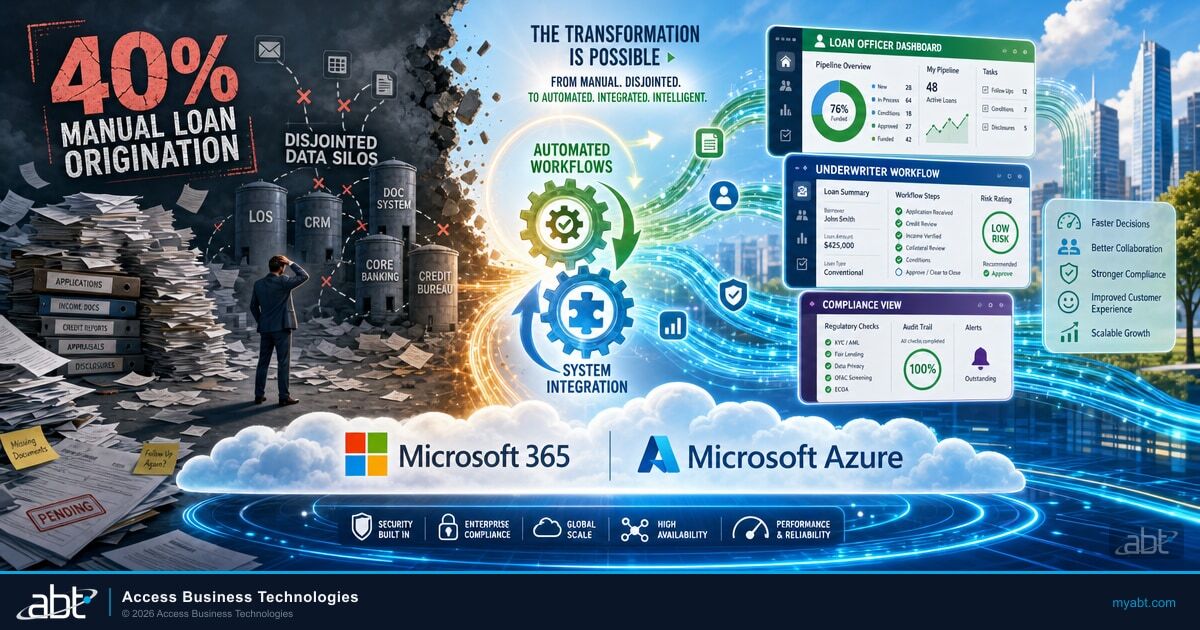
ICE Mortgage Technology estimates that up to 40% of the loan origination process remains manual. For platform lenders processing hundreds or thousands of applications a month, that 40% manual overhead translates to slower closings, higher error rates, and staff burnout. You cannot hire your way out of the problem. The technology already exists to automate the work. The question is whether your Managed Service Provider can implement it without breaking the lending operation that pays the bills, and whether their automation comes pre-built for mortgage workflows or has to be scripted from scratch for your shop. Access Business Technologies operates Microsoft 365 tenants and the mortgage-specific integration stack on top of them for more than 750 financial institutions, and platform lenders are a core part of that footprint.
Why Platform Lenders Run ABT
- Productized automation, not custom scripting. ABT's platform-lender stack is built once, deployed many times. MortgageExchange handles LOS-to-core integration, App Pilot manages the application lifecycle, DocumentGuardian handles document automation, and M365 Guardian provides the security and governance layer. Generalist MSPs build each integration from scratch, then bill you to maintain it.
- Mortgage-specific compliance fluency. TRID, RESPA, GLBA, FTC Safeguards, and state-level mortgage rules are baked into the workflow, not bolted on after the fact.
- Tier-1 Direct-Bill Microsoft CSP status. ABT manages your Microsoft 365 tenant under delegated admin and operates the Azure environment that hosts the integration platform. One operational owner, one accountability surface.
This article explains what platform-lender automation looks like when it is productized rather than improvised, how ABT's MortgageExchange, App Pilot, DocumentGuardian, and M365 Guardian stack fits together, and how a Tier-1 Direct-Bill Cloud Solution Provider pulls the whole picture into a single operational view that scales with the business.
The Technology Challenge for Platform Lenders
Platform lenders run on technology. Every application, every verification, every compliance check flows through digital systems. But most lenders did not build those systems from scratch. They assembled them over time, adding tools as needs emerged, patching integrations with manual workarounds, and accumulating technical debt that slows everything down.
The result is a fragmented stack where the LOS does not talk to the core, the document platform operates in isolation, and compliance tracking lives in a spreadsheet. Staff toggle between systems, manually transferring data and hoping nothing gets lost in translation.
This fragmentation creates three specific problems that compound at volume:
- Growth ceilings. Manual workflows break under volume. When application volume spikes 30%, your staff needs roughly 30% more hours. Automated workflows absorb the spike without proportional headcount increases.
- Error compounding. Every manual data transfer introduces error risk. Across a pipeline of 500 loans, even a 5% error rate generates 25 files that require rework. At 2,000 loans, that is 100 files.
- Compliance drift. When compliance requirements are tracked outside the primary workflow, gaps appear. TRID timing violations, missing disclosures, and incomplete audit trails all stem from disconnected systems.
A productized mortgage-focused MSP addresses all three problems by connecting systems, automating manual steps, and embedding compliance into the workflow rather than treating it as an afterthought. The phrase "productized" matters. The difference between a custom-scripted MSP engagement and ABT's pre-built platform-lender stack shows up in implementation time, in maintenance cost, and in the speed with which the lender can add new vendor relationships without paying for a fresh integration project every time.
ABT's Productized Platform-Lender Stack
This is the section where the difference between a generalist MSP and ABT becomes concrete. Most MSPs serving mortgage lenders deliver custom scripting. They are technically competent, but they treat every lender as a one-off. The result is a stack that works for the first 500 loans a month and breaks at the 2,000-loan mark, because the integration logic was never built to scale and the MSP is billing by the hour to keep it running.
MortgageExchange and App Pilot together are ABT's productized platform-lender automation stack, not generic MSP scripting. MortgageExchange is the custom interface layer that connects the lender's loan origination system to core banking platforms (Fiserv DNA, Symitar, Episys, FIS), to the GSE-facing systems, to credit bureaus, to title and appraisal vendors, and to investor delivery channels. It is a productized integration platform that runs in the lender's Azure environment under ABT's operational ownership, with new vendor connectors added through configuration rather than fresh code projects. App Pilot is the application lifecycle layer that sits on top of MortgageExchange and manages how loan applications move through the pipeline. It handles the workflow rules, the role-based interfaces, the status notifications, the conditional routing based on loan type and complexity, and the connection back to the LOS for the records of decision. Together, MortgageExchange plus App Pilot is the platform-lender automation stack that competing MSPs cannot match because they do not have an equivalent productized layer. They have scripts.
DocumentGuardian and M365 Guardian together are the document automation and security and governance layer that sits over the entire stack. DocumentGuardian is the document management product. It handles the inbound document classification across 600+ mortgage document types, the data extraction that populates the loan file without manual sorting, the retention rules that keep records inside the required windows under TRID, RESPA, and investor delivery requirements, and the secure document workflows that route NPI-bearing files only to the staff who need them. M365 Guardian is the security and governance operating model that ABT layers over the Microsoft 365 tenant the lender already pays for. It applies the Conditional Access policies that meet examiner expectations, the Microsoft Purview retention and Data Loss Prevention policies that match mortgage-industry recordkeeping rules, the Microsoft Defender configuration that catches the email-based fraud attempts that close on the wire transfer the day before the loan funds, and the Microsoft Sentinel deployment that produces the cross-tenant incident timeline a regulator will ask for. DocumentGuardian handles the mortgage-specific document automation, M365 Guardian handles the security and governance, and the two run as a continuous layer rather than two separately purchased tools that the lender has to integrate themselves.
The Microsoft 365 controls that platform lenders need are already inside the tenant. Microsoft Entra ID supplies the identity layer (MFA, Conditional Access, sign-in risk). Microsoft Intune enrolls and posture-checks every device that touches loan data. Microsoft Defender for Office 365 and Microsoft Defender for Endpoint handle the active threat side. Microsoft Purview Audit, DLP, and retention hold up the records side. Microsoft Sentinel aggregates the signals into the SIEM that produces the incident timeline. ABT manages those controls under M365 Guardian, and DocumentGuardian, App Pilot, and MortgageExchange sit on top as the mortgage-specific automation and integration layers. The lender keeps the Microsoft 365 licensing and the tenant ownership. ABT runs the operating model.
How the Automation Layer Actually Works
Automation in mortgage operations covers a wide range of tasks. Document classification. Data extraction. Income verification. Condition tracking. Disclosure delivery. Status notifications. Each one can be automated in isolation, but the value compounds when the automations connect into workflows that move a loan from application through closing without manual handoffs.
A productized mortgage MSP approaches automation in connected layers rather than isolated scripts:
- Document automation through DocumentGuardian. AI-driven classification and extraction that handles 600+ document types. Documents arrive from email, portal uploads, or mobile cameras. The system classifies each one, extracts relevant data, routes it to the correct loan file section, and surfaces the missing items so the processor sees the gap before the underwriter does. Modern platforms achieve over 95% accuracy without manual sorting.
- Workflow automation through App Pilot. Rules-based engines that route files through the pipeline based on loan type, complexity, and team capacity. When an underwriter clears a condition, the system automatically notifies the borrower if additional documentation is needed. When all conditions are satisfied, the file advances to closing. The workflow rules are configurable per lender, but the engine itself is productized.
- Communication automation through the Microsoft 365 tenant. Status updates, document requests, and milestone notifications sent automatically via email, text, or borrower portal. Borrowers and referral partners stay informed without loan officers manually sending updates. The communications run inside the Microsoft 365 tenant that ABT manages, so the email and portal traffic is logged, retained, and audit-ready.
- Robotic Process Automation (RPA). Software robots that handle repetitive data-entry tasks. Pulling credit reports, populating forms, transferring data between systems that lack API connections. RPA fills the gaps while longer-term API integration is being built through MortgageExchange.
ABT does not just install these tools. ABT configures them for the lender's specific operation, integrates them with the LOS and the core, layers the M365 Guardian security and governance posture over the top, and maintains the whole stack as a managed service. The lender's operations team focuses on lending, not on troubleshooting integrations.
Document Automation, Security, and Governance
The document layer and the security layer cannot be treated as separate purchases at a platform lender, because the same NPI-bearing documents that drive the workflow are also the records the regulator asks for under TRID, RESPA, GLBA, FTC Safeguards Rule, and state-level mortgage privacy rules. The way ABT runs the layer is to put DocumentGuardian on top of the Microsoft 365 tenant for the mortgage-specific document handling, and to run M365 Guardian as the operating model over the same tenant for the security and governance side.
What that looks like in practice for a 1,200-loan-a-month platform lender: every inbound document goes through DocumentGuardian classification within seconds of arrival. Customer NPI is identified and tagged. Retention windows are set per document type and bound through Microsoft Purview retention policies, with litigation hold available for any file that becomes the subject of a regulatory inquiry. Data Loss Prevention rules inside Microsoft 365 block the same NPI from leaving the tenant through unmanaged channels. Microsoft Defender for Office 365 watches the inbound email traffic for the wire-fraud attempts that target closing departments. Microsoft Sentinel aggregates the signals into a single incident timeline that the lender's compliance officer can pull on demand. M365 Guardian is the operating model that keeps all of that running, drift-free, across the tenant footprint.
The lender experiences this as: documents arrive, get classified, get extracted, get routed, and the audit log writes itself. Compliance is not a separate project. It is the byproduct of the productized workflow running correctly, every day, across every loan in the pipeline.
Custom Interfaces for Every Role
Loan officers, processors, underwriters, and compliance staff each interact with the same loan data differently. Off-the-shelf software forces everyone through the same screens, creating friction for every role. App Pilot's role-based interface layer gives each team member the data, actions, and workflow views they need:
- Loan officers see pipeline status, borrower communications, and pre-qualification results. They do not need to navigate underwriting screens or compliance dashboards.
- Processors see document status, condition requirements, and file completeness indicators. They need quick access to what is missing and what is next, surfaced from DocumentGuardian.
- Underwriters see risk analysis, income calculations, and document verification results. The interface presents the complete picture for fast decision-making.
- Compliance staff see disclosure timelines, regulatory requirements, and audit trail summaries. They need visibility into where compliance risk exists across the pipeline.
When the interface matches the workflow, adoption goes up, training time goes down, and errors decrease. This is the productivity unlock that platform lenders see first when they move to the ABT stack. The audit readiness shows up as the byproduct on the same dashboard.
Standardization is the productivity unlock. Audit readiness is the byproduct. Both show up on the same dashboard.
Vendor Integration Through MortgageExchange
Most platform lenders work with 10 to 20 technology vendors. Credit bureaus. Appraisal management companies. Title companies. Flood certification services. Document preparation platforms. Investor delivery systems. Each vendor has its own interface, its own data format, and its own integration requirements. MortgageExchange is the integration platform that connects them into a unified workflow.
- Single pane of glass. Staff see vendor data inside their primary workflow tool, not in separate vendor portals. Credit pulls, appraisal status, and title updates all appear in the LOS or a centralized App Pilot dashboard.
- Automated ordering. When a loan reaches a specific stage, MortgageExchange automatically orders credit, appraisal, title, and flood services without manual requests.
- Data standardization. Vendor data arrives in different formats. MortgageExchange normalizes it so the LOS receives consistent, clean data regardless of which vendor supplied it.
- Vendor management. ABT monitors vendor performance, tracks SLA compliance, and manages API connections so the lender's operations team focuses on lending, not on troubleshooting integrations.
When systems connect, data flows. When data flows, the team works faster. That is the simplest description of what MortgageExchange delivers. For deeper background on the architectural choices that make API-driven integration scalable, see our companion guides on API gateways in modern mortgage lending platforms and interface-driven duplicate-entry elimination in Encompass.
Why Platform Lenders Choose ABT
Not all MSPs understand mortgage lending. A generalist IT provider can set up email and manage workstations. But automating a mortgage origination pipeline, integrating LOS systems, building compliance infrastructure, and maintaining the security and governance posture that examiners actually grade requires industry-specific expertise and a productized product set. The platform lender's evaluation criteria reduce to four questions, and ABT's answer to each one is the reason platform lenders choose ABT:
- Mortgage industry experience. Founded in 1999. Operates Microsoft 365 tenants and the mortgage integration stack for more than 750 financial institutions, including platform lenders, independent mortgage banks, community banks, and credit unions. The founders still lead the company.
- Integration depth. MortgageExchange is the productized integration platform. New vendor connectors are added through configuration rather than fresh code projects.
- Compliance fluency. TRID, RESPA, GLBA, FTC Safeguards Rule, and state-level mortgage rules are baked into the DocumentGuardian and M365 Guardian operating models.
- Security and governance posture. Tier-1 Direct-Bill Microsoft CSP. SOC 2 Type II attestation available under NDA. M365 Guardian is the operating model that keeps the Microsoft 365 tenant inside examiner expectations every day, not just at the time of the annual audit.
For a side-by-side look at how the integration layer eliminates the duplicate-entry tax that breaks scaling pipelines, see our piece on how smart interfaces keep mortgage companies CFPB-compliant. For the broader Microsoft 365 mortgage industry posture, see the complete Microsoft 365 mortgage industry guide.
Key Takeaway
Platform-lender automation breaks at scale when the MSP is scripting integrations from scratch. ABT's productized stack (MortgageExchange for LOS-to-core integration and vendor connectivity, App Pilot for application lifecycle and role-based workflows, DocumentGuardian for document automation, and M365 Guardian for security and governance) replaces the scripting model with a managed product set that grows with the lender. The lender keeps the Microsoft 365 licensing and the tenant ownership. ABT manages the Microsoft 365 tenant under delegated admin, hosts the Azure environment that runs the integration stack, and provides the operating model that keeps the whole picture examiner-ready every day.
Get a Platform-Lender Automation Review
ABT runs the MortgageExchange, App Pilot, DocumentGuardian, and M365 Guardian stack for platform lenders processing hundreds to thousands of loans a month. A 30-minute conversation maps your current pipeline, surfaces the integration and compliance gaps that limit your growth, and outlines what an ABT-managed deployment would cover. No commitment, no quote, no obligation.
Frequently Asked Questions
A generalist IT provider manages hardware, email, and workstations. A productized mortgage MSP like ABT delivers a pre-built product set: MortgageExchange for LOS-to-core integration, App Pilot for application lifecycle workflow, DocumentGuardian for document automation, and M365 Guardian for the security and governance posture. New vendor connectors are added through configuration, not new code. The lender pays for managed product, not custom scripting, and the stack scales without proportional billing increases as loan volume grows.
MortgageExchange is the integration platform that connects the loan origination system to core banking platforms, credit bureaus, title and appraisal vendors, GSE-facing systems, and investor delivery channels. App Pilot is the application lifecycle layer that sits on top and manages how loan applications move through the pipeline (the workflow rules, the role-based interfaces, the status notifications, the conditional routing). Together, MortgageExchange plus App Pilot is the productized platform-lender automation stack ABT runs as a managed service, replacing the custom-scripting model that competing MSPs deliver.
Microsoft 365 ships with Entra ID, Intune, Defender, Purview, and Sentinel as the control surface. DocumentGuardian is the mortgage-specific document automation layer that handles classification across 600+ document types, data extraction, retention windows aligned to TRID and RESPA, and secure NPI handling. M365 Guardian is ABT's operating model that applies Conditional Access, Purview DLP and retention, Defender configuration, and Sentinel analytic rules in the patterns examiners look for, and maintains that posture drift-free across the lender's Microsoft 365 footprint. The lender owns the tenant and the licensing. ABT runs the operating model.
MortgageExchange is the productized integration platform that connects vendors into a unified workflow. New vendor connectors are added through configuration rather than fresh code projects. The platform normalizes data formats so the LOS receives consistent data regardless of which vendor supplied it. Automated ordering triggers vendor requests based on loan stage. ABT monitors vendor SLA compliance and manages the API connections, so the lender's operations team focuses on lending instead of troubleshooting integrations.
The stack covers the technology-control side of TRID, RESPA, GLBA, FTC Safeguards Rule, and state-level mortgage privacy and recordkeeping rules. DocumentGuardian handles document retention and NPI tagging. M365 Guardian configures Microsoft Purview retention and DLP, Conditional Access, Defender for Office 365 anti-phishing and anti-impersonation policies, and Microsoft Sentinel analytic rules to produce the incident timeline regulators look for. App Pilot embeds disclosure timing into the workflow so TRID-violating disclosures cannot ship by accident. The lender's compliance officer continues to own the policy interpretation. ABT runs the technology that enforces it.
Yes. ABT is a Tier-1 Direct-Bill Microsoft Cloud Solution Provider, which means ABT manages the lender's Microsoft 365 tenant under delegated admin and operates the Azure environment that hosts the MortgageExchange, App Pilot, and DocumentGuardian integration stack. The lender retains tenant ownership and the licensing relationship with Microsoft routes through ABT as the partner of record. The partner relationship is set up under Granular Delegated Administrative Privileges (GDAP) with least-privilege role grants, which aligns with the third-party oversight expectations under amended Regulation S-P and matching state-level mortgage privacy rules.