In This Article
- How Encompass API Integrations Work
- Encompass API Integration Types
- Connecting Encompass to CRMs, Compliance Tools, and Document Systems
- Business Impact of API-Driven Mortgage Workflows
- What Changed in 2025 and 2026
- How MortgageExchange Operates Encompass APIs in Production
- Microsoft Azure API Management as the Integration Backbone
- Turning API Telemetry into Mortgage BI Decisions
- Frequently Asked Questions
ICE Mortgage Technology released three major Encompass Developer Connect updates in 2025 alone. The November 25.3 Service Pack shipped webhook notification improvements. The August 25.3 release added new REST endpoints. The May 25.2 release expanded partner API coverage. If your team is still running legacy SDK integrations, the October 2025 deprecation deadline has already passed. The Encompass API surface is the work surface now, not an optional add-on, and the lenders who treat it that way close loans faster than the ones who treat integrations as a one-time project. Access Business Technologies operates Microsoft 365 tenants for 750+ financial institutions and runs the MortgageExchange integration platform for lenders who want a Tier-1 Microsoft Cloud Solution Provider operating the Encompass connections end to end.
Why Encompass API Integrations Matter in 2026
- Legacy SDK is gone. ICE Mortgage Technology ended SDK support in October 2025. Custom tools still calling SDK endpoints run on unsupported code and will not receive patches.
- Webhook reliability changed. The November 2025 service pack rewrote webhook delivery. Lenders who built polling-based workarounds because webhooks were unreliable can now retire that workaround and move to push-based architecture.
- Microsoft 365 is the natural destination. Encompass REST endpoints and webhook events land cleanly inside Microsoft Azure API Management, Power Automate, Teams, and Power BI, which is where the rest of the mortgage company already lives.
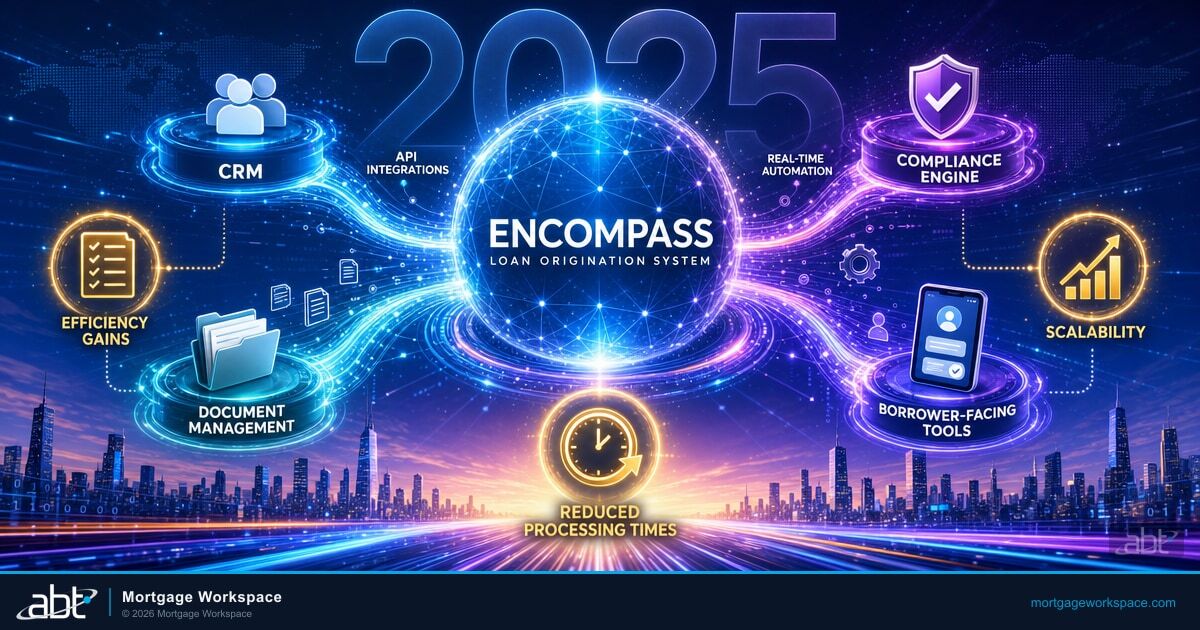
Encompass API integrations connect your loan origination system to CRMs, compliance engines, document platforms, and borrower-facing tools through REST endpoints. They replace manual data transfers with real-time automation. For mortgage companies processing hundreds of loans per month, every manual handoff is a bottleneck worth eliminating, and every duplicate data entry is an audit risk. This guide covers what Encompass APIs actually do, how they connect to the systems mortgage teams depend on, what changed in 2025 and 2026, and how ABT operates the integration layer for lenders that prefer a managed Microsoft partner over an in-house integration team.
How Encompass API Integrations Work
Encompass APIs follow a RESTful architecture. They use standard HTTP methods, return data in JSON, and authenticate through OAuth 2.0 tokens tied to your Encompass Client ID. Each API user needs explicit permissions configured in the Encompass admin console, and rate limiting applies across all endpoints, so high-volume operations need batching strategies and a retry-with-backoff pattern that handles transient throttling without dropping loan events.
Three components make the integration pattern work:
- Developer Connect (EDC): The primary API platform for custom integrations. Endpoints cover loan data, pipeline management, contacts, and document handling. This is the path an internal team or a managed partner uses to build connections to its own reporting, compliance, or workflow tools.
- Partner Connect (PCP): Designed for third-party vendors building products that plug into Encompass. Same REST architecture, additional marketplace controls and standardized contracts for the vendor side.
- Webhook notifications: Push-based alerts that fire when loan data changes. The November 2025 service pack improved delivery reliability so a webhook-first architecture is now the default rather than a workaround.
Encompass API Integration Types
Not every integration works the same way. The right approach depends on who builds it, where the data goes, and how it needs to flow back into the rest of the lender's stack.
Third-Party Integrations via Partner Connect
Vendors like Stavvy, ValueLink, and Clear Capital build integrations through Partner Connect. These appear in the Encompass marketplace and connect through standardized API contracts. Clear Capital expanded its Automated Service Ordering (ASO) in early 2026, automating appraisal workflows directly inside Encompass.
Custom Integrations via Developer Connect
Your internal team or your managed Microsoft partner builds these. Developer Connect gives access to loan-level data, borrower records, pipeline queries, and document management APIs. This is the path for connecting Encompass to your own reporting dashboards, custom compliance checks, internal workflow tools, or Microsoft 365 services like Teams and Power BI.
Cloud-Native Integrations
Encompass APIs are cloud-native by design. They connect to other cloud platforms without VPN tunnels or on-premise middleware. Microsoft Azure API Management, Azure Logic Apps, Azure Functions, and Power Automate consume Encompass webhooks directly. For lenders already running Microsoft 365 under a Tier-1 Cloud Solution Provider, this is the natural integration target because the identity, audit, and data protection controls already extend across the same boundary.
Connecting Encompass to CRMs, Compliance Tools, and Document Systems
The practical value of Encompass APIs shows up in specific system connections.
CRM Integration
Connecting Encompass to Salesforce or Microsoft Dynamics syncs loan status updates to your sales pipeline. Loan officers see borrower progress without switching systems. Lead assignment, milestone notifications, and follow-up triggers all flow through the API. The same pattern extends to real-time pricing integrations that pull rate sheets and lock decisions into Encompass without staff re-entering data.
Compliance and Verification
eRESI's 2025 integration with Encompass Investor Connect lets lenders deliver Non-Agency and Non-QM loan packages directly from Encompass. Covered Insurance's API platform handles real-time quoting across multiple states and carriers with embedded compliance monitoring. The pattern shrinks the manual reconciliation surface, which is where compliance findings usually originate.
Document Management
OnBase and similar content management systems pull documents from Encompass through the API. Loan files, disclosures, and verification documents sync without manual uploads. Audit trails stay intact across both systems, which matters for the books-and-records side of lender oversight.
Business Impact of API-Driven Mortgage Workflows
Mortgage origination costs are well above $11,000 per loan in the current cycle, and the largest share of that cost is staff time. Every manual step adds cost, time, and error risk. API integrations attack all three.
- Eliminate duplicate data entry: Loan data entered in Encompass flows to your CRM, compliance system, and reporting tools without re-keying.
- Cut processing delays: Automated webhook triggers start the next workflow step the moment a milestone hits. No waiting for someone to check a dashboard.
- Reduce compliance exposure: Automated data transfers maintain consistent records across systems. When regulators audit your loan files, the data matches everywhere.
- Scale without adding headcount: API-driven workflows handle volume increases without proportional staff growth, which matters when the loan origination software market itself is growing into multiple billions of dollars annually and your competitors are buying integration capacity faster than they hire processors.
What Changed in 2025 and 2026
ICE Mortgage Technology made several moves that affect every Encompass user's integration strategy.
Legacy SDK Deprecation (October 2025)
The old SDK integrations hit end of life in October 2025. If your custom tools still use SDK calls, they are running on unsupported code. Migration to Developer Connect or Partner Connect APIs is not optional.
Webhook Reliability Improvements
The November 2025 service pack addressed webhook delivery consistency. If your team previously built polling-based integrations because webhooks were unreliable, the architecture is worth re-evaluating. A webhook-first design with Microsoft Azure API Management in front cuts polling load and gets event data to downstream systems in seconds rather than minutes.
Clear Capital ASO in Encompass (February 2026)
Automated appraisal ordering through Clear Capital's Automated Collateral Analyzer (Aura) now works directly in Encompass. Configurable workflows trigger appraisal reviews without leaving the platform.
AI-Powered Compliance Workflows
Quandis QBO AI launched in 2025 with agentic AI for compliance-sensitive mortgage servicing. LoanNEX unified primary and secondary lock workflows with real-time alerts inside Encompass. Both signal a shift toward AI handling routine compliance decisions through API-connected tools.
How MortgageExchange Operates Encompass APIs in Production
For lenders that prefer a managed integration layer instead of an in-house integration team, ABT operates an Encompass integration platform called MortgageExchange. It is the largest interface product in ABT's portfolio and it sits where most of the real work of running Encompass APIs in production actually happens. MortgageExchange normalizes Encompass loan events, pipeline updates, and document references into a consistent integration pattern that downstream systems (the lender's CRM, compliance engine, core banking system, document management, BI layer) can consume without each one having to re-implement OAuth, retry logic, schema translation, and webhook acknowledgement on its own.
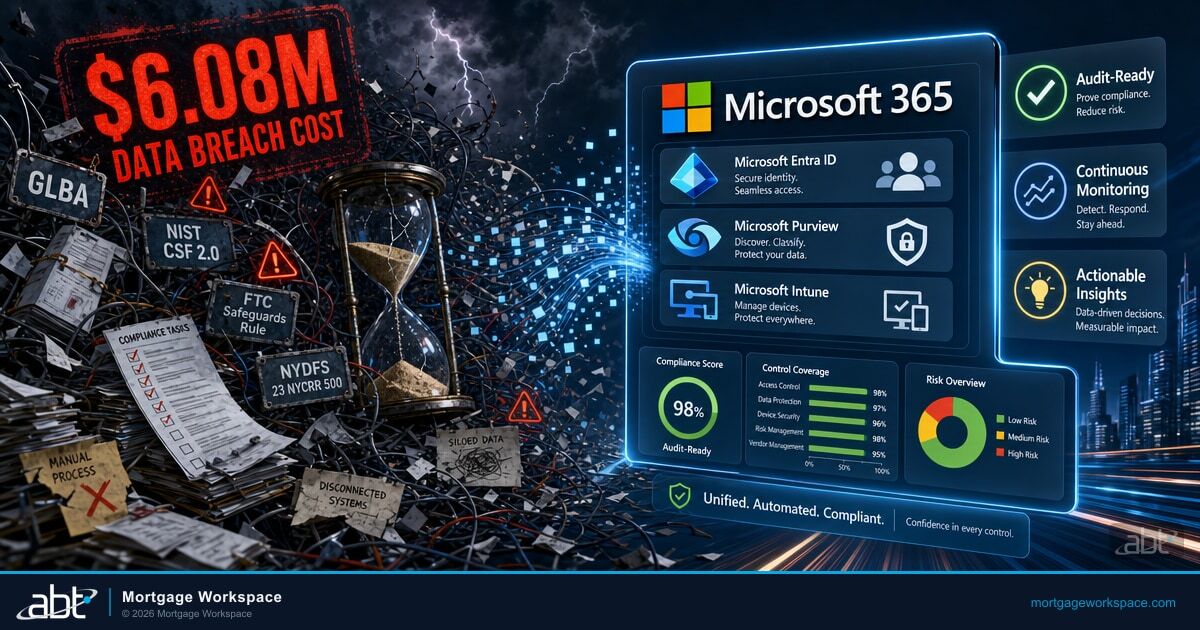
The operating model is straightforward. The lender keeps its Encompass instance, its license relationship with ICE Mortgage Technology, and its existing data ownership. ABT operates the MortgageExchange integration layer on Microsoft Azure as the partner of record, applies the same Microsoft Defender and Microsoft Purview controls that protect the rest of the lender's Microsoft 365 footprint to the integration tier, and produces the audit evidence the lender's compliance team needs when GLBA, state mortgage examiners, or investor due-diligence reviewers ask how loan data moves between systems. The lender experiences the outcome (loans close faster, fewer manual handoffs, cleaner audit trail), not the OAuth refresh cycle.
Microsoft Azure API Management as the Integration Backbone
The integration backbone underneath MortgageExchange is Microsoft Azure API Management. It is the layer that fronts the Encompass REST endpoints, terminates OAuth, applies rate-limit policies that respect ICE Mortgage Technology's throttling rules, signs webhook callbacks, and writes every API call to an audit log that the lender's compliance team can subpoena, query, and hand to an examiner. Azure API Management is a Microsoft-managed service, which means the partner running it for the lender is not patching API gateway infrastructure on the side. The service updates itself under the Microsoft operational model, and ABT operates the configuration, policies, and downstream connections as the partner of record for the Azure subscription.
Three operational properties of Azure API Management matter for a regulated mortgage integration:
- Policy-driven security at the edge. Azure API Management applies authentication, IP filtering, and rate limiting before a request reaches Encompass or any downstream system. The policies are documented in the Azure portal and exported as evidence on demand.
- Built-in observability. Every request, response, latency reading, and error rate is captured. The integration layer is observable in the same way Microsoft 365 mailbox traffic is observable through Microsoft Purview Audit, which means the lender's compliance team has one auditable surface for both Encompass-side and Microsoft 365 side activity.
- Versioning and deprecation control. When ICE Mortgage Technology ships a new Encompass API version, Azure API Management lets the lender route traffic between versions in a controlled way. Cutovers stop being all-or-nothing events.
For lenders evaluating whether to build the integration layer in-house, the question is rarely whether Azure API Management can do the job. The question is whether the lender wants to operate it themselves or have a Tier-1 Microsoft Cloud Solution Provider operate it. ABT hosts the Azure environment, manages the API Management policies, and ties the audit telemetry into the lender's broader Microsoft 365 governance surface so the integration layer is not a separate compliance project.
Turning API Telemetry into Mortgage BI Decisions
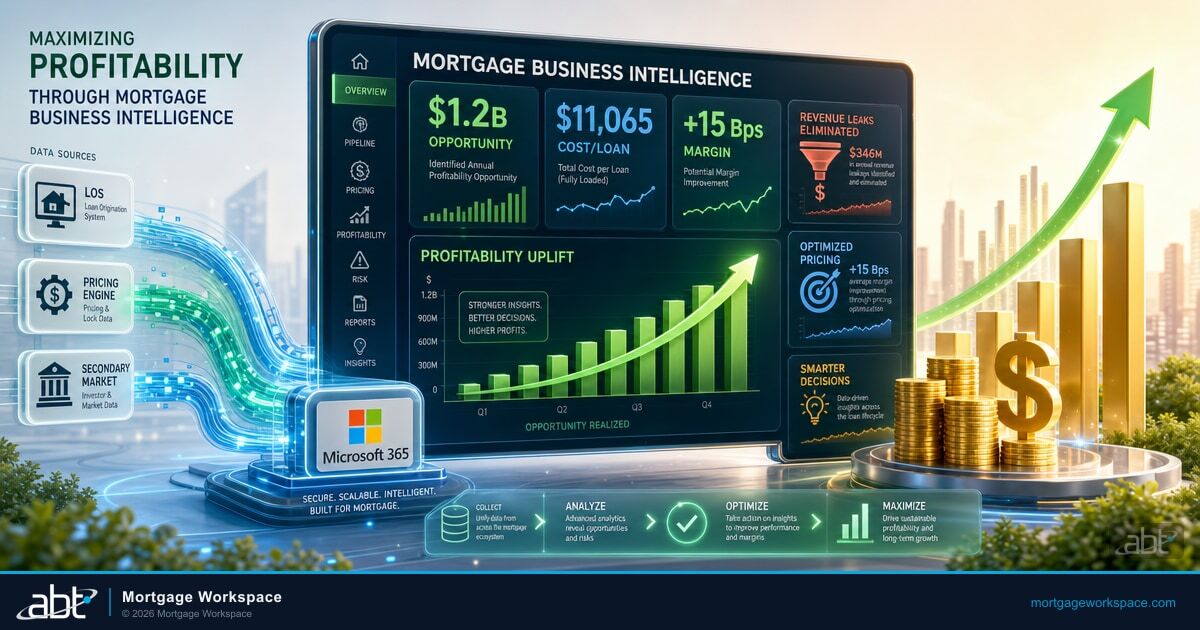
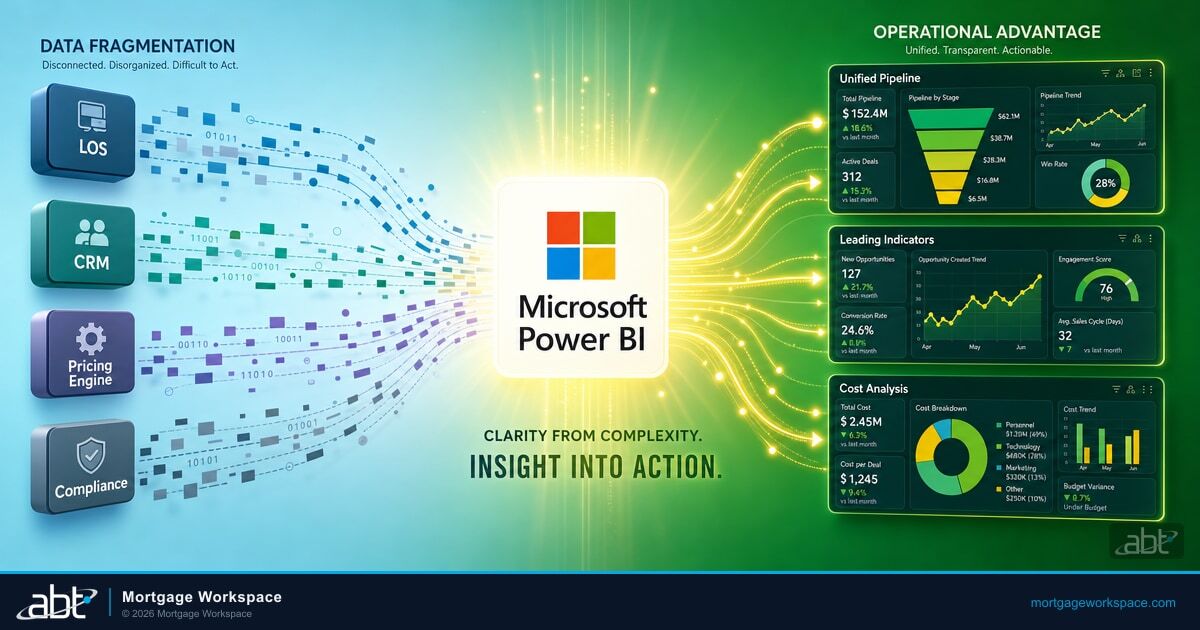
API integrations produce data. The volume is large enough that a separate reporting layer is the only way to turn that data into decisions a sales manager, operations leader, or CFO can act on. ABT's Mortgage BI product is the business intelligence layer that consumes the same Encompass API events that flow through MortgageExchange and renders them as the metrics mortgage executives actually use: pipeline by loan officer, fallout by milestone, conversion by lead source, time-in-stage by branch, application-to-close cycle time, and the cohort comparisons that explain why one team is closing faster than another.
Mortgage BI runs on the same Microsoft Azure platform that hosts MortgageExchange and reads from the same telemetry that Azure API Management captures. The architectural payoff is that a lender does not have to stitch three different reporting tools together to see the picture. The pipeline view in Mortgage BI reflects the same Encompass events that the lender's CRM sees, the same audit trail Microsoft Purview retains, and the same loan stages that the compliance engine validates. When a loan officer asks why a pipeline number does not match a CRM number, the answer is the same source-of-truth event log, not three reconciled spreadsheets.
The combined operating pattern is the point. MortgageExchange is the integration layer. Microsoft Azure API Management is the platform that runs the integration layer with the security, audit, and observability a regulated lender needs. Mortgage BI is the reporting layer that turns the integration telemetry into decisions. All three sit on the same Microsoft Azure surface that a Tier-1 Cloud Solution Provider manages as one operational footprint, not three separate vendor relationships.
Key Takeaway
Encompass API integrations are the work surface for modern mortgage operations, not an optional add-on. The lenders who treat them that way close loans faster, produce cleaner audit trails, and absorb volume growth without proportional staff growth. A managed integration layer (MortgageExchange) running on Microsoft Azure API Management, with reporting through Mortgage BI, is the cleanest available route to that outcome for lenders who prefer a Tier-1 Microsoft Cloud Solution Provider to operate the integration footprint instead of building one in-house.
Get an Encompass Integration Review
ABT operates Encompass integrations for mortgage companies and lenders running on Microsoft 365. A 30-minute conversation maps your current Encompass integration footprint, surfaces the gaps that the October 2025 SDK deprecation may have left behind, and outlines what an ABT-managed deployment (MortgageExchange + Microsoft Azure API Management + Mortgage BI) would cover for your operation. No commitment, no quote, no obligation.
Frequently Asked Questions
Encompass Developer Connect is the API platform for building custom integrations within your own organization. It provides REST endpoints for loan data, pipeline management, contacts, and documents. Partner Connect serves third-party vendors building marketplace products. Both use OAuth 2.0 authentication and the same RESTful architecture, but Partner Connect adds marketplace distribution and standardized API contracts for vendor products. For most lenders, the path forward is Developer Connect for internal integrations and Partner Connect for the vendor products that show up in the Encompass marketplace.
The Encompass API uses OAuth 2.0 authentication. Each integration needs an access token tied to a specific Encompass Client ID. API keys are generated in the Encompass admin console and linked to designated API users with explicit role-based permissions. Tokens expire and must be refreshed programmatically to maintain continuous access across automated workflows. A managed integration layer like MortgageExchange handles token refresh, rate-limit backoff, and credential rotation behind a single integration contract so downstream systems do not each have to implement OAuth on their own.
ICE Mortgage Technology deprecated legacy SDK integrations in October 2025. Any custom tools still using SDK calls run on unsupported code and will not receive patches or compatibility updates. Migration to the Developer Connect or Partner Connect REST APIs is required. ICE provides migration documentation and API equivalents for most SDK functions through the developer portal. Lenders running custom SDK-era integrations should treat the migration as a near-term operational priority, not a backlog item.
Encompass APIs transfer data through encrypted HTTPS connections. All API calls require authenticated tokens with role-based permissions controlling data access. For GLBA compliance, the API enforces the same access controls as the Encompass UI. State-level requirements are handled through the compliance engine within Encompass itself, and API integrations inherit those rules when reading or writing loan data. When the integration layer runs on Microsoft Azure API Management under a Tier-1 Cloud Solution Provider, the audit telemetry from API calls feeds the same governance surface that the lender's Microsoft 365 footprint already uses, so the compliance team has one place to query, not several.
Yes. Encompass REST APIs and webhooks connect to Microsoft 365 through Microsoft Azure API Management, Azure Logic Apps, Power Automate, or custom Azure Functions. Loan milestone events can trigger Microsoft Teams notifications. Pipeline data can feed Microsoft Power BI dashboards for real-time reporting, or feed a dedicated Mortgage BI layer that renders pipeline, fallout, cycle time, and conversion in the metrics mortgage executives actually use. The integration runs through standard REST and webhook protocols without requiring additional middleware or on-premise servers, and the entire footprint sits on the same Microsoft Azure surface that a Tier-1 Cloud Solution Provider already manages for the lender.
MortgageExchange is ABT's Encompass integration platform. It operates the Encompass Developer Connect and Partner Connect APIs in production for lenders that prefer a managed integration layer instead of building one in-house. MortgageExchange normalizes loan events, handles OAuth and rate-limit backoff, signs and acknowledges webhook callbacks, and presents a consistent integration contract to downstream systems (CRM, compliance engine, core banking, document management, business intelligence) so each system does not have to re-implement Encompass-specific logic. The platform runs on Microsoft Azure with Microsoft Azure API Management as the gateway and ABT operates it as the partner of record. The lender keeps its Encompass instance and its data ownership.