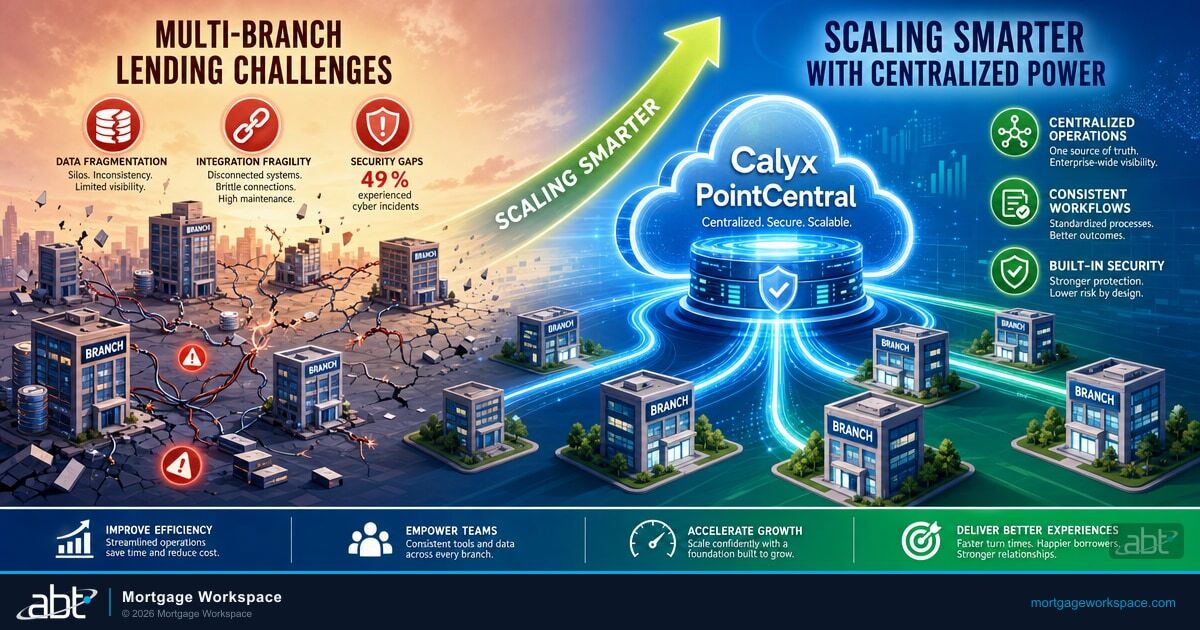
A recent Ncontracts survey of financial institutions found that 49% experienced a third-party cyber incident in the past year. For multi-branch mortgage lenders running Calyx across multiple locations, that number carries extra weight. Every new branch adds integration endpoints, user accounts, vendor connections, and network paths that need to be secured, monitored, and maintained consistently.
Multi-branch lending does not fail because of the LOS. It fails because the infrastructure underneath the LOS was built for a single office and never redesigned for scale. Calyx Point, Path, and PointCentral have the configuration depth to support dozens of branches. The question is whether your IT environment can keep up.
This guide covers the seven most common operational challenges multi-branch lenders face with Calyx and the specific strategies that solve them, plus how the ABT platform (MortgageExchange, MortgageWorkSpace, Mortgage BI, and M365 Guardian) pulls per-branch data, permissions, dashboards, and governance into a single operating picture on Microsoft 365.
In This Article
- Why Multi-Branch Calyx Is Harder Than Single Office
- Seven Multi-Branch Challenges and How to Solve Them
- Centralize Operations with PointCentral
- The ABT Multi-Branch Lending Platform on Microsoft 365
- Security and Compliance Across Every Branch
- Why Multi-Branch Lenders Need Managed IT
- Building a Calyx Environment That Scales
- Frequently Asked Questions
Why Multi-Branch Calyx Is Harder Than Single Office
Each branch office serves different borrower profiles, follows different state regulations, and may have been set up by a different IT team at a different time. That creates three compounding problems:
- Configuration drift where branches end up with different templates, workflows, and permission structures that make reporting inconsistent and audits painful
- Integration fragility where vendor connections to credit bureaus, appraisal management companies, and pricing engines break differently at different locations depending on network configurations
- Security gaps where each branch represents an additional attack surface with user accounts, devices, and network connections that need consistent protection
These problems compound as you add branches. A lender with three offices might manage the inconsistency manually. A lender with fifteen cannot. The complexity does not grow linearly. It multiplies.
Seven Multi-Branch Challenges and How to Solve Them
1. Data Fragmentation Between Branches
When branches operate as silos with their own data handling and templates, reporting gets messy and compliance becomes harder. Centralize your templates, borrower data, and reporting workflows within Calyx so every branch works from the same playbook. Shared systems let you generate reports without chasing mismatched data across locations.
2. Inconsistent Workflows and Permissions
Without standardized templates and centrally managed roles, each branch creates its own process. That turns audit season into a scramble. Centrally governed templates and permission sets reduce variation, maintain consistency, and make audits cleaner.
3. State-by-State Compliance Requirements
Every state has different rules. Each branch must meet local regulations without slowing the pipeline. Configure Calyx to enforce location-based compliance rules automatically so teams stay fast and compliant without needing to remember which state requires what.
4. Communication Gaps Between Teams
Without shared communication built into the LOS, details slip through cracks between branches in different time zones. Integrated notes, status tracking, and shared task visibility keep teams aligned without relying on email chains that nobody reads.
5. IT Scaling Without Breaking Existing Operations
Adding a new branch means provisioning users, migrating data, configuring roles, and keeping everything secure. Lean IT teams get overloaded. Role-based access templates and standardized onboarding processes in Calyx keep deployments secure and fast instead of chaotic and risky. This connects closely to The Role of API Gateways in Modern Mortgage Lending Platforms.
6. Third-Party Integration Reliability
Calyx connects to credit bureaus, e-signature platforms, fraud detection services, pricing engines, and compliance tools. When an integration fails at one branch, productivity drops. Pre-tested integration frameworks and automated monitoring ensure vendor connections stay reliable across every location.
7. Access Control at Scale
Multi-branch setups increase the risk of unauthorized access, especially when permissions are not tightly managed. Calyx supports dynamic, role-based permissions with audit trails that track every change. The key is actually enforcing those controls consistently rather than leaving each branch to manage its own access. We cover Secrets of the Best Online Lenders in a companion piece.
Centralize Operations with PointCentral
PointCentral acts as a single source of truth across all locations. It solves the versioning problem by standardizing borrower data, templates, disclosures, and workflows in one centralized system.
The operational benefits are concrete:
- Consistent borrower experience from Boise to Boston because every office uses the same templates and processes
- Faster audits because compliance data lives in one system with centralized reporting
- Streamlined onboarding when new branches deploy from standardized configurations instead of building from scratch
- Reduced template-based errors because changes push organization-wide instead of requiring manual updates at each location
Master templates for disclosures, applications, and borrower communications deploy across every branch simultaneously. When a regulation changes, you update the template once and it propagates everywhere.
The ABT Multi-Branch Lending Platform on Microsoft 365
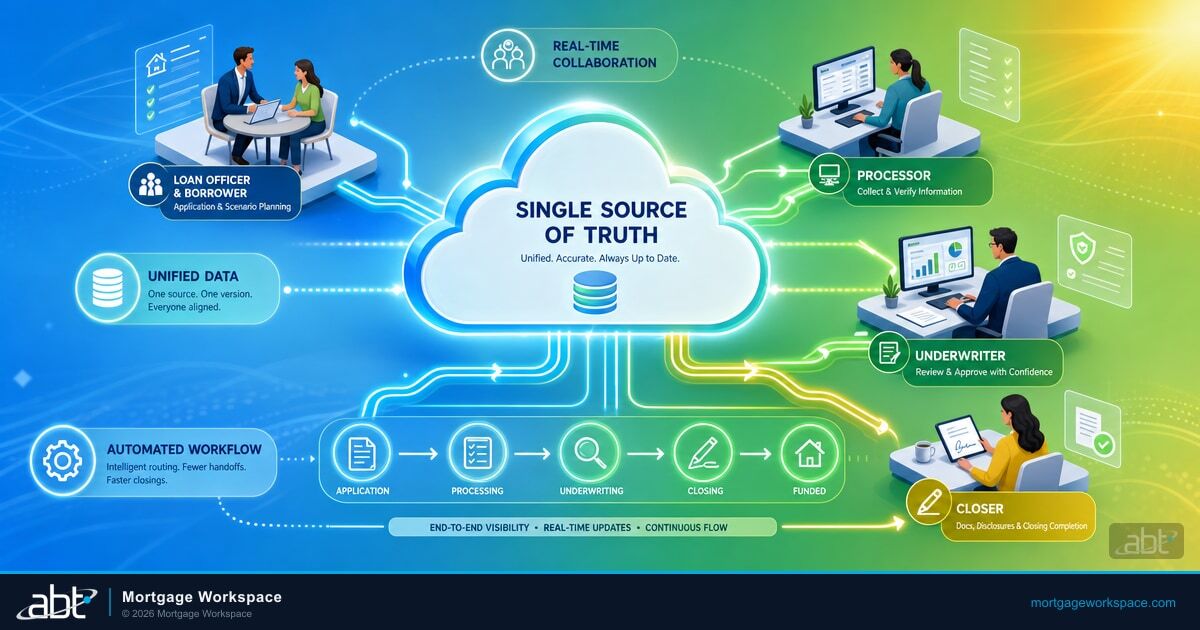
A centralized LOS solves part of the multi-branch problem. The other part is everything around the LOS: the per-branch identity, the per-branch data partitioning, the per-branch reporting view, and the per-branch security posture. MortgageExchange and MortgageWorkSpace are the ABT-built layer that delivers all of that on Microsoft 365. MortgageExchange is the custom interface between your LOS and the rest of the lender's technology stack (cores, pricing engines, credit bureaus, compliance vendors). MortgageWorkSpace is the multi-tenant Microsoft 365 architecture that lets a multi-branch lender carry per-branch data isolation, per-branch permissions, and per-branch Conditional Access policies inside one operating picture. ABT operates Microsoft 365 tenants for more than 750 financial institutions, and the multi-branch lenders in that footprint run on this same pattern.
Mortgage BI and M365 Guardian are the visibility and governance halves of the same platform. Mortgage BI builds per-branch dashboards on top of the MortgageExchange data layer so the chief lending officer sees pull-through, cycle times, lock-to-fund ratios, and rate-lock exposure for every branch from a single console rather than reconciling spreadsheets from each location. M365 Guardian is ABT's operating model for the Microsoft Entra ID, Microsoft Intune, Microsoft Defender, Microsoft Purview, and Microsoft Sentinel controls that sit underneath. Per-branch Conditional Access, per-branch device compliance, per-branch DLP, and a 24x7 security operations center that watches the signals are applied uniformly so a new branch inherits the same governance baseline on day one. Visibility plus governance, at branch scale, on the Microsoft 365 stack your team already knows.
Security and Compliance Across Every Branch
With 49% of financial institutions reporting third-party cyber incidents in the past year, security across a distributed Calyx environment cannot be treated as a branch-level responsibility. It requires centralized controls with branch-level visibility.
Centralized Security Controls
Apply patches, updates, and access policies across all branches from a single management dashboard. This eliminates the gap between when a security update is released and when it reaches every office. Centralized controls also ensure that terminated employees lose access across all systems simultaneously, not just at the branch that processed their departure.
Compliance Built into Workflows
Automated alerts and regulatory triggers inside Calyx keep every branch aligned with evolving state and federal requirements. Customize workflows by jurisdiction so that a loan originated in California automatically follows California rules and a loan originated in Texas follows Texas rules, without the loan officer needing to remember the difference.
Role-based permissions define exactly who can do what in the LOS. Built-in audit tracking provides the transparency that regulators expect and the documentation that makes examinations straightforward rather than stressful. For a deeper look at how Calyx and managed services work together, read our companion guide.
Why Multi-Branch Lenders Need Managed IT
Internal IT teams at growing mortgage companies face a math problem. Every new branch adds servers, devices, network configurations, user accounts, and vendor integrations that need monitoring and maintenance. The workload grows faster than the headcount budget allows.
A managed services provider built for mortgage operations handles the infrastructure so internal teams can focus on lending:
- Proactive monitoring that catches performance issues before they affect loan officers
- Patch management tested in staging environments and deployed during off-hours
- Integration support that maintains reliable connections between Calyx and every third-party vendor
- User provisioning that follows standardized processes with audit logs for every change
- Security operations including endpoint protection, email security, and access monitoring across every branch
The difference between reactive IT (fix it when it breaks) and proactive managed services (prevent it from breaking) becomes dramatic at multi-branch scale. A single integration failure at one branch during a rate lock rush can cost real money. Prevention is always cheaper than recovery.
Building a Calyx Environment That Scales
Calyx is only as powerful as your deployment and management strategy. The software handles the origination. The infrastructure determines whether that origination runs smoothly or stumbles.
ABT and MortgageWorkSpace specialize in cloud-hosted Calyx environments wired to MortgageExchange interfaces, Mortgage BI dashboards, and the M365 Guardian operating model for security and compliance. We manage the IT complexity so your team can focus on what matters: closing loans, growing branches, and serving borrowers. For ABT's fuller take, see Overcoming the Challenges of Cloud Adoption in Mortgage Lending.
Get a Multi-Branch Calyx and Microsoft 365 Readiness Review
ABT runs the MortgageExchange + MortgageWorkSpace + Mortgage BI + M365 Guardian platform described above for multi-branch lenders operating across multiple offices, states, and regulatory perimeters. A 30-minute conversation maps your current branch footprint, surfaces the gaps your next audit is most likely to find, and outlines what an ABT-managed deployment would cover. No commitment, no quote, no obligation.
Frequently Asked Questions
The seven most common challenges are data fragmentation between branches, inconsistent workflows and permissions, state-by-state compliance requirements, communication gaps between teams, IT scaling without disrupting existing operations, third-party integration reliability, and access control at scale. Each challenge compounds as branch count increases because the complexity multiplies rather than growing linearly.
PointCentral acts as a single source of truth across all locations, standardizing borrower data, templates, disclosures, and workflows in one centralized system. Changes to templates or compliance rules push organization-wide instead of requiring manual updates at each location. This delivers consistent borrower experiences, faster audits, streamlined onboarding for new branches, and fewer template-based errors.
MortgageExchange is the ABT-built custom interface layer between the LOS and the rest of a multi-branch lender's technology stack (cores, pricing engines, credit bureaus, compliance vendors). MortgageWorkSpace is the multi-tenant Microsoft 365 architecture that carries per-branch data isolation, per-branch permissions, and per-branch Conditional Access policies inside a single operating picture. Together they let a lender operate dozens of branches with consistent identity, data partitioning, and integration reliability without each branch standing up its own infrastructure.
Mortgage BI builds per-branch dashboards on top of the MortgageExchange data layer so executives see pull-through, cycle times, lock-to-fund ratios, and rate-lock exposure for every branch from one console rather than reconciling spreadsheets from each location. M365 Guardian is ABT's operating model for the Microsoft Entra ID, Microsoft Intune, Microsoft Defender, Microsoft Purview, and Microsoft Sentinel controls underneath, applied uniformly per branch with a 24x7 security operations center watching the signals. Visibility plus governance at branch scale.
Every new branch adds servers, devices, network configurations, user accounts, and vendor integrations that require monitoring and maintenance. Internal IT teams face a workload that grows faster than headcount budgets allow. A managed services provider handles proactive monitoring, patch management, integration support, user provisioning, and security operations across every branch so internal teams can focus on lending operations.
With 49% of financial institutions reporting third-party cyber incidents in the past year, multi-branch lenders need centralized security controls applied across all branches from a single dashboard. This includes consistent patch deployment, immediate access revocation for terminated employees across all systems, endpoint protection on every device, and automated monitoring that detects unusual access patterns at any location.
With standardized configurations, role-based access templates, and a managed services partner, a new branch can deploy with a fully configured Calyx environment in days instead of weeks. The key factors are having pre-built templates, standardized onboarding processes, and an IT partner that can provision users, configure network connections, and verify vendor integrations before the branch opens for business.